Friday, May 11, 2018

Tom P*tty & the Heartbreakers - Mary Jane's Last Dance - Non-Album Tracks (1992-1993)

Tom P. has put out a lot of great albums, but he could have put out even more. One "lost album" that few people seem to talk about is his 1993 album that never was. 

(Note that I'm not using the full name of this artist due to concerns about copyright issues.)

In 1992, Tom P. and the Heartbreakers returned to the studio to start recording a follow up to 1991's "Into the Great Wide Open." However, P. was having personal and musical problems with the drummer Stan Lynch, even though he's generally considered a talented drummer. (Already, the 1989 "Full Moon Fever" album was supposedly a P. solo album, but it was a de facto Heartbreakers album except for Lynch.) P. did some sessions with Lynch as the Heartbreakers and some without him technically not called the Heartbreakers, though the difference was essentially academic.

There were lots of good songs written, and the ones that have become public sound fine, but for whatever reason, P. wasn't satisfied. Instead of putting out an album, two of the songs went to a new greatest hits album (including what would become an all-time classic, "Mary Jane's Last Dance"). P. and his band continued recording, though without Lynch, who officially quit the band in 1994. Apparently, P. wrote tons of songs, and all that new material caused him to lose interest in most of the songs that started in 1992. His "Wildflowers" album came out in 1994, and it was a very solid album despite being 63 minutes long.

A bunch of the 1992 and 1993 songs came out on the 1995 retrospective "Playback," so the songs on "All the Rest," if it ever comes out, represent another lost album with little to no overlap with this album here.

In compiling this album, I focused almost entirely on studio tracks, most of which were originals. But two original songs from this time period are currently only available as live versions, so I added those in as well, with the audience noise minimized.

Note also that "Peace in L.A." is well known in its "Peace Mix" version, because that was included in "Playback." But that actually was the B-side. I've included the more straightforward A-side version of the song instead, which I think is similar but better.

This album is 43 minutes long.

UPDATE: In 2025, I added a newly available song, "What's the Matter with Louise." It is only available through the Amazon website, in relation to a new documentary about the band. Most information about this song states it's a "Wildflowers" outtake, but it actually was recorded in 1992.

I'm not including the track list due to copyright issues. But you can find it in the mp3 download file.

https://pixeldrain.com/u/p7K61bAD

alternate:

https://bestfile.io/AS5tf0mHQwWorZX/file

For the cover art, I used the cover of the single for "Mary Jane's Last Dance."

Crosby, Stills, Nash & Young - Winterland Reunion 1973 - Winterland, San Francisco, CA, 10-4-1973

Before I post the next album in my CSNY alternate universe series, I want to post this pivotal live show.

As I previously mentioned, CSNY had a big falling out in 1970 that kept them from working together with only a few exceptions for the next couple of years. Then, on October 4, 1973, Stills' band Manassas played a show at the Winterland in San Francisco, near where the other members of CSNY lived at the time. During the intermission of the show, Crosby and Nash came out to join Stills for an acoustic set. Then, halfway through the set, Young joined them as well. This would mark a new era of cooperation between the four of them that would culminate in a big 1974 concert tour (though, sadly, no studio album).

After the CSNY set ended, Manassas came back on stage for a second set. This has a bittersweet edge, because Manassas bassist Chris Hillman later said that when he saw CSNY get together that night, he knew that Manassas was finished, since CSNY would take priority for Stills. And sure enough, that's what happened. However, Manassas did perform some more shows before going their own way, including another Winterland show three days later when CSN again performed an acoustic set in the middle of the show (though this time without Young).

I don't like repeating the same song on an album. So what I've done here is present the entire October 7 CSN(Y) set. But then, at the start, I'd added in the different songs CSN performed during their October 4 set. I did make an exception in duplicating the song "Human Highway" though, because on October 4 CSN performed it with Stills singing lead, while on October 7 CSNY performed it with Young singing lead, so I figured that was different and interesting.

The first song I've put on this album, "Daylight Again - Find the Cost of Freedom" (an early version with different lyrics) is actually the last song of the second Manassas set. Stills played most of it alone, then Crosby, Nash, and the rest of Manassas joined in at the end.

So the order of this doesn't make much sense chronologically, but I think it makes sense from a listening point of view, with Manassas giving way to CSN(Y) and then the highlight being the conclusion of CSNY playing together.

Between the two shows, there's almost two hours of CSN and then CSNY playing acoustically. To me, this is the sort of dream concert CSNY would have done regularly in the alternate universe where they were much more active with each other than they actually were. What's remarkable is that despite not having played together since 1971, CSN(Y) played six songs in a row in their short set that were unreleased at that time, with little to no rehearsal, yet they still sounded great (tracks 12 to 19).

This album is one hour and 16 minutes long.

01 Daylight Again - Find the Cost of Freedom (Crosby, Stills & Nash)
02 talk (Crosby, Stills & Nash)
03 Southbound Train (Crosby, Stills & Nash)
04 talk (Crosby, Stills & Nash)
05 Human Highway (Crosby, Stills & Nash)
06 talk (Crosby, Stills & Nash)
07 The Lee Shore (Crosby, Stills & Nash)
08 Helplessly Hoping (Crosby, Stills & Nash)
09 talk (Crosby, Stills & Nash)
10 Wooden Ships (Crosby, Stills & Nash)
11 Blackbird (Crosby, Stills & Nash)
12 As I Come of Age (Crosby, Stills & Nash)
13 talk [Neil Young joins in] (Crosby, Stills, Nash & Young)
14 Roll Another Number [For the Road] (Crosby, Stills, Nash & Young)
15 Human Highway (Crosby, Stills, Nash & Young)
16 New Mama (Crosby, Stills, Nash & Young)
17 talk (Crosby, Stills, Nash & Young)
18 And So It Goes (Crosby, Stills, Nash & Young)
19 Prison Song (Crosby, Stills, Nash & Young)
20 Long Time Gone (Crosby, Stills, Nash & Young)
21 Change Partners (Crosby, Stills, Nash & Young)

https://www.upload.ee/files/17363413/CROSBSTLLSNSHYNG1973WintrlndSnFrncscoCA__10-4-1973_atse.zip.html

alternate:

https://pixeldrain.com/u/YcdMCSr9

Originally, I made the album cover from a still image of the video footage from this show. (It's available on YouTube, as well as the CSN and Manassas sets from October 4.) But the video quality was low. I later found a better photo that is from the concert. The only downside is that most of Graham Nash's face is obscured behind Neil Young's.

Gordon Lightfoot - BBC in Concert, Royal Albert Hall, London, Britain, 6-4-1971

Gordon Lightfoot's career has curiously lacked live albums from his golden era of the 1960s and 1970s. He did release one live album in 1969, but it was early in his career and mostly had new songs on it, so it contained few of his classics.

In the early 1970s, the BBC has a TV series called "In Concert" that featured many great artists doing hour or half hour shows. Luckily, Lightfoot got a full hour. I found the video of his show (broadcast in early 1972 but recorded in June 1971), converted it to mp3, and cut it into individual tracks. (Unfortunately, I often had to cut the track right in the middle of the applause, since he had a habit of starting the next song while people were still clapping.)

For the show, Lightfoot is only accompanied by a bass player and lead guitarist, allowing one to hear his songs without the orchestration and/or drumming that sometimes occurred on his studio albums.

This album is an hour and four minutes long.

01 Summer Side of Life (Gordon Lightfoot)
02 Saturday Clothes (Gordon Lightfoot)
03 For Lovin' Me (Gordon Lightfoot)
04 Affair on Eighth Avenue (Gordon Lightfoot)
05 If You Could Read My Mind (Gordon Lightfoot)
06 talk (Gordon Lightfoot)
07 Steel Rail Blues (Gordon Lightfoot)
08 Your Love's Return (Gordon Lightfoot)
09 Ten Degrees and Getting Colder (Gordon Lightfoot)
10 Early Morning Rain (Gordon Lightfoot)
11 Farewell Nova Scotia (Gordon Lightfoot)
12 talk (Gordon Lightfoot)
13 Miquel (Gordon Lightfoot)
14 Me and Bobby McGee (Gordon Lightfoot)
15 talk (Gordon Lightfoot)
16 Nous Vivons Ensemble (Gordon Lightfoot)
17 Minstrel of the Dawn (Gordon Lightfoot)
18 Talking in Your Sleep (Gordon Lightfoot)
19 Canadian Railroad Trilogy (Gordon Lightfoot)

https://www.upload.ee/files/16693281/GORDNLGHTFT1971_BBCncrtRoylAlbrtHll__6-4-1971_atse.zip.html

If you want to watch the show, just search for his name and "in concert" on YouTube. I made the album cover from a still shot taken from the video.

Thursday, May 10, 2018

Crosby, Stills, Nash and Young - Witching Hour - Non-Album Tracks (1973)

I've made nearly 20 studio albums in my alternate history of Crosby, Stills, Nash and/or Young. Out of all of them, I'm pretty sure this one is the biggest stretch to exist as an album. My alternate CSN(Y) albums generally have a lot of them together as a threesome or foursome. but this album only has three songs where a mere two of them are performing together.

I don't know the full story, but in the latter part of 1970, future famous singer Rita Coolidge got romantically involved with Stills, then soon left him for Nash. Crosby wrote the song "Cowboy Movie" about it. (Coolidge is the Indian girl.) That conflict, plus generally being overwhelmed by too much fame and drug use, meant there was very little combined CSN or CSNY activity from 1971 to late 1973.

So why did I make this CSNY album? In the early 1970s, CSNY were highly productive songwriters. Even though a lot of their material hasn't made it to the public yet, even in unreleased form, there are enough stray tracks from 1971 to 1973 to make up a good studio album. My goal was to gather up all their good songs from this period that weren't released on any of their official solo albums at the time. In fact, all but tour of these 14 versions are still unreleased (and only a couple more of them have been released in other versions). It's not really a "CSNY together" album, but I think it makes a good listen of songs that generally have been unjustly forgotten.

I made some notable edits on a couple of a songs that need some explaining. In 2009, Stills released the song "High and Dry" on an archival release of his Manassas era material. In fact, this is a medley of two musically related songs, "High and Dry" and "White Nigger." The title of this second song poses a problem! The Urban Dictionary defines "white nigger" to mean: "a white person who does not have the typical privileges associated with white people, and thus who is looked down on by 'normal' whites." So Stills didn't intend anything racist here, but instead it was supposed to be a typical "woe is me" blues sentiment. (Though it's hard to feel that sort of pity for him when he was rich and famous by that point.)

It was a different era than today. For instance, the famous rock critic Lester Bang actually used the term "white niggers" to describe "punks" before the phrase "punk music" caught on. Elvis Costello also used the term in his 1979 hit "Oliver's Army." ("All it takes is one itchy trigger, one more widow, one less white nigger.")

Even so, any use of the "N-word" today by a white guy such as Stills would understandably be seen as offensive by many people. So for the "Pieces" release, he took the entire "White Nigger" half of the medley and slathered it with fake crowd noise, no doubt to hide the embarrassing lyrics. One can tell, because there's a bootleg that has the exact same take of the song, only without the crowd noise.

I've gone a different route and simply edited out the offensive second half of that medley. But the officially released recording ends abruptly due to moving into the second song. So I took the very end of the medley, where it returns back to the tempo and chords of the "High and Dry" part, and edited in a better tail end for the song.

So that was one tricky song to deal with. Another tricky song is what's commonly known as "Mountain Song." In the early 1970s, a loose San Francisco-based musical grouping called "The Planet Earth Rock and Roll Orchestra" (PERRO) played together in different formations on various musical projects. You can read about it at Wikipedia:

https://en.wikipedia.org/wiki/Planet_Earth_Rock_and_Roll_Orchestra

In 1971, Crosby, Jerry Garcia and Phil Lesh of the Grateful Dead, Paul Kantner and Grace Slick of Jefferson Airplane, and David Freiberg of Quicksilver Messenger Service worked on "Mountain Song," but they never came close to a finished version. (Kantner would later release a very different version of it on a 1983 album, with him and Slick doing most of the lead vocals.) PERRO did four takes of the song that ended up on bootlegs. The versions were very rudimentary, with no soloing and generally just repeating of one phrase ("gonna make the mountains be my home") over and over again.

There was one promising take that had Crosby scatting over some complicated chord changes, but that ended after just a minute and a half. The version ended abruptly right when the song was about to move into the "gonna make the mountains be my home" part. So I edited the take with Crosby scatting to one of the takes that repeats that phrase. But I also cut the repetitions down to a reasonable amount, so the whole song is still less than four minutes long.

I was happy with the result, except for one thing: in the middle of the first part of the song, Crosby interjected over the music that he hasn't written more words, and he also juggled his talented scatting with calling out some of the chord changes as they were happening. (The others were clearly learning the song as they're playing it.) Luckily, there was another version of the song that went through the same chord changes, only without any of Crosby's scatting. So I patched in bits from that version to get rid of all of Crosby's talking.

So, yeah, I did a lot of meddling on this song, but I think the end result is much more listenable than any of the four bootleg versions. If you don't agree, you can find the unedited takes on various bootlegs or on YouTube.

It's a real shame that the song wasn't finished and released in the early 1970s, because it could have been a classic, especially if someone like Garcia had soloed on it. But it was probably left behind because it fell between the cracks of being a Crosby (or CSN) song, a Jefferson Airplane song, and a Grateful Dead song, and PERRO didn't finish an album for it to fit on.

In addition, I made a significant edit to the Stills song "Too Much Today." This extremely obscure song was played by him once on a French TV show in 1971 with a flutist joining in.  Unfortunately, after two verses the flutist is just starting a nice solo when the song gets cut off. That left the song only about a minute and a half long and feeling incomplete. So I edited it to repeat the first verse after the second verse, and then fade out with what little there was of the flute solo. I think it now sounds like a proper song instead of part of one.

I also edited about a minute and a half out of Crosby's "Is It Really Monday." I try not to do that very often, but this is mainly for my own listening enjoyment, and I felt the song dragged on too long.

This is a "Frankenstein" album of sorts, with individual pieces from all over that were never really meant to be together, but in my opinion it's a cohesive and enjoyable listen just the same, no doubt because all four of them were writing high-quality songs in the same general style.

Thankfully, in late 1973, CSNY got back together, both on stage and in the studio. So my next three alternate albums in this series will be very heavy with CSNY content on nearly all the songs.

Note that the sound quality of the two Young solo aren't quite up to my usual standards, coming from audience concert bootlegs. But I think the sound quality is worth it, given that they're good songs by him that haven't been officially released in any version yet.

01 Witching Hour (Stephen Stills)
02 Urge for Going (Crosby & Nash)
03 Come Along and Say You Will (Neil Young)
04 Everybody's Been Burned (Graham Nash)
05 I Am My Brother (Stephen Stills)
06 Is It Really Monday (David Crosby)
07 Sweet Joni (Neil Young)
08 High and Dry (Stephen Stills)
09 On the Line (Graham Nash)
10 Too Much Today (Stephen Stills)
11 Your Life Is What You Fill Your Day With (Crosby & Nash)
12 War Song (Neil Young with Graham Nash)
13 Thoroughfare Gap (Stephen Stills)
14 Mountain Song [Walking in the Mountains] (David Crosby & the PERRO)

https://www.upload.ee/files/17363393/CROSBSTLLSNSHYNG1973WtchngHur_atse.zip.html

alternate:

https://pixeldrain.com/u/9jDWyB8x

Since this album is really each of CSNY playing separately instead of together, I made an album cover that pictures each of them separately. It was done in the spirit of the Beatles' "Let It Be" album cover, which also marked a group that was more four people going in different directions than an actual group at that point.

Wednesday, May 9, 2018

Joe Jackson - The Harder They Come - Non-Album Tracks (1980)

Joe Jackson is another artist I really like. I don't know of a lot of alternate albums one can make from his material (other than live stuff), but I do have a couple.

I particularly enjoy his earliest albums, when he had energetic yet witty and tuneful songs. It turns out one can make another album in the style of "Look Sharp!" if one gathers up various B-sides and live tracks. (As I usually do when adding live tracks with studio ones, I've generally edited the live tracks to remove the crowd noise.)

In 1980, Jackson put out a single with a cover version of "The Harder They Come" as the A-side. It was a minor hit, but I think it's mostly been forgotten due to it not appearing on any of his official albums at the time. I'm using this as the title of this alternate album, as well as using the single's cover art (with the minor change of removing the name of the B-sides and enlarging the remaining words to cover that up).

Seven of the 12 songs here are cover songs. But they're all done in the early Joe Jackson style and they sound like songs he could have written. I'm imaging this album could have come out in 1980, since all the songs are from 1979 or 1980 except for one, "Knock Me a Kiss," a B-side from 1981.

As it happens, the album is 36 minutes long, and only five seconds longer than his "Look Sharp!" album.

The songs "Ain't Misbehavin'" and "Twenty Flight Rock" are cover versions. Unfortunately, the sound quality isn't that great, so I've only included those are bonus tracks. However, the sound on them is still pretty good, just not at the same level as the others.

01 The Harder They Come (Joe Jackson)
02 Out of Style (Joe Jackson)
03 Tilt (Joe Jackson)
04 Pressure Drop (Joe Jackson)
05 Come On (Joe Jackson)
06 Don't Ask Me (Joe Jackson)
07 You Got the Fever (Joe Jackson)
08 I Can't Give You Anything (Joe Jackson)
09 Enough Is Not Enough (Joe Jackson)
10 Knock Me a Kiss (Joe Jackson)
11 Ain't that a Shame (Joe Jackson)
12 Life Is a Bowl of Cherries (Joe Jackson)

Ain't Misbehavin'
Twenty Flight Rock

https://www.upload.ee/files/15906826/JoeJacks_1979d-1980_TheHardrTheyCome_atse.zip.html

The cover is the official cover for the "The Harder They Come" EP, but I made a change to replace three song titles in the bottom corner to just one song title.

The Rolling Stones - December's Children (And Everybody's) - Alternate Version (1965)

I continue with gathering the Rolling Stones' stray tracks.

For 1964, I had no make no less than three albums of stray tracks. With 1965, it's down to just one. But in my opinion, the quality is significantly higher. In 1964, the Stones were recording lots of covers of blues songs. But this album mostly contains songs they wrote themselves, including some big classics.

I made this an alternate version of "December's Children (And Everybody's)" - despite the unweildy title - because that was a 1965 US album that gathered up some stray tracks. But it's only a loose association, because a mere five of the 14 tracks here were on that album. Still, it gives me a title and album art to use.

01 [I Can't Get No] Satisfaction (Rolling Stones)
02 The Spider and the Fly (Rolling Stones)
03 The Last Time (Rolling Stones)
04 Play with Fire (Rolling Stones)
05 Fannie Mae (Rolling Stones)
06 I'd Much Rather Be with the Boys (Rolling Stones)
07 One More Try (Rolling Stones)
08 Get Off of My Cloud (Rolling Stones)
09 The Singer Not the Song (Rolling Stones)
10 Look What You've Done (Rolling Stones)
11 As Tears Go By (Rolling Stones)
12 Blue Turns to Grey (Rolling Stones)
13 I'm All Right (Rolling Stones)
14 Crawdad (Rolling Stones)

https://www.upload.ee/files/16701034/TROLLNGSTNES1965c_DecmbrsChildrnAltrnate_atse.zip.html

The cover is exactly the same as the official album version. However, to differentiate things a bit, I tinted it blue.

Tuesday, May 8, 2018

Pete Townshend - Rael - Non-Album Tracks (1965-1968)

There are so many artists whose recorded output is messed up and needs a complete overhaul. I plan on posting a lot more of the Who, but I have many alternate Pete Townshend albums too.

Basically, Townshend has recorded tons of demos over the years, both songs later played by the Who and songs just for himself. He's released some over the years, mainly in his "Scoop" series, but there are plenty more still unreleased. An example of that would be three demos of good songs that finally were released in 2016 as part of a "super deluxe" re-release of the Who's "My Generation" album that were of songs that hadn't even been bootlegged before. And apparently that was only a small number of his personal favorites that he chose to release from that year alone. And in his case, "demos" aren't really demos, but usually sound like well produced songs.

But of all his demos that we know of, I believe I can make no less than seven albums of good songs not on any Who albums and also not on any of his official solo albums. This is the first.

Despite my blog title, this is an album that really shouldn't exist. Having a band member do a solo album wasn't really a thing yet in 1968. Besides, if Townshend had released a solo album in the late 1960s, it almost certainly wouldn't have had anything like this song list. We know he was working on a min-opera called "Rael" that was at least 20 minutes long, so that would have dominated it. A five minute version of that was done by the Who on the "Who Sell Out" album in 1967.

The rest of the album really is a grab bag of all the good Townshend songs from 1965 to 1968 that weren't done by the Who. There's a big change in styles from 1965 to 1968, so the songs are in loose chronological order. Only six of them have been officially released so far. Hopefully Townshend will someday release a lot more of his demos, and in less scattershot fashion. But until then, this makes a good listen of all the publicly available non-Who songs from before he focused all his attention on his "Tommy" rock opera.

Note that there was one song I didn't include - "Do the Strip," because I simply didn't think it was a good song. From the title alone, one can see it's a silly novelty dance number. However, for anyone who is a completist, I included it as an unnumbered bonus track. Apparently, at one point, the Who seriously considered recording it and releasing it as their next single. Lucky they didn't do that.

The song "Sand," only became available in April 2019 when an acetate of the song was put up for auction. A sample of over one minute was made public to drum up interest in the auction. That covered all of the first verse and chorus, but only one line of the second verse. So, after that one line, I repeated the rest of the first verse and chorus to make it sound like a full song. 

Note that this version is not the same as the version released as a bonus track on some rare editions of the 2019 Who album "WHO." It's very similar, and that version dates from around this time. In fact, it could be that version is this version, but with more instruments and vocals added. But there definitely is a fuller arrangement with that one. So I put that other version on a 1960s Who stray tracks album called "Ready Steady Who."

This album is 52 minutes, not including the bonus track.

UPDATE: On November 26, 2023, I updated the mp3 download file. I added the songs "Kids, Do You Want Kids," "Inside Outside," and "I Always Say." I removed "Rael, Parts 1-9."  That's a Who song, so I put it on the Townshend album "Who Demos, Volume 3." I considered changing the album title, but I'm keeping it since there still is the song "Rael- That Motherland Feeling."

01 Things Have Changed (Pete Townshend)
02 As Children We Grew (Pete Townshend)
03 The Girls I Could've Had (Pete Townshend)
04 My Own Love (Pete Townshend)
05 Sand [Edit] (Pete Townshend)
06 King Rabbit (Pete Townshend)
07 Lazy Fat People (Pete Townshend)
08 Goin' Fishin' (Pete Townshend)
09 Kids, Do You Want Kids (Pete Townshend)
10 Inside Outside (Pete Townshend)
11 Kill My Appetite [Edit] (Pete Townshend)
12 Politician (Pete Townshend)
13 Rael- That Motherland Feeling (Pete Townshend)
14 Eel Pie Blues [Instrumental] (Pete Townshend)
15 Cookin' (Pete Townshend)
16 My Brother and I (Pete Townshend)
17 The Lone Ranger [Instrumental] (Pete Townshend)
18 I Always Say (Pete Townshend)

Do the Strip (Pete Townshend)

https://pixeldrain.com/u/f5HVMCC1

alternate:

https://bestfile.io/en/uVAP3zmYuKLyyXl/file


For the cover, I used a photo of Townshend from 1968. In January 2025, I upgraded it with Krea AI.

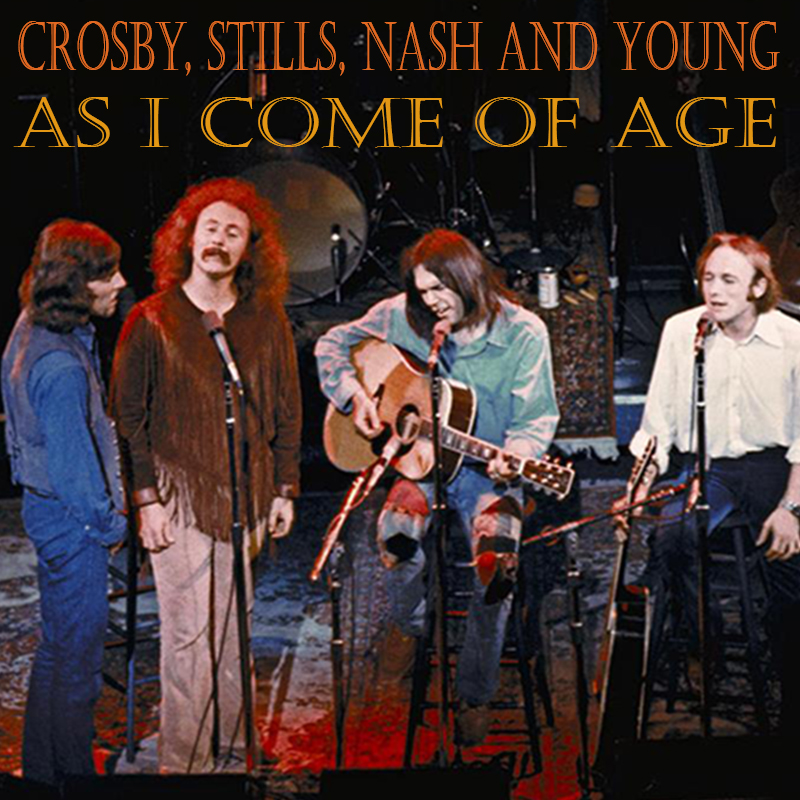
Crosby, Stills, Nash and Young - As I Come of Age - Non-Album Tracks (1970)

The alternate universe where CSNY put out lots of albums continues. As I mentioned in a previous post, CSNY was so productive as a group in 1970 that they had material for two albums, on top of "Deja Vu" being released that year.


Here's the second one. Since putting out three albums in a single year would have been a lot, even for that era, I figure this would have come out in 1971, along with the "Four Way Street" live album.

My policy is not to repeat songs on the official albums, unless there's a significant difference. There are a lot of cases of that on this album. Many of the songs would come out on other albums, either around that time or later. But all these versions are different than those of solo albums, usually because they were done by all of CSNY instead of just one of them. What's more surprising is that there are four good songs here by all of CSNY that have never been released in any form.

I made a couple of key edits to one song. "30 Dollar Fine" is one of those songs that has never been previously released. Luckily, there's a bootleg with CSNY doing a five-minute version of it. The problem is, Still sings for about the first minute, and the rest is all instrumental, but with no soloing. Probably, they were just learning the song, because Stills quietly mumbles through the first verse. So I edited out the last two minutes, since the music gets boring without any soloing. I also edited the second verse into the place of the first, because I figure Stills singing the same words twice is better than quiet mumbling.

Actually, now that I think about it, "30 Dollar Fine" was finally officially released earlier this year, but on a Jimi Hendrix archival album called "Both Sides of the Sky." I didn't use that here because it's Stills and Hendrix on that version, not CSNY. Even so, I would use it if Stills and/or Hendrix were soloing all over it, but they there isn't any actual soloing from either of them on that version, only some guitar fills here and there. Stills sings alone on that version and, frankly, Hendrix doesn't do much.

Also, as I often do, I cut out the audience noise on live tracks to make them sound like studio tracks.

"Wonderin'," an obscure Neil Young song. It was done by CSNY in concert only a few times. Luckily, one of those times was the famous 1969 Woodstock concert, and the version included here was finally released as part of the entire Woodstock concert being released for the concert's 50th anniversary. "Wonderin'" is only a minute and a half long, so it's not much of a song. But I think it's quite interesting, because it's a rare case of Young singing lead with backing vocals by just Stills.

Sadly, CSNY had a big falling out in 1971 (except for Crosby and Nash, who formed a duo), so we'll have go to 1973 for their next album.

There are two bonus tracks here. There's nothing particularly wrong with them. However, there are a ton of Stills songs, and these are two more Stills songs. I thought having that many Stills songs on the album would upset the balance. They were the weakest of the Stills songs, in my opinion, though they're still pretty decent. (By the way, I did the exact same thing with the "Find the Cost of Freedom" album, making two Stills songs bonus tracks there too.)

This album is 45 minutes long.

01 The Treasure (Stephen Stills)
02 Tell Me Why (Crosby, Stills, Nash & Young)
03 The Wall Song (David Crosby)
04 Simple Man (Crosby, Stills, Nash & Young)
05 30 Dollar Fine (Crosby, Stills, Nash & Young)
06 Only Love Can Break Your Heart (Crosby, Stills, Nash & Young)
07 Ivory Tower (Crosby, Stills, Nash & Young)
08 Wonderin' (Crosby, Stills, Nash & Young)
09 Everyday We Live (Crosby, Stills, Nash & Young)
10 Traction in the Rain (Crosby & Nash)
11 Birds (Crosby, Stills, Nash & Young)
12 Question Why (Graham Nash)
13 As I Come of Age (Crosby, Stills, Nash & Young)
14 Kids and Dogs (David Crosby)

I'll Be There (Crosby, Stills, Nash & Young)
Right On Rock 'N' Roll (Crosby, Stills, Nash & Young)

https://www.upload.ee/files/16383335/CROSBSTLLSNSHYNG1970AsICmofAge_atse.zip.html

I made the cover using a photo of CSNY playing live at the Fillmore East in June 1970.

Elton John - BBC Sessions, Volume 10: Rossia Concert Hall, Moscow, Russia, 5-28-1979

To be honest, I'm not that big of an Elton John fan. I think part of it is because I'm more into guitar based music than piano, especially acoustic guitar. But also, I think a lot of his stuff is overproduced. Add to that the fact that I've heard his hits many times on the radio and elsewhere and I'm a little tired of them.

But it occurred to me recently that if I could hear his music stripped down to just him playing alone on the piano, I might be able to hear his music in a new way and appreciate it more. So I went looking for that sort of thing and found this bootleg. He was the first major Western musical artist to play in Russia (then the Soviet Union) in 1979. He did a few shows in St. Petersburg and then a few in Moscow, and this is from one of the Moscow shows (at the Rossia Hotel Concert Hall, on May 28), in soundboard quality.

John is joined by a drummer halfway through the show, but the drumming is fairly restrained until the last few songs, where it's fun to end on some more lively numbers. All in all this is a great show that has caused me to appreciate his music a lot more. Its over two hours of him going through most of his famous 1970s songs.

By the way, this concert was officially released in 2019 as "Live from Moscow," though it was a limited "record store day" release.  However, this release is about 40 minutes shorter, and the sound quality is no better. So I've stuck with the bootleg version here.

01 Your Song (Elton John)
02 Sixty Years On (Elton John)
03 Daniel (Elton John)
04 Skyline Pigeon (Elton John)
05 Take Me to the Pilot (Elton John)
06 Rocket Man [I Think It's Going to Be a Long, Long Time] (Elton John)
07 Don't Let the Sun Go Down on Me (Elton John)
08 Goodbye Yellow Brick Road (Elton John)
09 Roy Rogers (Elton John)
10 Candle in the Wind (Elton John)
11 Ego (Elton John)
12 Where to Now St. Peter (Elton John)
13 He'll Have to Go (Elton John)
14 I Heard It through the Grapevine (Elton John)
15 Funeral for a Friend (Elton John)
16 Tonight (Elton John)
17 Better Off Dead (Elton John)
18 Idol (Elton John)
19 I Think I'm Gonna Kill Myself (Elton John)
20 I Feel like a Bullet [In the Gun of Robert Ford] (Elton John)
21 Bennie and the Jets (Elton John)
22 Sorry Seems to be the Hardest Word (Elton John)
23 Part Time Love (Elton John)
24 Crazy Water (Elton John)
25 Song for Guy (Elton John)
26 Saturday Night's Alright for Fighting - Pinball Wizard (Elton John)
27 Crocodile Rock - Get Back - Back in the U.S.S.R. (Elton John)

https://www.imagenetz.de/avGsh

alternate:

https://pixeldrain.com/u/3TkQf7Tt

second alternate:

https://bestfile.io/en/P2fCLGmstMlqSIi/file
 
I made my own cover, using a photo of him playing in Moscow in that year.

Monday, May 7, 2018

The Rolling Stones - Little Red Rooster - Non-Album Tracks (1964)

This is the last of the three 1964 Rolling Stones albums I've made in order to gather up all their stray tracks from that year. "Not Fade Away" covered the early part of the year, and "12 X 5" was largely determined what was on that US album. This covers the later part of the year.

Normally, I don't include a song if it's on another album, but I made an exception here for "Heart of Stone." It's done in a very different manner than the version that would appear on "Out of Our Heads" a year later.

Six out of these 11 songs are still unreleased. One of these, "Hear It," is an instrumental that ends the album. On the version I used, the song came to an abrupt, unnatural end. I'm pretty sure the band assumed the song would have faded out by that point. So I faded it out myself.

This ends my collection of the 1964 stray tracks from the Stones. But note that I didn't quite include all of the songs the band did that year. My goal is to include all the songs I like, not all the songs, period. There's not much difference between the two things in this case, but in the 1980s and beyond there will be a big difference, since the band hit quite a few rough patches, IMHO.

I don't recall exactly, but I think there are about three or four songs from 1964 that I found by them and didn't use. One example is the song "I Know." It was written and recorded by the band, but the main singer is their manager Andrew Oldham (apparently - it certainly isn't Mick Jagger or Keith Richards), so it doesn't really sound like a Stones song. Besides, it's just not much of a song, period. Another song I didn't include was "Each and Everyday of the Year," which was recorded in 1964 and released on the rarities album "Metamorphosis" in 1975, but I don't think it's much of a song. There's also a bland instrumental I left out, "And Mr. Spector and Mr. Pitney Came Too."

01 Little Red Rooster (Rolling Stones)
02 Meet Me in the Bottom [Down in the Bottom] (Rolling Stones)
03 Reelin' and Rockin' (Rolling Stones)
04 Stewed and Keefed [Instrumental] (Rolling Stones)
05 Heart of Stone [Demo] (Rolling Stones)
06 Surprise, Surprise (Rolling Stones)
07 Crackin' Up (Rolling Stones)
08 Ain't That Lovin' You Baby (Rolling Stones)
09 Goodbye Girl (Rolling Stones)
10 Key to the Highway (Rolling Stones)
11 Da Doo Ron Ron (Rolling Stones)
12 And Mr. Spector and Mr. Pitney Came Too [Instrumental] (Rolling Stones with Gene Pitney)

https://www.upload.ee/files/16701035/TROLLNGSTNES1964d_LttleRedRostr_atse.zip.html

For the cover, I once again used a cover of a single of the same name, with the art slightly modified. (Someone in some art department obviously seized on the use of the word "red" in "Little Red Rooster!")

The Rolling Stones - 12 X 5 - Alternate Version (1964)

This Rolling Stones album didn't require much changing by me. As bands typically did back in that era, the Stones were releasing more albums in the US than in Britain.

Their US album "12 X 5" ably gathers up a bunch of tracks. However, three of the songs of it were also used on one of the British albums, and I don't want any duplication. That left the album too short, plus, with the name "12 X 5" it needs to have 12 songs on it, not 9. Thus, I used three songs that were recorded a few months before the album came out, around the same time some of the other songs on the album were recorded.

Since this has the same title as the "12 X 5" US album, I'm using the same cover art. But I changed the record company logo to match the other ones in this series, and I put it in a less obtrusive spot.

01 Around and Around (Rolling Stones)
02 Confessin' the Blues (Rolling Stones)
03 Empty Heart (Rolling Stones)
04 Time Is on My Side [Organ Version] (Rolling Stones)
05 Good Times, Bad Times (Rolling Stones)
06 It's All Over Now (Rolling Stones)
07 2120 South Michigan Avenue [Instrumental] (Rolling Stones)
08 Congratulations (Rolling Stones)
09 If You Need Me (Rolling Stones)
10 [Walkin' Thru The] Sleepy City (Rolling Stones)
11 We're Wastin' Time (Rolling Stones)
12 We Were Falling in Love (Rolling Stones)

https://www.upload.ee/files/15256573/TRollngS_1964c_12by5Alternate_atse.zip.html

The album cover is the official cover without any changes.

Sunday, May 6, 2018

The Rolling Stones - Not Fade Away - Non-Album Tracks (1964)

Having just posted a Carpenters album, I need to post a real rock and roll album to try to restore my shattered musical credibility. ;)

As I mentioned in a previous post, the Rolling Stones are inadequately represented on their official British albums, and no year shows that more clearly than 1964. I'm assuming you own "The Rolling Stones," the only officially released British album that year. It turns out there are so many stray tracks that I've had to make THREE more albums for that year, all of them about the same length of the official one (which means 33 minutes, give or take a minute or two).

Here's the first of the three. This collects the stray tracks from the early part of the year. It's the usual mix of stray track sources, such as singles, BBC recordings, rarity collections, and so on. Three of the tracks are still unreleased, though you wouldn't know based on the song and sound quality. Although one song, "Andrew's Blues," has some rather explicit sexual language that easily explains why it still hasn't been released!

The tracks are in rough chronological order, with a few exceptions.

01 Not Fade Away (Rolling Stones)
02 Bye Bye Johnny (Rolling Stones)
03 Money [That's What I Want] (Rolling Stones)
04 You Better Move On (Rolling Stones)
05 Some Things Just Stick in Your Mind (Rolling Stones)
06 Try a Little Harder (Rolling Stones)
07 Cops and Robbers (Rolling Stones)
08 Andrew's Blues [Song for Andrew] (Rolling Stones with Gene Pitney)
09 Beautiful Delilah (Rolling Stones)
10 Don't Lie to Me (Rolling Stones)
11 High-Heeled Sneakers (Rolling Stones)
12 Tell Me Baby (Rolling Stones)
13 I'm Moving On (Rolling Stones)

https://www.upload.ee/files/15256426/TRollngS_1964a_NotFdeAway_atse.zip.html

I named this album "Not Fade Away" in part so I could use the artwork from the single by that name for the cover art. There were several different versions to choose from, most of which looked bad. I was left to one by default. Of the one I chose, I removed the B-side information and increased to size of the words "Not Fade Away" to compensate for the empty space.

The Carpenters - Near Acappella (1969-1975)

I'm doing something here that's extremely uncool. To be honest, I don't really like the Carpenters... but I do think that Karen Carpenter had one of the greatest voices of all time. And I'm hardly the only one to think that. I just looked up her Wikipedia entry, and it quotes Paul McCartney as saying that she had "the best female voice in the world: melodic, tuneful and distinctive."

The problem for me has been the Muzak-y song selection and production. But some of the group's songs were good or even classics, despite the fact they were cheesy. As for the production, recently I've been looking for multitrack versions of songs for some artists. I've been hoping to find that for the Carpenters in order to try to de-Muzak-ify the syrupy as best I could. The bad news is I couldn't find such multitracks for the group, but the good news is that someone else had them and already did what I wanted to do, stripping the songs down to their core of just Karen Carpenters' voice, plus bass and drums. There are some additional instruments and/or vocals here and there, but not much. 

In my opinion, listening to these songs in this way is a real revelation. By removing all the overproduced gunk, you can hear just how great her voice is. She doesn't do vocal gymnastics like TV talent show winners do (thankfully), but there's something about the sound of her voice that demands one's attention. Thanks to Jeremy Doe for making these stripped down versions. I'm calling this album "Near Acappella" because that's the term he used.

If you listen to this, I promise I won't tell anybody! ;) 

This album is 55 minutes long. 

UPDATE: On March 3, 2026, I updated the mp3 download file. I added two songs: "All I Can Do" and "All of My Life." Musical friend Fabio from Rio found them while he was looking for songs for other Carpenters album projects. I also changed the cover to one I like better.

01 Ticket to Ride (Carpenters)
02 All I Can Do (Carpenters)
03 All of My Life (Carpenters)
04 [They Long to Be] Close to You (Carpenters)
05 We've Only Just Begun (Carpenters)
06 For All We Know (Carpenters)
07 Rainy Days and Mondays (Carpenters)
08 Superstar [Groupie] (Carpenters)
09 Goodbye to Love (Carpenters)
10 Hurting Each Other (Carpenters)
11 It's Going to Take Some Time (Carpenters)
12 Sing (Carpenters)
13 This Masquerade (Carpenters)
14 Top of the World (Carpenters)
15 Yesterday Once More (Carpenters)
16 Please Mr. Postman (Carpenters)
17 Only Yesterday (Carpenters)

https://pixeldrain.com/u/2HNebtRT

alternate:

https://bestfile.io/rMEwKW7v7mRdnxy/file

For the cover art, I chose a picture that shows the drums, since these versions feature that instrument prominently. Interestingly, Karen Carpenter was a really good drummer, and she's the one playing the drums in this picture. This comes from a TV special on CBS in 1972.

Saturday, May 5, 2018

Crosby, Stills, Nash & Young - Find the Cost of Freedom - Non-Album Tracks (1970)

Here's the next installment of my alternate history of Crosby, Stills, Nash and sometimes Young. 1970 was probably the most productive time for CSNY as a unit, since they released the great "Deja Vu" album that year and also performed a lot of concerts. It turns out they did so much great music that year that I was able to make not one but two albums of stray tracks that I think hold up well as albums themselves. Here's the first one.

All the songs are from 1969 or 1970. Since "Deja Vu" came out in March 1970, I'm imagining this album could have come out in late 1970.

As I mentioned in my last post on this group (the "Wooden Music" album), my general rule is to not use any songs on their solo albums unless the song is done in a significantly different style, such as full band vs. acoustic, or with one of them vs. all four of them. There are a number of such cases here.

For instance, "I've Loved Her So Long" was on the 1969 album "Neil Young," but that was done in the studio with just him plus a full band, whereas this was done by CSNY in a live acoustic version. By contrast, "The Lee Shore" was done solo live by Crosby on the "Four Way Street" CSNY album, but I've included a studio version that actually has CSNY playing. "So Begins the Task" would be a track on Stills' 1972 album "Manassas" but I've included a version of CSNY doing it in concert in a different style. And so on. And, as usual, when I've added a live version of a song to a largely studio album, I've edited out the crowd noise at the end as best I could.

Many of the songs come from various archival releases, such as the box sets by CSN, Stills, and Young. Others are from bootlegs. "Onio" and "Find the Cost of Freedom" are from a CSNY single released in 1970. "Have You Seen the Stars Tonite" actually comes from a "Jefferson Starship" album (though it's more of a Paul Kantner and Grace Slick album since Jefferson Airplane hadn't really morphed into Jefferson Starship form yet). However, Crosby co-wrote it and co-sings it, and Nash is on it too, and this is a mix from Crosby's box set "Voyage." Plus, it's a great song.

There are two bonus tracks here. There's nothing particularly wrong with them. However, there are a ton of Stills songs, and these are two more Stills songs. I thought having that many Stills songs on the album would upset the balance. They were the weakest of the Stills songs, in my opinion, though they're still pretty decent.

This album is 47 minutes long, not including the two bonus tracks.

01 Ohio (Crosby, Stills, Nash & Young)
02 So Begins the Task (Crosby, Stills, Nash & Young)
03 Horses through a Rainstorm (Crosby, Stills, Nash & Young)
04 The Lee Shore [Edit] (Crosby, Stills, Nash & Young)
05 Who Ran Away (Stephen Stills)
06 Sea of Madness (Crosby, Stills, Nash & Young)
07 Little Miss Bright Eyes (Stephen Stills)
08 Drop Down Mama (David Crosby)
09 Everybody's Alone (Crosby, Stills, Nash & Young)
10 Man in the Mirror (Crosby, Stills, Nash & Young)
11 Have You Seen the Stars Tonite (Crosby, Nash & Paul Kantner)
12 Singin' Call (Stephen Stills)
13 I've Loved Her So Long (Crosby, Stills, Nash & Young)
14 Music Is Love (Crosby, Nash & Young)
15 Find the Cost of Freedom (Crosby, Stills, Nash & Young)

Hold On Tight (Crosby, Stills, Nash & Young)
Same Old Song (Crosby, Stills, Nash & Young)

https://www.upload.ee/files/16383333/CROSBSTLLSNSHYNG1970FndthCstofFredm_atse.zip.html

Originally,  I used a cover photo of CSNY practicing together in somebody's house in late 1969. It was taken by Tom G. O'Neal. That was in black and white, and I hate black and white photos, so I tinted it to jazz things up. Over a year later, I found a good color photo from around the same time, so I replaced it with that one.

Here's the original, if anyone prefers it.

Rosanne Cash - Private Moments - Non-Album Tracks (1990-1991)

Rosanne Cash is a very underappreciated artist, in my opinion. She's so much more than just Johnny Cash's daughter. I hope to post a fair amount of her (non-official album) stuff here to hopefully turn some people on to her music.

In the 1980s, Cash became a country music star. In fact, in 1988, she had four no. 1 country hits, and she sold the most of any country artist that year. But then for her next album, "Interiors" in 1990, she basically abandoned country music for more of a confessional singer songwriter style, and she seemingly followed her artistic muse with little concern about getting more hits. As a result, the country music industry and her own record company basically dropped her like a hot potato, and her sales plummeted. She's never been a big seller ever since.

That's a shame, because "Interiors" is my favorite album by her. I don't mean to oversell it by comparing it to one of the greatest albums of all time, but it reminds me some of "Plastic Ono Band" by John Lennon in that she clearly was going through some troubled emotional times and expressing that through her music.

I've noticed that when an artist is hitting a creative high point, even their stray tracks from around that time are usually excellent. That's the case here. I've gathered a bunch of tracks from her "Interiors" era. A few of them have made it on various retrospectives, but most of them remain surprisingly obscure, even though she wrote the vast majority of them. In fact, a handful of them are still unreleased, but I luckily found soundboard quality bootlegs of them being performed in concert. (As I often do when mixing in live tracks with studio ones, I edited out the clapping at the end of those songs to make them sound like studio tracks too.)

I recommend you give "Interiors" a close listen, if you haven't already. If you like it, I'll bet you'll like this too.

By the way, I normally try not to repeat songs on official albums, but the acoustic version of "What We Really Want," a track on "Interiors," is really nice and was a later bonus track for that album, so I couldn't resist including it.

01 All Come True (Rosanne Cash)
02 What We Really Want [Acoustic Version] (Rosanne Cash)
03 It Came Upon a Midnight Clear (Rosanne Cash)
04 Portrait (Rosanne Cash)
05 A Lover Is Forever (Rosanne Cash)
06 Lonely Hearts Brigade (Rosanne Cash)
07 Private Moments (Rosanne Cash)
08 Crescent City (Rosanne Cash)
09 Bedroom Lies (Rosanne Cash)
10 Road Widow (Rosanne Cash)
11 Ella's Song (Rosanne Cash)
12 Don't Think Twice, It's All Right (Rosanne Cash, Lucinda Williams & Bruce Cockburn)

https://www.upload.ee/files/15103720/RosanneC_1990-1991_PrivateMments_atse.zip.html

At some point, Cash released a version of "Interiors" which she called "Interiors - The Full Sessions" even though it was just the same album with two bonus tracks at the end. For whatever reason, it had a completely different (and rather strange) album cover. I've used that here, except that had no words on it and I added her name and the name I made for this album on top of it.

The Rolling Stones - Come On - Non-Album Tracks (1963)

Certain classic musical artists from the 1960s and 1970s don't lend themselves to much in the way of alternate albums. For instance, Creedence Clearwater Revival put out pretty much all their music on their albums, with very few stray tracks such as singles or outtakes or songs only done live. However, the Rolling Stones are the opposite. Their recorded output in the 1960s and 1970s is a total mess! In fact, many excellent songs of their have never been officially released in any form.

There's a good reason for that. Around 1970, the Stones got rid of their hard-nosed business manager Allan Klein. Or at least they tried to. Many lawsuits followed, which dragged on into the 1980s. It turned out that Klein's company ABKCO kept the rights to all the Stones' music up until about 1971, and Klein made way more money on releases of that music than the actual Stones did. (Note that a few days ago I posted a George Harrison bootleg called "Beware of ABKCO" - Klein and his company screwed the Beatles too.) As a result of this financial situation, for decades, the Stones avoided releasing or repackaging their 1960s material, since doing so would benefit their financial enemy more than them, and they had plenty of money from their other releases. The one exception was "Metamorphosis," a 1975 rarities album that they were forced to put out as part of a settlement to one of the lawsuits with Klein.

Happily, that situation may finally be starting to change. Klein died in 2009. In 2012, the Stones included some previously unreleased 1963 recordings on a bonus disc of their "GRRR!" greatest hits. In 2017, the Stones released "On Air," a collection of their BBC performances from 1963 to 1965. Hopefully, more archival releases will follow.

In the meantime, I've tried to gather up all the group's quality stray tracks that I could, and I've organized them into a series of alternate albums that augment the Britsh versions of their officially released albums. As with the Kinks, I think there's as much or more quality material not on their albums up until the early 1970s as there is on their official albums!

So here's the first of a series of alternates. This covers everything they did in 1963. They put out a few singles that year, but no album, so all of it is fair game for my purpose. Some of the material here is still unreleased, but the sound quality is essentially the same as the released stuff.  The songs are in rough chronological order. The album is 36 minutes long, which would be a long album for that year.

For this and any other album of stray tracks I post here, if you see any good songs I've missed, please let me know and I'll add them in. (Note that I try to avoid including duplicates of songs released elsewhere unless there's a very good reason to do so.) There are some recordings from before 1963, but I thought they weren't that interesting, except for die-hard Stones fans, and that predates when they became the Stones anyway.

The bonus track, "Go On to School," dates way back to 1961, before the Rolling Stones even began. The band, Little Boy Blue & the Blue Boys, was an early version of the Stones, with Mick Jagger and Keith Richards in it. I would have included more early songs like this one if they were good, but most suffer from bad sound quality. For some reason, this one sounded a bit better than the others in my opinion, but it's still fairly rough.

01 Diddley Daddy (Rolling Stones)
02 Road Runner (Rolling Stones)
03 Bright Lights, Big City (Rolling Stones)
04 Honey What's Wrong [Baby What's Wrong] (Rolling Stones)
05 Come On (Rolling Stones)
06 I Want to Be Loved (Rolling Stones)
07 Poison Ivy (Rolling Stones)
08 Fortune Teller (Rolling Stones)
09 I Wanna Be Your Man (Rolling Stones)
10 Stoned [Instrumental] (Rolling Stones)
11 Memphis, Tennessee (Rolling Stones)
12 Roll Over Beethoven (Rolling Stones)
13 My Only Girl [That Girl Belongs to Yesterday] (Rolling Stones)
14 It Should Be You (Rolling Stones)
15 Go Home, Girl (Rolling Stones)
16 Leave Me Alone (Rolling Stones)

Go On to School (Little Boy Blue & the Blue Boys [with Mick Jagger & Keith Richards])

https://www.upload.ee/files/16701025/TROLLNGSTNES1963_CmeOn_atse.zip.html

Note that I chose the name of the band's first single for this album title. When I first posted this album in 2018, I used the cover art of the single with some minor changes. But in March 2021, I found a great photo of the band from 1963, so I used that instead. I kept the text from the single art though, and added in the record company logo.

The Hollies - Live 1968

The Hollies don't get much respect. True, they were more of a singles band than an album band, but they created lots of classic songs, a majority of which they wrote themselves. For me, their best era was when they had Graham Nash in the band (from their start through most of 1968). He tried to pull the group in a more progressive direction before leaving, but once he left, they got stuck in a very square mode that was at odds with most of the great music happening at the time.

There isn't a lot of quality recording of the Hollies playing live. Luckily, there is a show from 1968 (the Lewisham Odeon Theatre, London, in May), done not long before Nash left, which was included as part of a box set on the years Nash was in the band. This is a short recording, only 24 minutes.

Luckily, I was able to find another show, also from 1968 and from before Nash left (Split, Yugoslavia, in August). I took the songs from that show that they didn't play in the other show and added them to the end. That makes it a 36 minute long album, a more satisfying length.

The Hollies didn't attempt to impress with instrumental soloing in their live shows. However, they were a tight band and certainly brought all their vocal harmonizing skills.

01 Stop, Stop, Stop (Hollies)
02 Look through Any Window (Hollies)
03 The Times They Are A-Changin' (Hollies)
04 On a Carousel (Hollies)
05 King Midas in Reverse (Hollies)
06 Butterfly (Hollies)
07 Jennifer Eccles (Hollies)
08 Carrie Anne (Hollies)
09 Dang Me (Hollies)
10 The Very Last Day (Hollies)
11 A Taste of Honey (Hollies)
12 Do the Best You Can (Hollies)

https://www.upload.ee/files/15122424/THollis_1968_LewishmOdeonTheatreLondonBritain__5-24-1968_atse.zip.html

Originallyl, I used the cover art of a photo of the band playing in Split, Yugoslavia. It was a screenshot from a YouTube video. But it was low-res and blurry. Over a year later, I replaced it with a much clearer photo of the band performing for the BBC in 1968.

Friday, May 4, 2018

George Harrison - Acoustic Versions (1969-1970)

A couple of days ago, I posted the George Harrison bootleg "Beware of ABKCO." That's a must-have acoustic collection of songs that were being considered for the "All Things Must Pass" album. These are all the stray tracks from him I've found that date from around that time. A few of the songs are the same as songs on "Beware of ABKCO," but they're different versions.

The album starts with "I'd Have You Any Time," done by Harrison and Bob Dylan just after they wrote it together at Dylan's house at the tail end of 1968. Even though that's the only song with Dylan on it, I chose a picture of Harrison and Dylan as the album cover since it dates from that exact time.

The next three songs are demos Harrison recorded for the Beatles, and were included on the Beatles' Anthology 3. It's fine to listen to those in a Beatles context, but I think it's also fitting to hear them in this solo acoustic context. The song after that was played by Harrison for the other Beatles during the Let It Be recording sessions in early 1969.

After that, it's pretty much all Harrison solo takes as he worked up to making his opus "All Things Must Pass." Many of them come from the "Early Takes, Volume 1" album. Although I'd like to note that the song "Isn't It a Pity" was actually written back in 1966, and was considered for various Beatles albums, including Revolver! What a shame that the other Beatles undervalued Harrison's songwriting, and didn't even properly record a great song like that one.

This album is only 31 minutes long. I could have made it longer, but I wanted to keep to the all-acoustic format. I have another album coming of other stray songs he did from that time with a band. I also have more acoustic takes from 1971 onwards.

01 I'd Have You Anytime (George Harrison & Bob Dylan)
02 All Things Must Pass (George Harrison)
03 Old Brown Shoe (George Harrison)
04 Something (George Harrison)
05 Window Window (George Harrison)
06 Isn't It a Pity (George Harrison)
07 Behind that Locked Door (George Harrison)
08 My Sweet Lord (George Harrison)
09 Apple Scruffs (George Harrison)
10 Woman Don't You Cry for Me (George Harrison)
11 Mama, You've Been on My Mind (George Harrison)

https://www.upload.ee/files/15119201/GeorgeH_1969-1970_AcoustcVersions_atse.zip.html

I'm not sure what year the cover art photo dates from, but I'd guess 1970 or thereabouts.

Crosby, Stills and Nash - Wooden Music - Non-Album Tracks (1969)

Crosby, Stills, Nash, and sometimes Young... Sigh! What great musicians, yet what lost potential. Of all the major musical groups I love, I think CSN(Y) are the most frustrating for me. With only a few exceptions, drugs, ego, money, and so on kept these four talented men from making music together as they should have.

Thankfully, we can at least partially make up for the roads they didn't take. I've created about 20 CSN(Y) albums that should have been yet never were, and sharing them is one of the main reasons I've made this blog. I've essentially created an alternate history where the three or four of them frequently got together to make great albums.

How did I do it? I've had several rules. I don't want to use music from their all too few great albums together ("Crosby, Stills and Nash" in 1969, "Deja Vu" in 1970, "Four Way Street" in 1971, "CSN" in 1977, and "Daylight Again" in 1982). Also, I don't want to use songs from their various prominent solo or duo albums. However, there is a big caveat to that: I will use a song if it's done in a markedly different way than on a studio album. For instance, perhaps a song was done just by one of them on a solo album but done by all four of them in a bootleg. That would be fair game.

I've drawn from various archival releases, bonus tracks, bootlegs, and live shows. When it comes to live shows, there were times I was able to find a soundboard quality performance with no crowd noise overlapping the music, and then I edited out the clapping at the end to make it sound like a studio take.

It'll take a while for me to post all my "alternate universe" CSN(Y) albums, but I'll start here and work forward chronologically.

Back in 1969, CSN had gotten together for the first time and were musically on fire. Of course the "Crosby, Stills and Nash" album released that year is an all-time classic, but the three of them had many more great songs at that time. There easily was enough for a second album for the trio to record before they hooked up with Neil Young to create CSNY. Back in that era, it was hardly unusual for a group to put out two albums in one year (or this could have come out in early 1970).

As it so happens, all the material I have to work with from this time is acoustic in nature, with one or more of them playing guitar. So I decided to call the album "Wooden Music," because that's the term Crosby had for acoustic music (played on wooden guitars).

The one problem I have with the music from this time.is that many of the songs were done by just one of them. In a perfect world, there would have been versions with all three of them singing together, but we'll have to make do.

I'm not interested in historical accuracy so much as creating albums that I personally enjoy frequently listening to. (And if you enjoy them too, then great, but I'm doing this mainly for myself.) To that end, I've created some artistic liberties. I included a demo of Crosby playing his Byrds song "Lady Friend." However, the demo was only about a minute and a half long, and it comes to a stop in a bad place, due to him forgetting the words. So I took the chorus from earlier in the song and seamlessly added it to the end to give the song a better ending.

I got more ambitious by editing two Stills songs. With his solo version of "Change Partners" on the "Just Roll Tape" album (recorded in 1968), it seemed incomplete to me without harmonies on the chorus, since that's how it's been performed the vast majority of the time ever since. Thus, I found a version of the song performed by CSNY at Winterland, San Francisco, in 1973, and I managed to isolate the vocals from that version and add them into this version. (Young was there, but he didn't sing on the song, effectively making it a CSN version.) I think it worked pretty well, though my audio editing skills are very basic.

I did the exact same thing for the Stills song "So Begins the Task." I've always imagined that song as one CSN performed acoustically. Unfortunately, they rarely or never played it that way, instead preferring to play it with a full band, and at a faster pace than how Stills did it for "Just Roll Tape." Stills released a version on his 1972 album "Manassas," but that lacked the CSN harmonies. The best CSN version I could find was them performing the song at the Greek Theater in Los Angeles, on August 31, 1969. But that was an audience recording with less than stellar sound, and I was only partially successful at isolating the vocals from the bass, drums, electric guitar, and so on. Thus, I've included the CSN version I've made at the end of this album, but be warned that the CSN vocals have some issues. You might like it, or you might think it's not up to stuff, in which case don't keep it with the rest of the album.

I hope that by putting these edits on the Internet, somebody with better audio editing skills than I have will eventually come along and make better versions. In my opinion, "So Begins the Task" is a great song that gets overlooked, probably because they never recorded it acoustically as they should have back in their glory days, despite it being written in 1968.

Even with the edits I made to those two songs, only seven of the 16 songs on the album are song by two or more of CSN. I've tried to spread those around to give the album a group feeling. All the alternate albums after this are much more group efforts. However, I think the album is unified by the all acoustic sound.

As I usually do, I've included details on where all the songs come from in the mp3 tags. But I'll make special note here of the fact that "Everybody's Been Burned" is performed by Crosby solo on guitar in 1964! It was recorded by the Byrds in 1967, yet the solo version included here was made even before the Byrds were formed. What's remarkable is how far ahead of its time it is. In my opinion, it sounds exactly as if Crosby played the song solo in 1969, which is why I've included it.

One thing I've tried to do with all my CSN(Y) alternate albums is to include a mix of songs by each member, scattered carefully through the album so one rarely hears two songs by the same person in a row. Unfortunately for this album, there isn't enough songs as I'd want from Nash, so I included his song "Be Yourself" from 1971. It's a solo demo, so it may well have been written and/or recorded before 1971. Even with that addition, only three of the 16 songs are written by Nash.

01 Do for the Others (Crosby, Stills & Nash)
02 Right Between the Eyes (Graham Nash)
03 Laughing (David Crosby)
04 How Have You Been (Crosby, Stills & Nash)
05 Be Yourself (Graham Nash)
06 Everybody's Talkin' (Crosby, Stills & Nash)
07 Triad (David Crosby)
08 Change Partners (Crosby, Stills & Nash)
09 Lady Friend (David Crosby)
10 Sleep Song (Graham Nash)
11 My Love Is a Gentle Thing (Stephen Stills)
12 Everybody's Been Burned (David Crosby)
13 Bumblebee [Do You Need a Place to Hide] (Stephen Stills)
14 Song with No Words [Trees with No Leaves] (Crosby & Nash)
15 Blackbird (Crosby, Stills & Nash)
16 So Begins the Task (Crosby, Stills & Nash)

https://www.upload.ee/files/16383334/CROSBSTLLSNSH1969WodnMsc_atse.zip.html

The cover shows CSN recording in the studio in 1969. The original was black and white, so I tinted it to make it more interesting.

Thursday, May 3, 2018

The Byrds - Bound to Fall (1968) (MASH-UP)

Having tackled the "Stranger in a Stranger Land" Byrds mash-up in my last post, I figured why not try another one. There's one other Byrds song I know of that is just an instrumental badly in need of vocals, and that's "Bound to Fall," a bonus track off the 1968 "Notorious Byrd Brothers" album.

The song was written by Mike Brewer of Mastin and Brewer, a little known duo that sometimes opened up shows for the Byrds in 1966 but only released one single that didn't contain this song. (Brewer would later go on to bigger success in the duo Brewer and Shipley, and that group would finally record the song on a 1974 album.) However, the song is associated with Byrds bassist Chris Hillman, who has played it off and on during his long career, Aside from the instrumental Byrds version, which came out in 1997 and obviously wasn't originally meant to be released in that form, a Hillman version of the song wouldn't get released until 1972, when it was done for the "Manassas" album led by Stephen Stills. Hillman was a member of the Manassas band, and he sang the song on the album with his voice intertwined with Stills' voice.

It would be very difficult for me to combine the Byrds version with the Manassas version, because Manassas does it in a different arrangement. I couldn't find any versions of the song sung only by Hillman. However, I found a bootleg of Hillman singing the song in a duet with Kim O'Kelley at My Father's Place in Roslyn, New York, on March 1, 1978. It was possible to isolate the vocals because the song was performed acoustically and in front of a very small crowd, so the vocals were clear.

I think the mash-up worked out well, although I should warn that I'm new to this sort of thing and I'm sure there are others who can do it better. One problem is that Hillman and O'Kelley were performing the song without any sort of rhythm section, so sometimes they got a little bit ahead of the beat or behind it, when compared to the Byrds' version. I tried my best to fix that, but I can only do so much with my limited audio editing skills. It was also tough to sync up the pitch and tempo.

Maybe someone with more skills will see this effort and make a better version. As with my last mash-up, I've included the two versions I combined, so one has the raw materials to make one's own combination.

As it is, I'd much rather hear this version with Hillman's vocals than the instrumental version. I hope you feel the same.

https://www.upload.ee/files/15239501/TByrd_BndtoFallSongEdit.zip.html

Blackburn and Snow with the Byrds - Stranger in a Strange Land (1965) (MASH-UP)

Here's something a little different. I've been experimenting with what I can accomplish by editing various songs, and I think I've created an interesting mash-up. 

I've long been frustrated that the Byrds never properly recorded the David Crosby song "Stranger in a Strange Land." It's a bonus track on the 1965 "Turn! Turn! Turn!" album, but it's only a rough instrumental version. The folk duo Blackburn and Snow recorded the song in 1966, but it was put out by a small and mismanaged record label and was barely noticed. If Crosby has ever recorded vocals to the song in his long career, his version has never made it to the public.

So I decided to try to add the Blackburn and Snow vocals to the Byrds' instrumental version. I was able to isolate the vocals fairly well. I lowered the pitch of that by half a step to match the sound of the Byrds' version. I matched the vocals to the Byrds' instruments by following the chord changes. To my surprise, both versions were done at the exact same tempo, so that made the matching relatively easy to do.

The Byrds version is about 40 seconds longer than the Blackburn and Snow one, and it turns out most of that is at the start, with the Byrds repeating the same riff over and over again before going into any chord changes. After I combined the two versions, the vocals didn't come in until a full 30 seconds into the song, which sounded strange given that there wasn't much happening musically during that time. So I edited that intro down. I also faded the song out some at the end, since the Byrds version kept on going after the vocals had climaxed and were clearly done.

The result is a mash-up that I think works pretty well. It's not the Byrds singing the song, but it might be the closest to that we're ever going to get, since the Byrds archives seem to have been thoroughly explored by lots of archival releases by this point.

I've included just two songs in the zip file: the Byrds instrumental version of this song and the combined mash-up.

https://www.upload.ee/files/15239464/TByrd_StrangrinStrngeLnd_atse.zip.html

Here's some more info about the song, from Wikipedia:

"Stranger in a Strange Land" has been said to have been written by David Crosby of The Byrds, although it was credited to the fictitious "Samuel F. Omar." The title and lyrics are based on the Robert A. Heinlein science fiction novel that was widely popular among the San Francisco youth culture in the mid-1960s. It was released as a single in late December 1966.

Here's some more, from the Wikipedia article about the Byrds' 1965 "Turn! Turn! Turn!" album:

The recording of the album was not without its tensions, with several members of the band expressing feelings of resentment towards the close working relationship that was beginning to form between [Roger] McGuinn and producer Terry Melcher. Rhythm guitarist David Crosby was particularly vocal in his disapproval, since he felt that McGuinn and Melcher (along with the band's manager Jim Dickson) were conspiring to keep his songs off of the album. Crosby had brought the self-penned "Stranger In a Strange Land" (later released by Blackburn and Snow) and "The Flower Bomb Song", along with Dino Valenti's "I Don't Ever Want to Spoil Your Party" (later released by Quicksilver Messenger Service as "Dino's Song") to the recording sessions but all three songs were rejected and remained unreleased at the time.

In my opinion Crosby had a very good point, because this is an excellent song that would have sounded wonderful if done by the Byrds. "The Flower Bomb Song" has never been publicly released, but "Dino's Song" would have made a fine Byrds song as well, judging by the Quicksilver Messenger Service version of it.


Here's another tidbit about the Blackburn part of the duo:

Jeff Blackburn joined Moby Grape in the mid-seventies; with Bob Mosley he formed the Jeff Blackburn Band which with the addition of Neil Young and Johnny Craviotto became The Ducks, playing a series of impromptu bar gigs in Santa Cruz, California in 1977. During this time, Blackburn co-wrote "My My, Hey Hey (Out of the Blue)" with Young.


Also, there's an NPR article from 2011 that refers to the Blackburn and Snow version as a "lost masterpiece." It goes on to say about the recording:

If this record had come out in early 1966, when it was recorded, and when interest in Robert Heinlein's book was peaking among proto-hippies, it might well have been a hit. But, as sort of a symptom of the problem which would soon destroy Trident, [Frank] Werber sat on the record for a full year, killing its chances and Blackburn and Snow's career.