Showing posts with label Pink Floyd. Show all posts

Friday, January 3, 2025

Pink Floyd - BBC Sessions, Volume 7: In Concert, Earl's Court, London, Britain, 10-20-1994

I haven't posted this until now because it's very similar to the official live album "Pulse." but if I want to present a full version of everything Pink Floyd did for the BBC, I should post this too.

"Pulse" is one of those live albums that is drawn from a bunch of different concerts. In this case, all of them were taken from the last month or so of the band's 1994 tour. Personally, I prefer this to "Pulse" because it's a real, full concert, warts and all. All the songs are in the order they were played, as opposed to "Pulse," where they were ordered very differently for some reason. 

About seven of performances from "Pulse" were taken from this exact show. Note also that the entire video of this exact show was included on "The Later Years" box set, but only in DVD format. It's never been released in an audio format.

Some people may say the David Gilmour-led Pink Floyd of the late 1980s and after wasn't the "real" Pink Floyd. I think those people have a point, since Roger Waters was such an essential part of the band. But if that's how you feel, you can just look at this essentially as a David Gilmour concert, and that's a very good thing as well.

Different versions of this bootleg exist. For instance, the video version sounds a bit different than the BBC radio version. I went with the one I thought sounded the best, which is the BBC radio one.

This album is two hours and 30 minutes long.

01 Shine On You Crazy Diamond, Parts I to V (Pink Floyd)
02 Learning to Fly (Pink Floyd)
03 High Hopes (Pink Floyd)
04 Take It Back (Pink Floyd)
05 Coming Back to Life (Pink Floyd)
06 Sorrow (Pink Floyd)
07 Keep Talking (Pink Floyd)
08 Another Brick in the Wall, Part II (Pink Floyd)
09 One of These Days [Instrumental] (Pink Floyd)
10 Speak to Me [Instrumental] (Pink Floyd)
11 Breathe (Pink Floyd)
12 On the Run [Instrumental] (Pink Floyd)
13 Time (Pink Floyd)
14 Breathe [Reprise] (Pink Floyd)
15 The Great Gig in the Sky (Pink Floyd)
16 Money (Pink Floyd)
17 Us and Them (Pink Floyd)
18 Any Colour You Like [Instrumental] (Pink Floyd)
19 Brain Damage (Pink Floyd)
20 Eclipse (Pink Floyd)
21 Wish You Were Here (Pink Floyd)
22 Comfortably Numb (Pink Floyd)
23 Run like Hell (Pink Floyd)

https://pixeldrain.com/u/CjnqvC7b

alternate:

https://bestfile.io/en/6a7qYvXdnmI7m0c/file

The cover photo is from this exact concert.

Wednesday, May 29, 2024

Knebworth Festival, Knebworth House, Knebworth, Britain, 6-30-1990, Part 8: Pink Floyd

Pink Floyd was the eighth and final musical act to perform at the 1980 Knebworth Festival.

At this point, Pink Floyd was essentially David Gilmour plus backing musicians. The band's former leader Roger Waters left the band in 1983. But I think it says quite a lot that the Gilmour-led version of Pink Floyd was still so popular in 1990 that it was the closing act of this festival, over such big names as Phil Collins and Paul McCartney, and even the trio of Eric Clapton, Dire Straits, and Elton John playing together.

As I mentioned back in my write-up for Part 1 of this festival, most all of the music from this festival remains officially unreleased, aside from a highlights album and video. But the exception to this is this Pink Floyd set. It was first released in full as part of "The Later Years" box set. Then it later got a stand alone release. Even so, I'm including it here so the entire festival can appear in one place.

Pink Floyd toured all over the world from 1987 to 1989, in the wake of their "Momentary Lapse of Reason" album. However, they wouldn't do another big tour until 1994, after the release of their "Division Bell" album that year. In between, the only full concert they played was this one. 

On the band's classic 1973 album "Dark Side of the Moon," the wordless vocals for the song "The Great Gig in the Sky" were sung by Clare Torry. So it was a special treat when she assisted the band by singing that part in this concert. Beautiful and talented Candy Dulfer also played saxophone.

This album is an hour and one minute long.

01 talk by Tommy Vance (Pink Floyd)
02 Shine On You Crazy Diamond [Parts 1-5] (Pink Floyd)
03 The Great Gig in the Sky (Pink Floyd with Clare Torry)
04 talk (Pink Floyd)
05 Wish You Were Here (Pink Floyd)
06 Sorrow (Pink Floyd)
07 Money (Pink Floyd)
08 Comfortably Numb (Pink Floyd)
09 talk (Pink Floyd)
10 Run like Hell (Pink Floyd)
11 talk (Pink Floyd)

alternate:

https://pixeldrain.com/u/zDzX4AZ7

alternate:

https://bestfile.io/en/NWoJW1HfISeoTcK/file

The cover photo of lead singer David Gilmour is from this exact concert.

Saturday, December 2, 2023

David Gilmour - On TV and Radio, Volume 2: 1987-2006

I started out trying to make a series of BBC albums for Gilmour, but I discovered too much interesting non-BBC stuff to leave out. That's particularly the case with this volume, in which only tracks 5 and 6 were recorded for an unreleased 2002 BBC studio session.

A majority of the songs here are from DVDs. "Deep in the Blues" is from a tribute concert to guitar pioneer Les Paul, that was later put out on DVD. "Don't" is very unusual compared to Gilmour's usual style. It's a cover of a Leiber and Stoller song that was performed by Elvis Presley, and was done at a tribute concert in 2001. It later showed up on the DVD "David Gilmour in Concert," even though it didn't really fit with the rest of the music from that. Tracks 7 through 9 are from a 2004 concert called "The Strat Pack," that was a tribute to a guitar, the Stratocraster, rather than a person. That too came out on DVD. 

That leaves just a few songs. "Ah, Robertson, It's You" was played on the "Saturday Night Live" TV show in 1987. Since it was never released, I guess there's some controversy about the song title, and some call it "Song for My Sara" instead. "On the Turning Away" was done for an Amnesty International benefit concert, which is fitting considering the subject matter of the song. "Dominos" was a bonus track on some editions of Gilmour's "Live in Gdansk" album, even though it was recorded in Paris.

Note that trcks 3, 5, 7, 8, and 9 were original done for Pink Floyd albums. And while "Dominos" was never a Pink Floyd song per se, it was written by Syd Barrett, the first lead singer of Pink Floyd.

This album is 56 minutes long.

01 Ah, Robertson, It's You [Song for My Sara] [Instrumental] (David Gilmour)
02 Deep in the Blues [Instrumental] (David Gilmour)
03 On the Turning Away (David Gilmour)
04 Don't (David Gilmour)
05 Fat Old Sun (David Gilmour)
06 Smile (David Gilmour)
07 Marooned [Instrumental] (David Gilmour)
08 Coming Back to Life (David Gilmour)
09 Sorrow (David Gilmour)
10 Dominoes (David Gilmour)

https://www.upload.ee/files/16010870/DavdGlmour_1987-2006_OnTVndRdioVolum2_atse.zip.html

The cover photo was taken at the Secret Policeman's Third Ball in London, Britain, on March 26, 1987.

Thursday, November 16, 2023

David Gilmour - Meltdown Festival, Royal Festival Hall, London, Britain, 6-22-2001

David Gilmour was the lead guitarist of Pink Floyd for almost the entire duration of that band's existence. He'd led Pink Floyd since the band's former main lead vocalist and songwriter Roger Waters left around 1983. But by the time of this concert, he was tired of playing stadiums and doing everything big when the name "Pink Floyd" was involved. He hadn't done a proper solo tour since 1984. But he decided to do a different kind of concert in 2001, performing in semi-acoustic mode and playing more unexpected songs instead of all Pink Floyd classics.

The impetus for this different kind of tour was Robert Wyatt, the former lead singer of the prog rock band the Soft Machine. The annual Meltdown Festival is unusual in that every year a famous musical figure is the director, and gets to pick the acts that perform at the festival. Wyatt was the director for 2001, and one of the acts he picked was Gilmour. (Note that Wyatt also was a guest vocalist in this concert on the song "Comfortably Numb.") Gilmour hadn't been doing much musically at the time, but he spent several months practicing new songs and learning to do familiar songs in a new way that fitted the semi-acoustic format. He later commented that he was so nervous at first that his hands were shaking. But he liked the format enough to do six more concerts in this same format in 2001 and another eight in 2002.

Surprisingly, given all the effort he put into these concerts, he has never put out a concert album from any of them. However, a DVD based on this concert was released in 2002, called "David Gilmour in Concert." I took the audio from the DVD, so the sound quality is excellent. That DVD had a few songs at the end from other concerts on the tour. I haven't included those here. However, I will include most of those songs on a different album I plan on posting here later.

Because Gilmour felt free to play what he enjoyed playing instead of what audiences at Pink Floyd concerts expected, he played some unusual cover songs. "Terrapin" is a solo song by Pink Floyd founding member Syd Barrett. "Dimming of the Day" is by Richard Thompson. "Hushabye Mountain" is by Robert and Richard Sherman, and first appeared in the 1968 movie "Chitty Chitty Bang Bang." But the oddest song of all was "Je Crois Entendre Encore," which is an aria from the Georges Bizet opera "Les Pecheurs de Perles." Gilmour sang it in French, a language he didn't actually speak.

Note also that this was the first performance of the original song "Smile." It would be included on the album "On an Island" five years later. And while the focus was not on Pink Floyd hits, he did play eight songs first done by that band. A couple of them were lesser known choices, like "Fat Old Sun," which is from the 1970 album "Atom Heart Mother."

This album is an hour and ten minutes long.

01 Shine On You Crazy Diamond [Parts 1-5] (David Gilmour)
02 Terrapin (David Gilmour)
03 Fat Old Sun (David Gilmour)
04 Coming Back to Life (David Gilmour)
05 High Hopes (David Gilmour)
06 talk (David Gilmour)
07 Je Crois Entendre Encore (David Gilmour)
08 talk (David Gilmour)
09 Smile (David Gilmour)
10 Wish You Were Here (David Gilmour)
11 Comfortably Numb (David Gilmour with Robert Wyatt)
12 Dimming of the Day (David Gilmour)
13 Shine On You Crazy Diamond [Parts 6-9] (David Gilmour)
14 talk (David Gilmour)
15 A Great Day for Freedom (David Gilmour)
16 Hushabye Mountain (David Gilmour)

https://www.upload.ee/files/15952402/DavdGlmour_2001_MeltdwnFstivalRoylAlbrtHallLondnBrtain__6-22-2001_atse.zip.html

The cover photo of Gilmour comes from this exact concert.

Saturday, November 26, 2022

Roger Waters - Colisee de Quebec, Quebec City, Canada, 11-7-1987

Here's something that I really like. If you're a Pink Floyd/Roger Waters fan, you should definitely check it out. This isn't just a bootleg of the date and location in the title; it's something I've carefully put together. It'll take a bit for me to explain why this is special and unique.

Roger Waters, the main singer and songwriter for Pink Floyd, did a solo tour in 1985, another one in 1987, then stayed away from touring until 1999. I've already posted a excellent soundboard bootleg of a show he did in 1985 (with Eric Clapton on guitar, no less). It turns out there's no bootleg of a complete 1987 show with soundboard quality. However, I made a complete show with some editing. I started with the Quebec City show of the title. That had 20 of the 30 songs here with excellent sound quality, due to those songs being professionally recorded for a radio broadcast. Then I found another eight of the songs played that night from a different stop on the tour, in London, England. Those also have excellent sound quality, due to them being professionally recorded for another radio broadcast. That recording wasn't very long, but it was very lucky that almost all of those songs were the ones not included in the Quebec recording.

After that, there were just two songs on the Quebec City set list that I didn't have: "Not Now John" and "Going to Live in L.A." Unfortunately, there don't seem to be any soundboard level boots of those. But I listened to those songs from a bunch of audience tapes, and found what I decided was the best ones, from a concert in Hoffman Estates, Illinois. Those two don't sound quite as good as the others, but they're pretty close. Plus, it's just two songs. The result is that you can hear what a complete 1987 Roger Waters concert sounded like, with truly impressive sound quality.

However, it's more complicated than that. Waters was touring to support a pretty usual concept album, "Radio K.A.O.S." To explain what it was about, I'm going to quote a (slightly edited) review I saw for it written on social media by someone named Castovalve:

"Roger's protagonist is disabled, can hear radio waves 'in his head', moves to America after his brother is jailed, meets radio DJ Jim Ladd, fakes a nuclear Armageddon, but ultimately humanity is redeemed via the magic and sweeping majesty of the Live Aid benefit concert. I feel stupid even trying to describe the plot. ... But, this album is soaked in horrifying 80's production - it's all fake drums, synthesizers, and squealing sax solos. ... Jim Ladd contribues unfunny and annoying dialogue to the record."

So yeah, as you can guess from that summary, the album had issues. Waters himself later basically disowned it, mainly due to the production:

"Between [producer] Ian Ritchie and myself, we really fucked that record up. We tried too hard to make it sound modern. I allowed myself to get pushed down roads that were uncomfortable for me. I should never have made that record."

I agree that the album suffered from typical 1980s production excesses. But the songs sound much better live in concert, without all the studio tinkering. They're also nicely mixed with lots of classic Pink Floyd songs.

However, Waters didn't just have a regular concert. He tried to keep some of the conceits of the concert album going. For instance, there was a dialogue between the story's main character, Billy, and the radio DJ Jim Ladd. Ladd appeared live for every show of the tour and talked to the audience and/or to a computerized voice of Billy, before or even or some of the songs. Furthermore, there also was the idea that the story was playing out live over Ladd's radio station ("Radio K.A.O.S"), so there were attempts to make the concert seem like it was being played over the radio, even for the audience there live. For instance, Ladd typically started the concerts playing one or two recorded hits by other artists. A recording of the Pink Floyd classic "Arnold Layne" was played. There were fake commercials. There even was a call in section where real fans called in and had Waters answer questions live in front of the audience.

For better or worse, parts of the Quebec City concert broadcast on the radio, and thus available here in excellent sound quality, cut out nearly all of that. I'm not a big fan of the fake commercials and such myself, so I decided to cut out what was left, and just keep the songs. Thus I cut out a few remaining instances of Billy and/or Jim Ladd talking. I think this makes the concert much more amenable to repeat listening. The radio station conceits didn't really work anyway, in my opinion, because the songs from "Radio K.A.O.S." with the album concept were scattered around and mixed with Pink Floyd songs, so the very hard to follow plot became even harder to follow. I think it's better to just enjoy the songs as songs. Stripped from the concept and the talking bits, I think the "Radio K.A.O.S." songs hold up pretty well. It helps that two of the better ones, "Molly's Song" and "Going to Live in L. A." didn't actually appear on the album but showed up as B-sides instead. (Another regret Waters had was that he'd wanted to make a double album, not a single one, so a bunch of songs were left off it, including those two. Most of the rest remain unreleased.)

If you look at the set list below, you'll see a lot of songs have "[Edit]" in their titles. Those are the ones where I made significant edits. In about half of the cases, I made edits to remove the talking of Billy and/or Jim Ladd. For the other half, I had to make some edits to make the songs from different sources fit together. For instance, one might come to a sudden end, so I would add in some applause patched in from the end of another song. The bottom line is that this should sound like a single concert now, with a focus on just the songs. (By the way, Waters himself said virtually nothing between songs, since he gave that role to Jim Ladd.)

A further complication is that there were a few songs Waters didn't want to sing because they were out of his vocal range. Most of those were Pink Floyd classics that he wrote but were sung by band member David Gilmour. For this tour, Paul Carrack (of the bands Ace, Squeeze, and Mike + the Mechanics) sang most of those.

Even with all the banter, fake commercials, prerecorded songs, and such cut out, this is a longer concert than usual, at two hours and ten minutes. 

In case you want to know more about what you missed, here's a good review of a concert on this tour, with explanations about everything that happened, song by song (the set lists differed only a little bit from night to night):

Amazing Pudding , issue #26, 1987 (pink-floyd.org)

From what I understand, when Waters toured again many years later (1999 and after), he'd lost some vocal range and power, and it's said he often lip-syncs to many of his songs. So if you want one best recording of him all real in a solo concert, in my opinion this would be the one to hear.

01 Radio Waves (Roger Waters)
02 Welcome to the Machine [Edit] (Roger Waters)
03 Who Needs Information (Roger Waters)
04 Money (Roger Waters with Paul Carrack)
05 In the Flesh (Roger Waters)
06 Have a Cigar (Roger Waters with Paul Carrack)
07 Pigs [Three Different Ones] (Roger Waters)
08 Wish You Were Here (Roger Waters)
09 Mother (Roger Waters)
10 Molly's Song [Edit] (Roger Waters with Doreen Chanter)
11 Me or Him [Edit] (Roger Waters)
12 The Powers That Be [Edit] (Roger Waters)
13 Going to Live in L. A. [Edit] (Roger Waters)
14 Sunset Strip [Edit] (Roger Waters)
15 Get Your Filthy Hands Off My Desert (Roger Waters)
16 Southampton Dock (Roger Waters)
17 If (Roger Waters)
18 5-06 AM [Every Stranger's Eyes] (Roger Waters)
19 Not Now John [Edit] (Roger Waters)
20 Another Brick in the Wall, Part 1 [Edit] (Roger Waters)
21 The Happiest Days of Our Lives (Roger Waters)
22 Another Brick in the Wall, Part 2 (Roger Waters)
23 Nobody Home (Roger Waters)
24 Home [Edit] (Roger Waters)
25 Four Minutes [Edit] (Roger Waters with Doreen Chanter)
26 The Tide Is Turning [After Live Aid] [Edit] (Roger Waters)
27 Breathe (Roger Waters with Paul Carrack)
28 Brain Damage (Roger Waters)
29 Eclipse (Roger Waters)
30 talk (Roger Waters)

https://pixeldrain.com/u/n76BLbhv

alternate:

https://bestfile.io/en/Td7odxFaJRPaecG/file

alternate:

https://www.imagenetz.de/aw2vo

The cover photo comes from the Hoffman Estates concert where two of the songs here were recorded. Apparently he wore these dark sunglasses for the entire tour, because he wore them for all of the photos I saw of him on stage.

Tuesday, November 2, 2021

Pink Floyd - Gyllene Cirkeln, Stockholm, Sweden, 9-10-1967 (WITH VOCALS!)

Here's something I'm very psyched to post. If you're a fan of early Pink Floyd music, you really need to give this a listen.

Syd Barrett was Pink Floyd's lead singer and main songwriter from the time the band formed around 1965 until he flamed out around the end of 1967. The band had a lot of critical and commercial success in 1967, but unfortunately there's no good concert recording of them from when Barrett led them, either officially released or on bootleg. "The Early Years" box set did include a complete show of about 50 minutes recorded at the Gyllene Cirkeln (Swedish for "Golden Circle") in Stockholm, Sweden. It's clearly the best Syd Barrett-era live recording in terms of the music. But there's virtually no vocals to be heard whatsoever! It basically sounds like an all-instrumental concert. 

In recent months, I've been doing a lot of audio tinkering with the programs Spleeter and X-Minus. It occurred to me I could strip the vocals from some versions of songs and add them to the Stockholm versions that were lacking vocals. Someone at a Pink Floyd forum named SydMorrison67 had already done this to one song from the concert, "See Emily Play." He did such a great job that I simply used his version. But I added the vocals for the others that needed vocals. I took the vocals from either the studio versions or the BBC versions, whichever I felt fit better.

Personally, I think the end result sounds really great! It's like finding a soundboard recording of the Barrett-era band after all these years. 

Some other changes were made too. There isn't much banter between songs, but what little there was was so quiet that it could barely be heard. I boosted the volume of that talking drastically, so you can clearly hear what's being said. Furthermore, after I finished editing the files, I handed them to my musical friend MZ. He did some things to improve the listening quality, such as filling out some under represented frequencies.

Now, as to why the recording on "The Early Years" lacked vocals in the first place, that's a bit of a mystery. Some speculate that the P.A. system at the show was badly mixed. But there are audience bootlegs of concerts from Rotterdam and Copenhagen from roughly the same time period (September and November 1967), and the vocals on those can barely be heard as well. Three shows is a pattern, not a fluke. Perhaps there was something systematically off with the band's sound set-up during those months. But another possibility is that lead vocalist Syd Barrett was singing very quietly and/or not near the microphone. By September 1967, his behavior had already gotten erratic, to the point that the band had to cancel a U.S. tour. Or it could be a combination of the two. Note that the backing vocals couldn't be heard well either.

I found this explanation on a music blog (radiodupree.blogspot.com):

"Anders Lind [the person who recorded the show] explained that there was no such thing as a PA system back in '67, and there was no one mixing the sound. The sound came from the amps on stage and the signal from the vocal microphones were sent to a couple of small vocal amps. The sound was a result of each musician handling their own amp, and during the show the vocal amps would probably not be adjusted at all. But the lack of vocals on the tape can also be a result of Syd's health and/or attitude at the time. Maybe he did not make the effort to sing out loud, by some reason."

One additional factor is that it turns out the Gyllene Cirkeln was actually a supper club! Which means that it was a restaurant with a stage, and you ate dinner during the show. That typically meant the audience was more the type of crowd who wanted to see Sammy Davis, Jr. or Englebert Humperdinck, not a psychedelic band! Furthermore, although Pink Floyd had just had a top ten hit in Sweden with "See Emily Play" the previous month (as well as it being a hit all over the world), they had the indignity of being the opening act that night for a mildly popular Swedish band called the Sleepstones. It sounds like Pink Floyd had a Spinal Tap moment that night.

I first made the cover art shown above. That uses a photo of the band lip-syncing their way through the British TV show "Top of the Pops" in mid-1967. But after I made that, I did some more research on the details of this concert and managed to find a black and white photo from the exact concert in question! So I've created an alternate cover for people who prefer accuracy over appearance, since the picture isn't as good.

As you can see from this actual, realm and strange photo, the venue was very small. Perhaps this helps explain the problem with the vocals on the recording. They might have been able to be heard to some degree without any amplification, so perhaps what the amps did didn't matter so much. 

Let me explain in more detail what I did with the vocals. For "Matilda Mother" and "Scream Thy Last Scream," it was as I described above, taking the vocals from one version and adding them to another. Everything seemed to be in pitch for all the songs, so that wasn't a problem. But I had to make lots of minor adjustments to make sure the timing matched up. "Pow R. Tok H." is basically an instrumental, but there are some vocal noises near the start. Some of these actually could be heard on the original recording, especially before the band loudly joins in. So I kept those but added in more to make sure it all could be heard. "Set the Controls for the Heart of the Sun" is the one case where some of the original vocals could be heard over the full band. But that was only intermittent through the song, like a radio station fading in and out. I kept those vocals, and added in more. The fact there was some vocals helped me align the additions.

"Arnold Layne" actually comes from another concert. As I mentioned above, there are bootlegs from Rotterdam and Copenhagen from the same late 1967 time period. Both of those shows have the same problem of the vocals not being heard, as well as poorer sound overall. They also have pretty much the same set lists. But "Arnold Layne" was played at the Copenhagen concert, and the instrumental sound was pretty decent. So I used the same trick and added vocals to that one too. Consider it kind of a bonus track at the end.

If you hear the vocals being out of sync with the instruments at any point, please let me know. I can probably fix it. And if you have any ideas of other music that could use this sort of treatment, please let me know too.

01 talk (Pink Floyd)
02 Reaction in G [Instrumental] (Pink Floyd)
03 talk (Pink Floyd)
04 Matilda Mother [Edit] (Pink Floyd)
05 Pow R. Toc H. [Edit] (Pink Floyd)
06 Scream Thy Last Scream [Edit] (Pink Floyd)
07 talk (Pink Floyd)
08 Set the Controls for the Heart of the Sun [Edit] (Pink Floyd)
09 See Emily Play [Edit] (Pink Floyd)
10 talk (Pink Floyd)
11 Interstellar Overdrive [Instrumental] (Pink Floyd)
12 Arnold Layne [Edit] (Pink Floyd)

https://www.upload.ee/files/16696995/PNKFLYD1967_GyllneCirkelnStckhlmSwedn__9-10-1967_atse.zip.html

I explained what I did with the cover art up above as part of my explanation about the venue and such. The only thing I'd add is that I usually hate black and white album covers, so I tinted the alternate version to make it a little more interesting.

Sunday, October 31, 2021

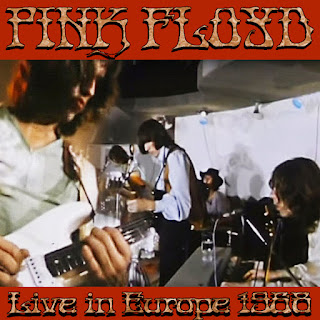
Pink Floyd - Live in Europe 1968

1968 was a transitional year for Pink Floyd. They'd had great success in 1967, but most of that was due to their lead singer and chief songwriter Syd Barrett, who flamed out and left the band near the end of the year. The other band members had to stand on their own, with guitarist David Gilmour taking Barrett's place.

In terms of live music, Pink Floyd put on almost 150 concerts in 1968, but there's not much in the way of quality live recordings, officially released or not. What I've done is gather together the few songs that were recorded with top notch sound quality and cobble together a live album for the year. By chance, all the songs here were recorded on the European continent, even though most of the shows the band did that year were in Britain or the US, so I've called this album "Live in Europe 1968."

The first three songs, which make up the bulk of the music, comes from the bootleg of a performance at an international rock festival in Rome, Italy, in May 1968. It seems some songs from different bands playing at this concert were broadcast in excellent sound quality on the radio at the time. There's a similarly excellent sounding recording of the Byrds from one day later that also was played on the radio. But unfortunately, only some of the songs were broadcast, and the others apparently have been lost. It's known the band played "Pow R. Toc H." and "Remember a Day" as well, probably more, but there are no known good recordings of them.

The sound quality for the unreleased "Keep Smiling People" is merely good, not great like the others here. But I figured it was worth including because it's an instrumental, so the relatively poor sound quality isn't as obvious without vocals. Also, although you can clearly hear it introduced as "Keep Smiling People," it would evolve into "Careful with that Axe, Eugene," so I figure this early, different version needs more attention. (Other early versions of the song gave it the name "Murderotic Woman.")

The songs are arranged in chronological order. The last two songs are the only ones officially released, but they only came out as DVD extras to "The Early Years 1965-1972" box set. There are a bunch of other "live" songs from 1968 on that box set, but it turns out they're generally lip-synced performances, and only included on the DVD for their visual value.

Now, I need to explain about the editing. The songs generally sound great here, with the exception of the vocals. For the songs with vocals, other than "Flaming," the instruments came through just fine, but the vocals were too low. So I used the sound editing programs Spleeter and X-Minus to boost the vocals where I could. That worked on parts of songs where there was enough vocals heard to get amplified. But for parts of "Astronomy Domine" and "Let There Be More Light," I could barely hear anything at all. So I used BBC versions of these songs, also from 1968, to help. I stripped the vocals from those versions and patched them into these versions where help was needed. It worked because the pitches were the same, and I tweaked the tempos to make them fit, sometimes having to make minor adjustments line by line.

However, I ran into unexpected problems with "Let There Be More Light." Typical versions, including the studio recording, have three verses, with different chorus lyrics following each one. But this version had four. I found out it wasn't simply a matter of repeating one. Instead, the lyrics were all jumbled up. The first verse and chorus was the same as the studio version, but beyond that, different verses were followed by different choruses without any apparent order. I'm guessing it probably was whatever they managed to remember right at that moment. So it took more work to figure out which lyrics went where, and then patching in the clearer version where it was needed. In the end, most of the vocals on this song are actually a mix of the boosted vocals from the same version as the instruments with more patched in vocals from the BBC version. I figured I could get away with that because there already were two vocalists singing at once, so things didn't have to match exactly.

It probably sounds weird with a written explanation, but try listening to it. I hope and assume it will sound perfectly fine, with much clearer vocals than the version you'll find on the box set DVD.

The irony is that there's a different version of "Let There Be More Light" with much better vocals on that DVD that I could have used instead, if I would have known in advance how much work this would take. That's from the same TV show performance as "Flaming" here. But that version is only four minutes long, and the version I chose is seven minutes long. I wanted the extra minutes of jamming. 

One more thing. The songs here generally lacked audience applause at the end. For instance, the three songs recorded in Rome had only maybe two seconds of clapping at the end before getting cut off. So, for songs like that, I pasted in the sound of cheering taken from other concerts to give the songs their natural live conclusions.

The bottom line is, there are lots of excellent live recordings of Pink Floyd from 1969 and later (the live half of the double album "Ummagumma" was recorded in May and June of 1969), but really no good live album from 1967 or 1968. This hopefully will set a new standard of sound quality for 1968. For 1967, I've taken the Stockholm concert included on "The Early Years" box set that has an excellent recording of the instrumentation but almost no vocals to be heard, and used the same technique I used here to add in the vocals from studio versions. I'll post that soon.

Also, I mentioned it in a different post, but I'll repeat it here: I just reuploaded all the Pink Floyd albums I've posted here so far. In a couple of cases I've changed the songs on it, most especially the "See Emily Play" stray tracks album. But I also fixed the volume balance between songs. It turns out those were wildly off, with some songs twice as loud as ones next to it. So if you're a big Pink Floyd fan, you might want to redownload those.

By the way, Pink Floyd played four songs for the French TV show "Bouton Rouge" in early 1968. I considered including them here, but since that was done in a studio with no audience present, I decided those weren't really live versions. They're more like the BBC versions, also done live but in a studio with no audience. So I added those to the album "BBC Sessions, Volume 2."

01 Astronomy Domine [Edit] (Pink Floyd)
02 Set the Controls for the Heart of the Sun [Edit] (Pink Floyd)
03 Interstellar Overdrive [Instrumental] [Edit] (Pink Floyd)
04 talk (Pink Floyd)
05 Keep Smiling People [Early Version of Careful with That Axe, Eugene] (Pink Floyd)
06 Flaming (Pink Floyd)
07 talk (Pink Floyd)
08 Let There Be More Light [Edit] (Pink Floyd)

https://www.upload.ee/files/16697001/PNKFLYD1968_LivinErope68_atse.zip.html

For the album cover, I used a screenshot taken of the TV performance of "Flaming," included here. It's not the greatest quality, but it is in color and it features all four members of the band. I had a really hard time finding any other concert photo from 1968 with all of them in it.

Pink Floyd - The Committee Soundtrack (1968)

Even if you're a die-hard Pink Floyd, chances are you've never heard of their songs from the 1968 movie "The Committee." Two of the songs made it onto "The Early Years 1965-1972" box set, but that's about it. There are several reasons for this. For one, apparently it's a pretty bad movie, with a length slightly under an hour, so few people have ever seen it. Secondly, all the Pink Floyd songs are mood setting incidental instrumentals, the kind one usually hears in movies, so it's far from their most interesting stuff. 

But worst of all is the fact that the only known versions of the songs come from the movie itself, complete with the actors talking all over the songs. Even the two songs included on the box set have some talking over them, though those were probably chosen because they don't have much compared to the others. 

Then, on top of all that, the Pink Floyd songs added together only make up about 15 minutes worth of music. Apparently, back in 1968, the band considered putting this music on record, but decided against it because they thought only 15 minutes would be a rip off for an album. (Plus, they probably realized it wasn't their best.)

So, long story short, this is for die-hard Pink Floyd fans only. But at least the worst problem of all the talking over the music can be eliminated, so one can actually properly enjoy the music for the first time. Early today, I posted a couple of Pink Floyd songs from 1967 where I was able to remove a BBC narrator talking over the music, due to two sound editing programs I use, Spleeter and X-Minus. I realized if I could do that for them, I could do the same thing here, so I did.

I'm glad to say the program worked quite well. Most of these songs had actors talking over them pretty much non-stop, from start to finish. I was able to remove all that, so you don't hear a word. There is some sound degradation here and there, but it's like night and day compared to trying to listen to the music with the talking on top. What's revealed is mainly a lot of noodling around on the organ by Rick Wright. David Gilmour had joined the band as lead guitarist shortly before this was recorded, but you don't hear any blistering solos from him. However, this does make for good mood setting background music.

Since The Committee songs only add up to 15 minutes, I'd added a version of "Interstellar Overdrive" to the end. This appeared in another 1968 movie, called "San Francisco." However, it actually was recorded in late 1966. As such, it's a pivotal recording by the band. It's probably the first thing they ever properly recorded with the name "Pink Floyd," the first showing they'd changed from a blues band to a psychedelic one. Since it's about 15 minutes long, it makes the whole album about 30 minutes long. That's still short, but at least it's plausible for an album. Because it's instrumental, I think it continues roughly the same mood set from the earlier songs.

By the way, I don't think any of "The Committee" songs have actual names. For the two songs on the box set, they were just called "Music from The Committee No. 1" and "Music from The Committee No.2." I've ignored those names, since they're confusing with the numbering of all the songs, in the order they appeared in the movie. (In this numbering system, "Music from The Committee No. 1" is "Part 2" and "Music from The Committee No.2" is "Part 8."

However, I wasn't happy with just "Part 1" and "Part 2" and so forth. I had a hard time keeping track. So I took it upon myself to give them all different subtitles, at least. For those, I generally used words from the first line or two of the actors' dialogue spoken over the music (now deleted, of course). Parts 1, 2 and 9 are exceptions. "Part 1" is simply "Part 9" played backwards. Both versions didn't have any talking over them. And "Part 2" also didn't have any talking over it, but it did have the sound of birds chirping near the front, as well as some laughing near the end (I removed the laughing). So I called it "Birds Chirping."

"Part 2" and "Part 8" are clearly the same music idea, what one probably would call the theme song for the movie. "Part 7" is said to be an early version of "Careful with that Axe, Eugene," though it doesn't sound that similar to me.

01 The Committee, Part 1 [Backwards] [Instrumental] [Edit] (Pink Floyd)
02 The Committee, Part 2 [Birds Chirping] [Instrumental] [Edit] (Pink Floyd)
03 The Committee, Part 3 [Sound like a Snob] [Instrumental] [Edit] (Pink Floyd)
04 The Committee, Part 4 [In the Womb] [Instrumental] [Edit] (Pink Floyd)
05 The Committee, Part 5 [Suffocating] [Instrumental] [Edit] (Pink Floyd)
06 The Committee, Part 6 [Access to Knowledge] [Instrumental] [Edit] (Pink Floyd)
07 The Committee, Part 7 [The Fakery] [Instrumental] [Edit] (Pink Floyd)
08 The Committee, Part 8 [Do You Play Bridge] [Instrumental] [Edit] (Pink Floyd)
09 The Committee, Part 9 [Not Backwards] [Instrumental] [Edit] (Pink Floyd)
10 Interstellar Overdrive [1966 Version] (Pink Floyd)

https://www.upload.ee/files/16696997/PNKFLYD_1968_TCmmitte_atse.zip.html

The cover is based on a poster for the movie. I cropped it from a rectangular shape and added "Pink Floyd" at the top. I believe this is from a later rerelease of the movie that makes it look much more interesting than it is. From what I understand, nearly all of the movie is just of people in a room talking about some pseudo-intellectual BS.

Pink Floyd - Tomorrow's World (Song Edit) (1967)

Early Pink Floyd has some recordings that are marred in significant ways. Some songs have vocals that can't be heard due to poor recording techniques. Others are marred by narration talking all over the music. Thanks to my recent discovery of the sound editing programs Spleeter and X-Minus, I'm working on fixing many of these problems.

The two songs here are a good example of what I mean. In 1967, some Pink Floyd instrumental music was used in the background of a BBC science documentary called "Tomorrow's World." One original instrumental doesn't have a known name, so I'm calling it "Tomorrow's World." The other is a cover of the classic soul instrumental "Green Onions." The problem with both of these is the BBC narrator talked all over the music. "Tomorrow's World" wasn't so bad, with the narrator just talking in a few places, but "Green Onions" was basically ruined, with talking over the vast majority of it.

To show you what I mean, I'm including a screenshot of "Green Onions" from the sound editing program Audacity. I took the screenshot after I split the vocals from the music using the X-Minus program. I don't think you need to know much about sound editing to understand the picture. The top half shows the two stereo channels of just the music. The lower half shows the two stereo channels of just the BBC narrator talking. As you can see, not only did the guy talk over all but a few short snippets of the song, but the music volume was turned way down so you could barely hear anything behind his voice!

Given all that, I think it's pretty remarkable what I was able to do, thanks to the X-Minus program in this case. It does a great job of separating the vocals from the music. (Better than Spleeter, in fact, at that task, though Spleeter does other things better too.) So once I had the vocals removed, then I had to carefully boost the volume of the quiet parts to match the loud parts. This took dozens of minor volume changes, for both songs, until I had the volume level more or less the same across the two songs.

The end result sounds much better on "Tomorrow's World," I think. For one thing, the amount of narration wasn't as bad on that song. But also, it's a really nice original instrumental. Whereas with "Green Onions," you can hear more of the sound degradation due the narration. But also, it's not that captivating of a cover version. For instance, you don't really get soloing. However, we don't have many recordings of Pink Floyd with Syd Barrett on lead guitar, so both songs are worth hearing for that alone.

If you want to hear these edits, I've updated the Pink Floyd "BBC Sessions, Volume 2" album and put these versions of that (since the documentary was for the BBC).

The link to that album is here:

https://albumsthatshouldexist.blogspot.com/2019/05/pink-floyd-bbc-sessions-1968.html

Monday, August 24, 2020

Roger Waters with Eric Clapton - Rosemont Horizon, Chicago, IL, 7-26-1984

Wouldn't it have been interesting if Eric Clapton took over from David Gilmour when Pink Floyd broke up, and soloed all over classic Pink Floyd songs? It turns out that's pretty much exactly what happened in 1984!

Pink Floyd had effectively broken up after the release of "The Final Cut" album in 1983, although the break wouldn't be official until 1985. Pink Floyd's main singer and songwriter Roger Waters released his solo album "The Pros and Cons of Hitch Hiking" in 1984 and went on tour to promote it. Surprisingly, Eric Clapton was hired to play lead guitar for the first leg of the tour, even though Clapton was more of a household name than Waters, and he was busy with his own successful solo career. I believe it's the first and only time in Clapton's long solo career that he played a whole tour as a supporting musician for someone else.

I'm posting this because I'm working on my own super-sized version of Pink Floyd's "The Wall" album, which should be coming soon. While working on that, I gave this bootleg concert another listen, and I was struck at how excellent the sound is. This is a pristine soundboard that sounds as good as any officially released album at the time.

Furthermore, the performance is excellent. The first half of the concert, which i two hour and four minutes long, consists entirely of Pink Floyd classics, played in rough chronological order. The second half features the entire "Pros and Cons" album played in the same order as the album. Personally, I think that album is merely good, not great. But I think it comes alive more in concert than on the studio album. But mostly, it's a blast hearing Clapton solo all over those songs, and especially the Pink Floyd classics in the first half of the show (as well as the encore).

For most of his long musical career, Waters has been big on putting on an audio-video spectacle for his concerts. For this tour, there was constant video footage playing behind the musicians, and various other special effects happening, so the music had to be choreographed carefully. As a result, there was very little musical variety from night to night. Clapton got bored of that, and left after only one leg of the tour. But luckily we have this one soundboard from that leg to give us a hint of what a Pink Floyd with Clapton in it would have sounded like.

01 Set the Controls for the Heart of the Sun (Roger Waters with Eric Clapton)
02 Money (Roger Waters with Eric Clapton)
03 If (Roger Waters with Eric Clapton)
04 Welcome to the Machine (Roger Waters with Eric Clapton)
05 Have a Cigar (Roger Waters with Eric Clapton)
06 Wish You Were Here (Roger Waters with Eric Clapton)
07 Pigs on the Wing, Part 1 (Roger Waters with Eric Clapton)
08 In the Flesh (Roger Waters with Eric Clapton)
09 Nobody Home (Roger Waters with Eric Clapton)
10 Hey You (Roger Waters with Eric Clapton)
11 The Gunner's Dream (Roger Waters with Eric Clapton)
12 talk (Roger Waters with Eric Clapton)
13 4-30 A.M. [Apparently They Were Travelling Abroad] (Roger Waters with Eric Clapton)
14 4-33 A.M. [Running Shoes] (Roger Waters with Eric Clapton)
15 4-37 A.M. [Arabs with Knives and West German Skies] (Roger Waters with Eric Clapton)
16 4-39 A.M. [For the First Time Today, Part 2] (Roger Waters with Eric Clapton)
17 4-41 A.M. [Sexual Revolution] (Roger Waters with Eric Clapton)
18 4-47 A.M. [The Remains of Our Love] (Roger Waters with Eric Clapton)
19 4-50 A.M. [Go Fishing] (Roger Waters with Eric Clapton)
20 4-56 A.M. [For the First Time Today, Part 1] (Roger Waters with Eric Clapton)
21 4-58 A.M. [Dunroamin, Duncarin, Dunlivin] (Roger Waters with Eric Clapton)
22 5-01 A.M. [The Pros and Cons of Hitchhiking] (Roger Waters with Eric Clapton)
23 5-06 A.M. [Every Stranger's Eyes] (Roger Waters with Eric Clapton)
24 5-11 A.M. [The Moment of Clarity] (Roger Waters with Eric Clapton)
25 talk (Roger Waters with Eric Clapton)
26 Brain Damage (Roger Waters with Eric Clapton)
27 Eclipse (Roger Waters with Eric Clapton)

https://pixeldrain.com/u/pftEbz1V

alternate:

https://bestfile.io/en/KDEZPbIElLy5B3P/file

alternate:

https://www.imagenetz.de/fcjLF

The cover art photo shows Waters and Clapton on stage during Waters' 1984 tour. (Waters is much closer to the camera, playing bass.) I don't know which concert it's from exactly.

Monday, August 17, 2020

Pink Floyd - Oakland Coliseum, Oakland, CA, 5-9-1977

Slowly but surely, I've been posting what I consider to be the best and most important Pink Floyd live performances. Most of those were performed at or for the BBC, but this one is not. I consider it just as much of a "must have" as the BBC ones.

In 1977, Pink Floyd toured to promote the album they put out that year, "Animals." It wasn't as popular as some of their other albums, since it didn't have any obvious hit singles (or even songs short enough to be easily played on the radio), but I consider it one of their very best. So it's key to have a good concert from 1977, both for the "Animals" songs, since they played that entire album, but also for the "Wish You Were Here" songs, since they played that entire 1975 album too. And they played three more songs at the end on top of that. (Note that the 1974 BBC concert I posted has most of the "Animals" songs, but they were early versions with different titles and different lyrics.)

There aren't many songs in this concert, but most of the songs are long, with lots of great soloing. The album is two hours and 20 minutes (or 147 minutes) long. I added up the lengths of all the studio versions of the songs, and that totaled 107 minutes. So you basically get 40 extra minutes of solos. There's virtually no between song banter, except for the occasional sentence here and there.

The one snag with 1977 Pink Floyd concert bootlegs is that there are no decent soundboards that have leaked to the public. But the Oakland show here is widely considered the best of the audience bootlegs. In my opinion the sound is excellent, just as good as many soundboards I've heard from other bands. If anyone knows of a better sounding 1977 Pink Floyd show, please let me know.

My interest in live Pink Floyd pretty much comes to an end after this. They only did a small number of concerts to promote their 1979 album "The Wall," and the best of those have been released as an official life album. After that, the band didn't play live again until after band leader Roger Waters left, and my interest in the David Gilmour-led version of the band is much lower. But I'll still post more of the "classic" (1960s to early 1980s) version of the band by and by.

01 Sheep (Pink Floyd)
02 Pigs on the Wing, Part 1 (Pink Floyd)
03 Dogs (Pink Floyd)
04 Pigs on the Wing, Part 2 (Pink Floyd)
05 Pigs [Three Different Ones] (Pink Floyd)
06 Shine On You Crazy Diamond, Parts 1-5 (Pink Floyd)
07 Welcome to the Machine (Pink Floyd)
08 Have a Cigar (Pink Floyd)
09 Wish You Were Here (Pink Floyd)
10 Shine On You Crazy Diamond, Parts 6-9 (Pink Floyd)
11 Money (Pink Floyd)
12 Us and Them (Pink Floyd)
13 Careful with that Axe, Eugene (Pink Floyd)

https://pixeldrain.com/u/dYdunqJu

alternate:

https://bestfile.io/en/HbCjWNtrfPInvos/file

alternate:

https://www.imagenetz.de/fNXgr

The album cover art is made out of two main pieces. The photograph is of the band actually playing at Oakland in the very concert posted here, I'm happy to say. Unfortunately, David Gilmour was way off to the side, and I had to crop him out of the photo. I've added the band name in huge lettering. This comes from a photo I found of an official concert T-shirt from the 1977 tour. I liked the flying pig inside the band's name, so I added that to the cover.

Thursday, April 16, 2020

Pink Floyd - BBC Sessions, Volume 6: Wembley Empire Pool, London, Britain, 11-16-1974

Here's one of the all-time great Pink Floyd concerts. If you don't have this, you really need to get it. Technically, it's a BBC performance, but it's really just a full concert from 1974, over two hours in length, that happened to get recorded by the BBC, so it has outstanding sound quality.

All of the material here has been officially released. There's even a Wikipedia page for it:

https://en.wikipedia.org/wiki/Live_at_the_Empire_Pool

But that Wikipedia page is strange, because no such album with that title actually exists. Instead, parts of it have been released on three different albums. One has to put them together to get the full concert, which is exactly what I did here.

For once, there are no sound quality issues at all. (And by the way, there appears to have been no talking between songs whatsoever.) So instead I'll comment on the material. I think the most interesting part are the first three songs. The first one, "Shine On You Crazy Diamond," would become a big part of Pink Floyd's next album, "Wish You Were Here," released a year later. The next two songs, "Raving and Drooling" and "You've Got to Be Crazy," were also supposed to go on that album. The three songs were all so long that when combined they made 51 minutes of music, more than enough for an album. But instead, the band shelved "Raving and Drooling" and "You've Got to Be Crazy," worked on them some more, including changing lots of the lyrics, and released them as "Sheep" and "Dogs" respectively for their 1977 album "Animals."

After those three songs, the entire "Dark Side of the Moon" was played in order. A 25-minute long encore of "Echoes" finished the concert.

Later, I'm planning on posting a 1977 concert, so one can hear live versions of the "Wish You Were Here" and "Animals" albums.

01 Shine On You Crazy Diamond, Parts 1-9 (Pink Floyd)
02 Raving and Drooling [Early Version of Sheep] (Pink Floyd)
03 You've Got to Be Crazy [Early Version of Dogs] (Pink Floyd)
04 Speak to Me [Instrumental] (Pink Floyd)
05 Breathe (Pink Floyd)
06 On the Run [Instrumental] (Pink Floyd)
07 Time (Pink Floyd)
08 The Great Gig in the Sky (Pink Floyd)
09 Money (Pink Floyd)
10 Us and Them (Pink Floyd)
11 Any Colour You Like [Instrumental] (Pink Floyd)
12 Brain Damage (Pink Floyd)
13 Eclipse (Pink Floyd)
14 Echoes (Pink Floyd)

https://pixeldrain.com/u/eJqEJYXr

alternate:

https://bestfile.io/en/FSnxQ8lJPtAf9Rs/file

alternate:

https://www.imagenetz.de/bq9g8

I could be wrong, but I think the cover art photo comes from the exact concert in question. At the very least, it comes from the same 1974 tour.

Thursday, April 9, 2020

Pink Floyd - BBC Sessions, Volume 5: Sounds of the 70s, Paris Theatre, London, Britain, 9-30-1971

I recently posted an album of Pink Floyd performing for the BBC in 1970. This is basically the exact same deal, except 1971 instead of 1970. The format was the same: an hour-long concert in front of an audience, played live on the radio. Even the host was the same, famous BBC DJ John Peel. Like the other show, he did all the talking between songs. So if you liked that one, you're sure to like this one.

A couple of the songs played in that 1970 concert are played again here: "Fat Old Sun" and "Embryo." But there are only five songs played in all, because the emphasis is on instrumental jamming. This concert took place one month before their album "Meddle" was released. Two songs from that album are played, "One of These Days" and "Echoes." "Echoes" is the clear focus and highlight, lasting for nearly half an hour. "Blues" is an unnamed instrumental played as an encore that was never released on any Pink Floyd album.

As far as song quality goes, this comes from "The Early Years" box set, so the sound quality is as good as you could hope for. The main thing I did was break up the talking between songs into their own tracks, and boosting the volume on those.

01 talk (Pink Floyd)
02 Fat Old Sun (Pink Floyd)
03 talk (Pink Floyd)
04 One of These Days (Pink Floyd)
05 talk (Pink Floyd)
06 Embryo (Pink Floyd)
07 talk (Pink Floyd)
08 Echoes (Pink Floyd)
09 Blues [Instrumental] (Pink Floyd)

https://www.upload.ee/files/16697018/PNKFLYD1971a_BBSssonsVolum5Sunds70sParsThetre__9-30-1971_atse.zip.html

For the cover art photo, I went with a photo of the band in the studio in late 1971.

Sunday, April 5, 2020

Pink Floyd - BBC Sessions, Volume 4: In Concert, Paris Theatre, London, Britain, 7-16-1970

Around 1970, the BBC began playing hour-long concerts in front of live audiences. Pink Floyd was one of the bands that benefited from being able to stretch out in that new format. They wound up playing concerts from the BBC in 1970 and 1971, as well as a longer one in 1974. This is the first of those.

Note that I've already posted three albums of Pink Floyd playing at the BBC (done in the BBC studios with no audience present). Since I'm continuing with three more BBC albums from them, I've decided to rename those earlier albums slightly, so they all have "Volume" in the title. For instance, the first one was known as "BBC Sessions, 1967," but now I'm calling it "BBC Sessions, Volume 1." I've just renamed those and updated the cover artwork accordingly. This one, then, is Volume 4.

Although this is live, it was professionally recorded, and it widely considered one of the few really great concert recordings of the band. It was included on the official box set "The Early Years." I'm including it here to continue the BBC series, plus it really should be heard on its own.

I've broken the talking between songs onto their own tracks, but other than that, I didn't need to change anything. Note that the concert was hosted by legendary BBC DJ John Peel. He's the one that does all the talking between songs.

The concert took place while the band was in the middle of recording the album "Atom Heart Mother." So it's not surprising that it features three songs from that album, "If," "Fat Old Sun," and "Atom Heart Mother." We're especially fortunate that "If" was included, because the band only played that excellent song a handful of times. The song "Atom Heart Mother" had been played a few times already, using the clunky title "The Amazing Pudding." They wanted something better, and realized that had to come up with something fast so that Peel would have a new title to give it for this BBC show. Luckily, they came up with the new title shortly before the concert when band member saw the headline "Atom Heart Mother Named" in a newspaper article about a nuclear-powered pacemaker.

Also note that the song "Atom Heart Mother" really needed a full choir, plus a full orchestra, to play right. For this concert, they hired a professional choir and professional orchestra to back them. Later, when they played the song on tour, they had to make do with a revolving group of back-up musicians who often didn't perform nearly as well. As a result, they shortened the song in concert and cut out the parts that needed the choir and orchestra. So this is probably the definitive live version, especially due to the sound quality.

01 talk (Pink Floyd)
02 Embryo (Pink Floyd)
03 talk (Pink Floyd)
04 Fat Old Sun (Pink Floyd)
05 talk (Pink Floyd)
06 Green Is the Colour (Pink Floyd)
07 Careful with that Axe, Eugene (Pink Floyd)
08 talk (Pink Floyd)
09 If (Pink Floyd)
10 talk (Pink Floyd)
11 Atom Heart Mother (Pink Floyd)

https://www.upload.ee/files/16697017/PNKFLYD1970c_BBSssonsVlum4InConcrtParsThetre__7-16-1970_atse.zip.html

The cover art photo comes from a Pink Floyd concert later in 1970, at the Fillmore East in New York City.

Friday, January 24, 2020

Pink Floyd - Fillmore West, San Francisco, CA, 4-29-1970

For a band like Pink Floyd that's known for the pristine sound on their albums, you'd think there would be lots of pristine recordings of their concerts. But that's surprisingly not the case. There are very few multitrack concert recordings from them (which usually sound the best), and not many more soundboard recordings, at least in terms of what has been made publicly available, officially or through bootlegs.

So this concert of Pink Floyd playing the Fillmore West in San Francisco in April 1970 needs to be treasured, due to be an excellent performance and excellent sound quality. Furthermore, none of it was used for the box set "The Early Years." That's probably because just one day earlier, the band played about an hour of music at the Fillmore when it was empty for a local PBS station, PBS. The video footage of that is included in the box set, and they probably didn't include this because the set list is very similar. But the KQED performance was slightly less than one hour, whereas this is over two hours.

By the way, I'm pretty sure the reason this sounds so good is because KQED recorded it as well. I just did a little Googling, and found that KQED brought a mobile recording unit to the Fillmore to record their show without an audience, for maximum sound clarity. They probably just kept the unit there and recorded the show with the audience too. This guess is strengthened by the fact that the KQED producers even went to a Pink Floyd concert the next week in Los Angeles and recorded that in hopes of getting more footage to use.

So there are definitely no complaints from me about the sound, except for one thing: the audience noise at the end of most songs. For whatever reason, it turned out that a lot of those were messed up. Some were simply cut off in the middle of the audience reaction. Others were extremely quiet. So I did some editing to make sure there's a proper audience response after each song (except when the band went straight into the next song). In some cases, I patched in clapping from the end of a different song, such as when the audience noise got abruptly cut off.

I made another major kind of edit as well, and that was to get rid of some of the "dead air" between songs. It turns out there was a lot of noodling and/or tuning between some songs. I probably cut about five minutes of that. But, as always, I was careful not to cut any of the actual speaking between songs. (By the way, I believe all the talking is done by Roger Waters.) I also sometimes adjusted the volume of the talking, as the speaker might be too close or too far from the microphone.

Anyway, the songs are great, and while there was some issues between the songs, I believe I've fixed all that, so it should sound great all the way through. If you want just one pre-"Dark Side of the Moon" concert from them, you should make it this one.

01 Granchester Meadows (Pink Floyd)
02 Astronomy Domine (Pink Floyd)
03 talk (Pink Floyd)
04 Cymbaline (Pink Floyd)
05 talk (Pink Floyd)
06 Atom Heart Mother (Pink Floyd)
07 Embryo (Pink Floyd)
08 talk (Pink Floyd)
09 Green Is the Colour (Pink Floyd)
10 Careful with that Axe, Eugene (Pink Floyd)
11 Set the Controls for the Heart of the Sun (Pink Floyd)
12 talk (Pink Floyd)
13 A Saucerful of Secrets [Instrumental] (Pink Floyd)
14 talk (Pink Floyd)
15 Interstellar Overdrive [Instrumental] (Pink Floyd)

https://pixeldrain.com/u/q6tYNgE9

alternate:

https://bestfile.io/en/aWUrI46QNRdq7MI/file

alternate:

https://www.imagenetz.de/jHq3r

For the album cover art, I found a concert poster of the band playing at the Fillmore in late 1967. (Apparently, the concert got cancelled.) I liked the art, so I decided to use it. But I had to make a lot of changes and additions to the text, including changing "Fillmore" to "Fillmore West."

Friday, September 27, 2019

Robyn Hitchcock - Acoustic Syd Barrett Songs (2000-2017)

Note that this entirely contains versions of songs that I'm including on other albums that I'm posting here. I've been posting lots of albums of Robyn Hitchcock's acoustic cover versions. I have many most albums in that series to post. But I just thought it would be fun and interesting to compile all the covers of Syd Barrett songs from those albums into one album. That's what I've done here.

Hitchcock has always been a huge fan of Syd Barrett's work. I think it's safe to say that the three biggest musical influences on him have been the Beatles, Bob Dylan, and Syd Barrett (both for his work as part of Pink Floyd and as a solo artist). There are zillions of other artists who have been influenced by the Beatles and Dylan, and countless thousands of cover versions of their songs. But that's not the case with Barrett. While Barrett's musical legacy has been very influential, it's also been considered too idiosyncratic for many to cover his songs.

But clearly that's not the case with Hitchcock, thus this album. It starts in 2000 and continues to 2017, with the songs arranged in chronological order. But the only reason I didn't include songs from earlier in Hitchcock's career is that I went for the versions with the best sound quality, and they often are the more recent ones. Hitchcock has been heavily influenced by Barrett since the very start of his career, for instance covering Barrett's "Vegetable Man" on a record back in 1980 when he led the band the Soft Boys. (I didn't include that here because that was done with a full band and this is only acoustic versions.)

Barrett is best known for his Pink Floyd song, despite the fact that he wasn't in that band for very long. But not in Hitchcock's world. Only four of the songs here are Pink Floyd songs ("Astronomy Domine," "Bike," "Chapter 24," and "Arnold Layne.") The rest are from Barrett's solo career. I suspect the reason there aren't more Pink Floyd songs is because most of those really need a full band to do them justice, and again, this just includes acoustic versions.

Hitchcock has done covers of other songs with a full band, such as "See Emily Play," and even had a concert in which he played all the songs from "Piper at the Gates of Dawn," the only Pink Floyd album where Barrett was a full participant. But that's the subject for music to be posted here at another time.

As for this album, I think this is a great foot in the door for people who haven't gotten into Barrett's solo work much yet.

All the songs here are officially unreleased. However, two songs can be seen on a DVD video called "The Pink Floyd and Syd Barrett Story." Generally speaking, the sound quality for these songs is very good, though there are a few exceptions. "Astronomy Domine" has some crowd noise in the middle of the song at a few points. A couple of the other songs sound a bit muffled or distant. But I think the sound is perfectly acceptable even on those. Note that I've removed audience noise whenever possible, as I sometimes do.

The album is 45 minutes long, which is pretty much the ideal length for vinyl albums.

01 Astronomy Domine (Robyn Hitchcock)
02 Dominoes (Robyn Hitchcock)
03 It Is Obvious (Robyn Hitchcock)
04 Baby Lemonade (Robyn Hitchcock)
05 Chapter 24 (Robyn Hitchcock)
06 Gigolo Aunt (Robyn Hitchcock)
07 Bike (Robyn Hitchcock)
08 Terrapin (Robyn Hitchcock)
09 Waving My Arms in the Air (Robyn Hitchcock)
10 I Never Lied to You (Robyn Hitchcock)
11 Long Gone (Robyn Hitchcock)
12 Arnold Layne (Robyn Hitchcock)
13 Dark Globe (Robyn Hitchcock)
14 Wined and Dined (Robyn Hitchcock)
15 Wolfpack (Robyn Hitchcock)

https://www.upload.ee/files/16697076/ROBYNHTCHCK2000-2017_AcusticSydBSngs_atse.zip.html

For the album cover, I tried to do something different and creative. I found a photo of Syd Barrett (from 1967) looking straight ahead, and another one of Hitchcock doing the same (from 1986). Then I manipulated the photos so Barrett makes up half of a head and Hitchcock makes up the other half. I also colorized them, with Barrett being green and Hitchcock blue. I'm pleased at how nicely the two faces fit together.

Wednesday, August 28, 2019

Pink Floyd - Zabrinskie Point - Alternate Version (1970)

In 1968 and 1969, director Michelangelo Antonioni made a Hollywood movie about the counterculture called "Zabrinskie Point." Since it was about the counterculture, he wanted music to match for the soundtrack. He used some existing songs by various bands, and got Pink Floyd, the Grateful Dead, and Kaleidoscope to compose new music for the film.

When the movie came out in early 1970, Pink Floyd only ended up with three songs on the soundtrack. But in fact they recorded a lot more, enough to have an entire album just from them. This is my attempt to create a "Zabrinskie Point" soundtrack featuring only Pink Floyd music.

I could have made this a very long album that gathers up absolutely everything Pink Floyd did that was considered for the soundtrack. But frankly, a lot of it isn't that good. Pink Floyd's "The Early Years" box set has no less than 16 outtakes from the soundtrack. I didn't include any of them, because they're all incidental film music, meant to help set a mood but not far removed from forgettable muzak. Many of them are alternate versions of songs I have included.

What I did instead was pick the strongest songs I could find, so this album would stack up with the other Pink Floyd albums from that era. I included the three songs that made it on the actual soundtrack album, plus two more songs that were bonus tracks released in the 1990s, and one of the songs from "The Early Years" box set. On top of that, I've included two more songs that were on "The Early Years," but slightly different unreleased alternate versions.

One more song, "The Violent Sequence," needs a little explanation. It almost made it to the official soundtrack, but the director decided it sounded too sad. If you listen to it, you'll immediately recognize it as an instrumental version of what would become "Us and Them" on the classic 1973 album "Dark Side of the Moon."

All the songs mentioned above make for a 39-minute long album, which is a decent length. But I've added three more songs that weren't connected to "Zabrinskie Point" at all, because I don't have a better place to put them. These come from another 1970 soundtrack, this one for a documentary about the human body called "The Body." The soundtrack is called "Music from the Body," and it's credited to Roger Waters, the main singer and songwriter for Pink Floyd at the time, and avant garde artist Ron Geesin. Most of the songs are experimental, strange sounding instrumentals that aren't to my taste. But it also includes three folky songs written and sung by Waters, and I've added them here. They sound exactly like lost Pink Floyd songs, and that's basically what they are. In fact, one of them, "Give Birth to a Smile," is performed by all four members of Pink Floyd, so I've credited it to the full band.

01 Heart Beat, Pig Meat [Instrumental] (Pink Floyd)
02 Country Song [The Red Queen] (Pink Floyd)
03 Aeroplane [Fingal's Cave] [Instrumental] (Pink Floyd)
04 Crumbling Land (Pink Floyd)
05 Alan's Blues [Instrumental] (Pink Floyd)
06 Oenone [Early Version] [Instrumental] (Pink Floyd)
07 Rain in the Country [Unknown Song] [Instrumental] (Pink Floyd)
08 Come in Number 51, Your Time is Up [Careful with that Axe, Eugene] [Instrumental] (Pink Floyd)
09 The Violent Sequence [Early Version of Us and Them] [Richard Wright Demo] (Pink Floyd)
10 Chain of Life (Roger Waters & Ron Geesin)
11 Sea, Shell and Stone - Breathe (Roger Waters & Ron Geesin)
12 Give Birth to a Smile (Pink Floyd)

https://www.upload.ee/files/16701316/PNKFLYD1970a_ZabrskiPontAlternte_atse.zip.html

The official "Zabrinskie Point" soundtrack seems to have had several different album covers, that I think were for different editions of the album. I picked a version that had the least text, with just the words "Zabrinskie Point" in big letters. Then I added "Pink Floyd" above it.

Sunday, May 12, 2019

Pink Floyd - BBC Sessions, Volume 3: 1969

I've got a lot of Pink Floyd material to post, because I think they're fantastic and a lot of their stuff didn't make it onto their studio albums at the time.

This is the fifth Pink Floyd album I've posted so far. Two are stray tracks collections covering 1967 to 1969. Two others, plus this one, contain BBC performances, also from 1967 to 1969. The way I look at it, these five albums all go together, gathering up all the little bits and pieces of their musical output during that time. After 1969, Pink Floyd no longer played only a few short songs each time they showed up at the BBC. They did return to the BBC a couple more times, but each time, they performed entire concerts. Similarly, they began thinking in terms of cohesive albums and not individual songs. So 1969 was the last time they released a single that wasn't taken from an album.

Thus, this album is kind of an end of an era. The first four songs come from the last "normal" BBC studio performance Pink Floyd did, in May 1969.

The next song, "Merry Christmas Song," was written by Pink Floyd and apparently recorded by the BBC in 1969. However, it didn't actually get played by the BBC until 1975. It's a jokey Christmas number, and it's sung by the drummer Nick Mason.

The song after that is an instrumental called "Moonhead." It came about because the BBC thought it would be clever to have Pink Floyd play their "spacey" music during the broadcast of the first person landing on the moon in July 1969. The song is about seven minutes long. I edited out about 30 seconds of it, because about a minute into the song, a BBC announcer spoke over the music. I wouldn't have minded since he was talking about the moon landing, except what he said was inane or dumb, ending with the comment that when people finally land on the moon, they'll be able to find out if it in fact is made out of green cheese. I hope that was supposed to be a joke! Luckily, the half minute of talking takes place during a lull in the music, so I think I was able to remove it without it being noticeable or affecting the flow of the song.

I must confess that the final song here isn't associated with the BBC at all. I'm just sticking it here because I don't have a better spot in my musical collection to put it. Pink Floyd performs their instrumental "Interstellar Overdrive" later in 1969. What makes this special and unique is that Frank Zappa joins in and does a lot of soloing. In case you want to see it and not just hear it, there's a high quality video of it on YouTube.

As an aside, I find it amusing that when both Zappa and the members of Pink Floyd were asked about this musical collaboration decades later, they all had no recollection of it happening, though they did remember meeting each other. However, the video and audio definitely proves it happened.

01 Grantchester Meadows (Pink Floyd)
02 Cymbaline (Pink Floyd)
03 The Narrow Way, Part 3 (Pink Floyd)
04 Green Is the Colour (Pink Floyd)
05 Careful with that Axe, Eugene (Pink Floyd)
06 Merry Xmas Song (Pink Floyd)
07 Moonhead [Instrumental] [Edit] (Pink Floyd)
08 Interstellar Overdrive [Instrumental] (Pink Floyd with Frank Zappa)

https://www.upload.ee/files/16697016/PNKFLYD1969_BBSssonsVolum3_atse.zip.html

I purposefully made the cover art to match the two earlier Pink Floyd BBC albums I made. For the band photo in the middle, I chose a publicity photo from 1969. It uses a fish-eye lens.. That was the hip thing to do in those days, but I like the effect in this case.

Friday, May 3, 2019

Pink Floyd - BBC Sessions, Volume 2: 1968

I've already posted Pink Floyd stray tracks for 1967 and 1968. Then I posted an album of BBC performances from 1967. That's because BBC performances are so key for Pink Floyd in the late 1960s and early 1970s, due both to sound quality issues and the fact the band would play songs for the BBC they would rarely or never play in normal concerts. So I'm continuing that trend by posting an album of BBC performances from 1968.

As it so happens, all of the BBC performances from 1967 made up one normal length album, and it's the same for 1968. I love how nicely that works out.

Note that starting around this time, it can get confusing figuring out what Pink Floyd songs are what, due to the band using more than one name for a song. It some cases, they had an early name and then changed it to something else entirely by the time they officially recorded it. Whereas in other cases, they already had a recorded version, but then gave it a new name in order for it to fit into a new project, such as a concept album. Three of the songs here fit into either of those cases, so I've added the other names the songs are known as in parentheses in each title.

The first four songs aren't from the BBC, but are from a French TV show called "Bouton Rouge." It's basically the same though, because they were done live in studio, without an audience. You can find the video of the performances on YouTube. One of the songs, "Let There Be More Light," was also done later in the year for the BBC. Normally I don't like including two versions of the same song on one album, but for the sake of completeness I've included both versions.

This album is 53 minutes long.

01 Astronomy Domine (Pink Floyd)
02 Flaming (Pink Floyd)
03 Set the Controls for the Heart of the Sun (Pink Floyd)
04 Let There Be More Light [Edit] (Pink Floyd)
05 Instrumental Improvisation (Pink Floyd)
06 Murderotic Woman [Careful with that Axe Eugene] [Instrumental] (Pink Floyd)
07 The Massed Gadgets of Hercules [A Saucerful of Secrets] [Instrumental] (Pink Floyd)
08 Julia Dream (Pink Floyd)
09 Let There Be More Light (Pink Floyd)
10 Point Me at the Sky (Pink Floyd)
11 Embryo (Pink Floyd)
12 Baby Blue Shuffle in D Minor [The Narrow Way, Part 1] [Instrumental] (Pink Floyd)
13 Interstellar Overdrive [Instrumental] (Pink Floyd)

https://www.upload.ee/files/16697013/PNKFLYD1968_BBSssonsVolum2_atse.zip.html

For the cover art, I found a publicity photo of the band in 1968. I'll bet Roger Waters would be chagrined to see himself in that fur coat. ;)

Monday, April 22, 2019

Pink Floyd - BBC Sessions, Volume 1: 1967

I've posted two Pink Floyd albums already, but that's just the tip of the iceberg of all the stuff of theirs I plan on posting. However, before I post more of their stray tracks stuff, I want to post some of their BBC performances. For late 1960s and early 1970s Pink Floyd, their BBC recordings are essential, both in terms of the breath and quality of the songs performed, but also the excellent sound quality.

So here's Pink Floyd at the BBC in 1967, at a time when Syd Barrett was still a member of the group. Nearly all of these come from "The Early Years" box set. But there are a couple of things I did that are different from just making an album of all their 1967 BBC appearances.

For one thing, sadly, there are no BBC versions of their great hit "See Emily Play." In fact, no good live performances of this song by the band have been recorded at all. (They did play the song a time or two on TV, but they just mimed to the record.) However, there's one partial exception: the song was recorded well for a 1967 concert in Stockholm, Sweden, and that performance was included on "The Early Years." But unfortunately, the vocals were recorded so low that it's as if they don't exist. So consider this an instrumental version.

The original song "One in a Million" wasn't included on "The Early Years." Maybe it's a sound quality issue. The vocals are muffled and distant, making it nearly impossible to understand the words being sung. But the instrumental part sounds as good as lots of other things that made "The Early Years," and any Pink Floyd originals from 1967 should be treasured. The song is mostly an instrumental anyway, and one can treat the vocals as just another instrument.

The original instrumental "Tomorrow's World" is also on "The Early Years," but there's a big problem with it. It comes from a BBC science documentary "Tomorrow's World," and parts of the song have an announcer loudly talking over the music. So I made an edit just of the two sections without the talking and spliced them together. That makes it just over a minute long, but I considered it interesting enough for inclusion anyway.

The band did two songs for a BBC science documentary that were marred by a narrator talking over large portions of the songs. Thanks to the sound editing program X-Minus, I figured out a way to split the audio from the music. The song "Tomorrow's World" is a really nice instrumental in a longer version than before, since I could include a bit more where there had been the narration. "Green Onion" is a cover of the classic instrumental. I hadn't included it previously due to narration over the entire thing. It's not the greatest, but it does show Syd Barrett's guitar playing.

I also added "Reaction in G." I'd skipped it before because it's only 40 seconds long. (Clearly there should have been more, but the BBC only played that much, and the rest apparently has been lost.) Furthermore, the BBC DJs talked over most of that, so there wasn't much left. But now one can at least hear all of it clearly.

The total length of this album is 40 minutes, which is an ideal length for an album of the era.

01 Astronomy Domine (Pink Floyd)
02 One in a Million (Pink Floyd)
03 Matlida Mother (Pink Floyd)
04 The Gnome [Edit] (Pink Floyd)
05 The Scarecrow [Edit] (Pink Floyd)
06 Set the Controls for the Heart of the Sun [Edit] (Pink Floyd)
07 Reaction in G [Instrumental] [Edit] (Pink Floyd)
08 Flaming [Edit] (Pink Floyd)
09 Tomorrow's World [Instrumental] [Edit] (Pink Floyd)
10 Green Onions [Instrumental] [Edit] (Pink Floyd)
11 Scream Thy Last Scream (Pink Floyd)
12 Vegetable Man (Pink Floyd)
13 Pow R. Toc H. (Pink Floyd)
14 Jugband Blues (Pink Floyd)

https://www.upload.ee/files/16696993/PNKFLYD1967_BBSssonsVolum1_atse.zip.html

I normally detest using black and white photos for cover art if anything in color can be used instead. But in this case, I found an actual photo of Pink Floyd at the BBC in 1967. Specifically,  they're at BBC's Maida Vale Studios on October 9, 1967. I cropped the photo somewhat to focus in on the band members. From the larger photo, I gather they're listening to a playback of their BBC performance. Of course, I had to colorize the photo, because everything in psychedelic 1967 was in vivid color. ;)