Showing posts with label Phil Lesh. Show all posts

Sunday, February 15, 2026

Northern California Folk-Rock Festival, Santa Clara County Fairgrounds, San Jose, CA, 5-18-1968, Part 3 - The Grateful Dead

This is the third album out of seven albums I'm posting from the 1968 Northern California Folk-Rock Festival. This set features the Grateful Dead.

I said quite a lot in my write-up for the first album I posted from this festival, the Youngbloods set. I recommend you read that, because most of that applies to this set too. Most importantly, note that this is sourced from an audience bootleg, so the sound quality isn't up to my usual standards. I had to do a lot of work to fix all sorts of flaws. The final results sounds pretty decent for a 1968 concert, in my opinion, but you need to be tolerant about the flaws that still remain.

At the time of this concert, the Grateful Dead were still in a formative stage. They had only released one studio album so far, the cleverly titled "The Grateful Dead," in 1967. Most of the songs performed in this short set were from the second side of the band's second album, "Anthem of the Sun." But that album wouldn't be released until a couple of months after this concert.

The Dead weren't originally scheduled to perform at this festival, so they didn't appear on the poster, or in articles announcing the festival from a few days earlier. However, they did get listed in the official program, as well as in an article that came out a day before the festival. 

In the two write-ups I've done for this festival so far, I extensively quoted a review of this concert from the San Francisco Examiner. It didn't say much about the music, but the reviewer highlighted a few favorite performers. In addition to calling the Steve Miller Band "astonishing", it said "Mike Bloomfield and Buddy Miles in the Electric Flag, Jerry Garcia's guitar with the Grateful Dead, and the blues of Taj Mahal were also outstanding over the weekend." 

This album is 39 minutes long. 

01 Alligator (Grateful Dead)
02 Drums [Instrumental] (Grateful Dead)
03 Alligator [Reprise] [Instrumental] (Grateful Dead)
04 Caution [Do Not Stop on Tracks] [Instrumental] (Grateful Dead)
05 Feedback [Instrumental] (Grateful Dead)

https://pixeldrain.com/u/V37q7cce

alternate: 

https://bestfile.io/en/cLQFR8qFjNuyunf/file

The cover photo is from this exact concert. That's Jerry Garcia in the middle, before he fully grew out his distinctive beard. And Ron "Pigpen" McKernan's head can be seen in a cowboy hat.

Thursday, January 22, 2026

Our Final Week - The Closing of the Fillmore West, Fillmore West, San Francisco, CA, 7-2-1971, Part 3: The Grateful Dead

Here's the third (and final) set from the third day of five days of concerts that closed the Fillmore West venue in San Francisco in 1971. (See my write-up on the Boz Scaggs set for general information about the closing.) This set features the Grateful Dead.

I had created all these albums in this series a year or two, but never got around to posting them on my blog. The recent death of Bob Weir (I'm writing this in January 2026) gave me the motivation to post them sooner rather than later, mostly so I could get to posting this set. Finally, here it is. But there's a lot more to come, with two more days of the series of concerts still to be posted.

This is a fitting tribute to the passing of Weir, I think because it's a good show of the band in their prime. In my opinion, they had many great years, but their absolute peak was probably 1970 or 1971.

This is a typical Grateful Dead concert for the era. It's long, at nearly three hours. (As is usual for Dead concerts, there was a lot of dead air between songs, but I generally cut that out.) And it consisted of two sets. The first one consisted mostly of shorter songs, often acoustic, while the second set is where the band got spacey and jammed a lot more. 

Some of this has been officially released. Two songs were released on the "Fillmore - The Last Days" album: "Casey Jones" and "Johnny B. Goode." Then, in 2021, many more were released when the "Skull and Roses" live album from 1971 was rereleased in an expanded edition. There were ten songs from this concert on the extra disc (tracks 15, 17 through 22, 25, and 26). However, all those together make up about an hour and fifteen minutes. So that still is less than half of what's here.  

By the way, here's a good blogpost by a Deadhead about this very concert:

Grateful Dead Listening Guide: 1971 July 02 - Fillmore West 

This album is two hours and 41 minutes long. 

01 talk by Bill Graham (Grateful Dead)
02 Bertha (Grateful Dead)
03 Me and Bobby McGee (Grateful Dead)
04 Next Time You See Me (Grateful Dead)
05 China Cat Sunflower (Grateful Dead)
06 I Know You Rider (Grateful Dead)
07 Playing in the Band (Grateful Dead)
08 Loser (Grateful Dead)
09 Ain't It Crazy [The Rub] (Grateful Dead)
10 Me and My Uncle (Grateful Dead)
11 Big Railroad Blues (Grateful Dead)
12 Hard to Handle (Grateful Dead)
13 Deal (Grateful Dead)
14 Promised Land (Grateful Dead)
15 Good Lovin' (Grateful Dead)
16 Sugar Magnolia (Grateful Dead)
17 Sing Me Back Home (Grateful Dead)
18 Mama Tried (Grateful Dead)
19 That's It for the Other One (Grateful Dead)
20 Drums [Instrumental] (Grateful Dead)
21 That's It for the Other One [Reprise] (Grateful Dead)
22 Big Boss Man (Grateful Dead)
23 Casey Jones (Grateful Dead)
24 Not Fade Away (Grateful Dead)
25 Goin' Down the Road Feelin' Bad (Grateful Dead)
26 Not Fade Away [Reprise] (Grateful Dead)
27 talk (Grateful Dead)
28 Johnny B. Goode (Grateful Dead)

https://pixeldrain.com/u/xUZsaYbF

alternate: 

https://bestfile.io/en/uJ3AYFRLyXngCGF/file

The cover photo of Jerry Garcia is a screenshot taken from this exact concert. It's from the "Fillmore" movie. Given Bob Weir's recent death, I wanted to use a photo that had Weir in it. But the only one like that I could find would have been very tricky to colorize, due to it being dark and murky. Plus, I'm not completely sure if it's from this exact concert or not. But here it is anyway. If nothing else, it's good way to help imagine the ambience of the concert, since it shows the audience too.

Friday, January 9, 2026

The Allman Brothers Band and Friends - Tune In to Hep C Benefit, Beacon Theatre, New York City, 6-27-2011

When it comes to the Allman Brothers Band, I like all their music up to about the year 2000. That's when Dickey Betts was kicked out of the band. It very well could be the band has good reasons to kick him out, but in my opinion it just wasn't the same without him. However, this concert is an exception. I really like this one, even though it's from 2011, which was close to the end. (The band folded in 2014.) The reason is this had interesting guest stars for a majority of the concert, resulting in the band playing different songs than usual.

When I found this bootleg, it came with a file that contains the text of an article from Rolling Stone Magazine describing the concert in detail. I've left that in the download zip. I recommend you give it a read.

The short version is the band's main singer-songwriter at this point, Gregg Allman, got hepatitis C when he was younger. It gave him health problems, and in 2010, he had to get a liver transplant. So when a non-profit charity called Hep C asked him to perform a benefit concert to help them out, he readily agreed, and he brought some special guests. The guests weren't chosen by accident, since most of them also had hepatitis C. Phil Lesh, bassist for the Grateful Dead, had to get a liver transplant. So did David Crosby, of Crosby, Stills and Nash. Natalie Cole also had the disease. I'm guessing Graham Nash didn't, but was there to assist Crosby, his longtime musical partner.

The concert started out as a typical Allman Brothers Band performance for its era, though even here the band did some nice covers of classic songs, like "I Want on Guilded Splinters," "Into the Mystic," and "Blind Willie McTell." Even one of their old originals, "Black Hearted Woman," ended with an instrumental jam based on "That's It for the Other One" by the Grateful Dead. 

Then came the guest vocalists, starting with Natalie Cole (who also came back later). The five songs with Crosby and Nash were all songs written by Crosby or Nash (with one song, "Find the Cost of Freedom," written by their longtime bandmate Stephen Stills). Phil Lesh joined them for the last two. Then three Grateful Dead classics followed, with Lesh still anchoring things with his bass playing. There were other guests too, including Bill Evans playing saxophone on a few songs, and Billy Gibbons of ZZ Top playing some lead guitar on the last song. 

The music here is unreleased. This concert was broadcast on the radio, which is why the sound quality is excellent. For some of the songs, like the Grateful Dead covers, the lead vocals were low in the mix. So I fixed that with the help of the MVSEP program.

This album is two hours and 56 minutes long. 

UPDATE: On April 16, 2026, I updated the mp3 download file. The songs are exactly the same. But, a commenter named Bob said all the songs were a bit slow, and sent me a corrected version. So the update is that version.  

01 Don't Want You No More [Instrumental] (Allman Brothers Band)
02 It's Not My Cross to Bear (Allman Brothers Band)
03 I Walk on Guilded Splinters (Allman Brothers Band)
04 One Way Out (Allman Brothers Band)
05 Into the Mystic (Allman Brothers Band)
06 Statesboro Blues (Allman Brothers Band)
07 Blind Willie McTell (Allman Brothers Band)
08 Black Hearted Woman - That's It for the Other One (Allman Brothers Band)
09 talk (Allman Brothers Band)
10 A Change Is Gonna Come (Allman Brothers Band with Natalie Cole)
11 The Weight (Allman Brothers Band with Natalie Cole)
12 In Memory of Elizabeth Reed [Instrumental] (Allman Brothers Band with Bill Evans)
13 talk (Allman Brothers Band)
14 talk (Allman Brothers Band with Crosby & Nash)
15 Teach Your Children (Allman Brothers Band with Crosby & Nash)
16 talk (Allman Brothers Band with Crosby & Nash)
17 Guinnevere (Allman Brothers Band with Crosby & Nash)
18 talk (Allman Brothers Band with Crosby & Nash)
19 Find the Cost of Freedom (Allman Brothers Band with Crosby & Nash)
20 talk (Allman Brothers Band with Crosby & Nash)
21 Cowboy Movie (Allman Brothers Band with Crosby & Nash, & Phil Lesh)
22 talk (Allman Brothers Band with Crosby & Nash, & Phil Lesh)
23 Almost Cut My Hair (Allman Brothers Band with Crosby & Nash, & Phil Lesh)
24 talk (Allman Brothers Band with Crosby & Nash, & Phil Lesh)
25 Shakedown Street (Allman Brothers Band with Phil Lesh)
26 Sugaree (Allman Brothers Band with Phil Lesh)
27 Franklin's Tower (Allman Brothers Band with Phil Lesh & Bill Evans)
28 Whipping Post (Allman Brothers Band with Natalie Cole)
29 talk (Allman Brothers Band with Crosby & Nash, & Natalie Cole)
30 Midnight Rider (Allman Brothers Band with Crosby & Nash, & Natalie Cole)
31 talk (Allman Brothers Band with Crosby & Nash, & Natalie Cole)
32 Will the Circle Be Unbroken (Allman Brothers Band with Crosby & Nash, Natalie Cole, & Billy Gibbons)

https://pixeldrain.com/u/iDwmfrV7

alternate:

https://bestfile.io/W639upo80TT7BiV/file

The cover photo is from this exact concert. In the front row, from right to left, that's Warren Haynes of the Allman Brothers Band, Graham Nash, David Crosby, and Phil Lesh. I darkened the large video screen shown at the top of the image, so the writing on it wouldn't conflict with the writing of the band name I added in that area.

Monday, March 18, 2024

Jamaica World Music Festival, Montego Bay, Jamaica, 11-25-1982, Part 5: The Grateful Dead

The fifth and final set from the first day of the 1982 Jamaica World Music Festival was performed by the Grateful Dead. But don't worry, there are two other days to the festival after this.

Actually, it would be more accurate to say this took place on November 26th instead of the 25th, because the band started playing after midnight... well after midnight! The festivals started at 7 P.M. each "day" of the festival, so it was probably dark by the time the first acts got on stage. But then there were delays common to such festivals. Apparently, by the time the Grateful Dead took the stage, it was about four in the morning!

The Dead played one of their typical sets, going for about two hours. However, it seems to me that they were inspired by the Jamaica festival setting to play more of their upbeat songs than usual, including some that came close to having a reggae sound.

One interesting note is that the song "Throwing Stones" played here hadn't been released on album yet, and in fact wouldn't be released until five years later, on the band's 1987 studio album "In the Dark." They had just started playing it in concert a couple of months earlier.

This album is an hour and 55 minutes long.

65 talk (Grateful Dead)
66 Sugaree (Grateful Dead)
67 New Minglewood Blues (Grateful Dead)
68 Loser (Grateful Dead)
69 Man Smart, Woman Smarter (Grateful Dead)
70 Althea (Grateful Dead)
71 Let It Grow (Grateful Dead)
72 talk (Grateful Dead)
73 Samson and Delilah (Grateful Dead)
74 Scarlet Begonias (Grateful Dead)
75 Fire on the Mountain (Grateful Dead)
76 Drums [Instrumental] (Grateful Dead)
77 Space [Instrumental] (Grateful Dead)
78 Throwing Stones (Grateful Dead)
79 Not Fade Away (Grateful Dead)
80 Black Peter (Grateful Dead)
81 Good Lovin' (Grateful Dead)

https://www.imagenetz.de/dmUEX

alternate:

https://pixeldrain.com/u/hyStHwiC

second alternate:

https://bestfile.io/en/Kqkz3cffmHWtLrc/file

The cover photo is from this exact concert. However, the original was in black and white. I used the Palette program to help convert it into color. From right to left, that's Phil Lesh, Bob Weir, and Jerry Garcia. The three other band members weren't in the photo.

Wednesday, December 13, 2023

Phil Lesh & Friends with Joan Osborne - Joan Osborne Sings Grateful Dead Songs, Volume 4 (2006)

I've already posted three volumes of Joan Osborne singing lead vocals on Grateful Dead songs with the band Phil Lesh and Friends. This the fourth, and unfortunately, last album in the series.

As with the others in this series, the entire tour was professionally recorded and released at the time, so the sound quality here is great. Also like the others, the songs are in chronological order from when they were played in concert.

Most of the songs here are Grateful Dead originals, but not all of them. "Let the Good Times Roll" and "In the Midnight Hour" are classic songs in their own right that were frequently covered by the Dead. "Blue Sky" was never performed by the Dead. However, it's by the Allman Brothers Band, another famous jam band from the same era, so it fits right in. Finally, just like the last volume, a Ryan Adams song was performed, "Peaceful Valley."

This album is one hour long, more or less exactly.

01 Attics of My Life (Phil Lesh & Friends with Joan Osborne)
02 Here Comes Sunshine (Phil Lesh & Friends with Joan Osborne)
03 Blue Sky (Phil Lesh & Friends with Joan Osborne)
04 Reuben and Cherise (Phil Lesh & Friends with Joan Osborne)
05 Lazy River Road (Phil Lesh & Friends with Joan Osborne)
06 Let the Good Times Roll (Phil Lesh & Friends with Joan Osborne)
07 Peaceful Valley (Phil Lesh & Friends with Joan Osborne)
08 In the Midnight Hour (Phil Lesh & Friends with Joan Osborne)

https://www.upload.ee/files/16049341/JoanO_2006d_JoanOsbrneSngsGrtefulDdSngsVolum4_atse.zip.html

The cover photo shows Osborne at some point during this 2006 tour, but I don't know the details.

Friday, December 8, 2023

Phil Lesh & Friends with Joan Osborne - Joan Osborne Sings Grateful Dead Songs, Volume 3 (2006)

I've previously posted two albums of Joan Osborne singing Grateful Dead songs with Phil Lesh and Friends in 2006. Here's a third album. There's one more to come.

As I said with the previous volumes, there's a lot of charm in hearing how Jerry Garcia and Bobby Weir of the Grateful Dead originally sung these songs. But hearing Osborne sing them is a different thing altogether. Not only does she have a remarkable voice, but it's interesting hear a woman sing these songs. Plus, you still got very Dead-like jamming thanks to Dead bassist Phil Lesh and the other musicians.

All the songs here have soundboard level quality, due to the fact that all the concerts by this band from 2006 were officially released at one point. I've put them in chronological order.

This time, all the songs are Grateful Dead originals, except for "I Know You Rider" and "Turn on Your Lovelight." But the Dead played those two zillions of times. And "Magnolia Mountain" was originally by Ryan Adams, and was written after the Dead had already broken up.

This album is an hour and 17 minutes long.

01 I Know You Rider (Phil Lesh & Friends with Joan Osborne)
02 Turn on Your Lovelight (Phil Lesh & Friends with Joan Osborne)
03 High Time (Phil Lesh & Friends with Joan Osborne)
04 Magnolia Mountain (Phil Lesh & Friends with Joan Osborne)
05 Althea (Phil Lesh & Friends with Joan Osborne)
06 Candyman (Phil Lesh & Friends with Joan Osborne)
07 China Doll (Phil Lesh & Friends with Joan Osborne)
08 Stella Blue (Phil Lesh & Friends with Joan Osborne)

https://www.upload.ee/files/16029883/JoanO_2006a_JoanOsbrneSngsGrtefulDdSngsVolum3_atse.zip.html

The cover is a photo of Osborne from the Bonnaroo Festival in 2006.

Thursday, November 30, 2023

Phil Lesh & Friends with Joan Osborne - Joan Osborne Sings Grateful Dead Songs, Volume 2 (2006)

This is a second volume of Joan Osborne singing lead on Grateful Dead songs with the band Phil Lesh and Friends in 2006. There are four volumes in total.

Every concert Phil Lesh and Friends performed in 2006 were released digitally at the time, so everything here has soundboard quality. The vocals on "Shakedown Street" were rather low in the mix though. Maybe that was how it was at the concert, for whatever reason. But I fixed that using the UVR5 audio editing program.

All of the songs here are closely associated with the Grateful Dead. However, some of them happen to be covers for the Dead that they played in concert a lot. Only "New Speedway Boogie" and "Shakedown Street" were originals.

This album is an hour and ten minutes long. There are only six songs despite this album being well over an hour long due to lots of jamming.

01 Good Lovin' (Phil Lesh & Friends with Joan Osborne)
02 Next Time You See Me (Phil Lesh & Friends with Joan Osborne)
03 New Speedway Boogie (Phil Lesh & Friends with Joan Osborne)
04 Morning Dew (Phil Lesh & Friends with Joan Osborne)
05 Gimme Shelter (Phil Lesh & Friends with Joan Osborne)
06 Shakedown Street (Phil Lesh & Friends with Joan Osborne)

https://www.upload.ee/files/16003044/JoanO_2006a_JoanOsbrneSngsGrtefulDdSngsVolum2_atse.zip.html

The cover photo shows Osborne with Phil Lesh at the Bonnaroo Festival in Memphis, Tennessee, in 2006. Osborne and Lesh were much further apart, but I moved them closer using Photoshop.

Saturday, November 18, 2023

Phil Lesh & Friends with Joan Osborne - Joan Osborne Sings Grateful Dead Songs, Volume 1 (2006)

Singer-songwriter Joan Osborne had the honor of singing lead vocals with the Dead, the successor band to the Grateful Dead, in 2003. However, she didn't sing lead all that much, and did more backing vocals, because the band still had Bob Weir as a member, who had been one of the two main lead vocalists for the entire duration of the Grateful Dead's existence. By 2006, she was lead vocalist again for the related band Phil Lesh and Friends. This time, she did a lot more of the lead vocals. It also so happens that all of the band's concerts from this year have been made available with soundboard quality. So I've gone through those and picked out all the songs where Osborne sang lead. That resulted in four albums. Here's the first one.

Before I go further, I should explain why I've specifically sought out the songs sung Osborne. The Grateful Dead and successor bands have had many excellent lead vocalists over the years, most especially the two main originals, Jerry Garcia and Bob Weir. But those vocalists were known more for having character than technical prowess. Osborne, in addition to being a successful singer-songwriter in her own right, has one of those special voices, a diva voice, if you will, that can expertly sing just about anything. So it's quite something to hear Grateful Dead songs sung by someone of her caliber, while at the same time one got the instrumental prowess of bassist Phil Lesh and his band mates.

Speaking of band mates, in 2003, in addition to Lesh and Osborne, the band consisted of Larry Campbell (guitar, violin, slide guitar, mandolin, and vocals), Rob Barraco (keyboards and vocals), and John Molo (drums), and either John Scofield, Barry Sless, or Trey Anastasio (guitar).

The songs are generally Grateful Dead originals or covers closely associated with the band. "Nobody's Girl" is a rare case of an original written after the Grateful Dead came to an end in 1995.

The songs are in chronological order of the concerts they occurred in. The range here is from February to June 2006. You can find the exact details in the mp3 tags, as usual.

This album is an hour and 15 minutes long.

01 All Along the Watchtower (Phil Lesh & Friends with Joan Osborne)
02 Caution [Do Not Stop on Tracks] (Phil Lesh & Friends with Joan Osborne)
03 Sugaree (Phil Lesh & Friends with Joan Osborne)
04 Nobody Girl (Phil Lesh & Friends with Joan Osborne)
05 He's Gone (Phil Lesh & Friends with Joan Osborne)
06 Cosmic Charlie (Phil Lesh & Friends with Joan Osborne)
07 Mr. Charlie (Phil Lesh & Friends with Joan Osborne)
08 Death Don't Have No Mercy (Phil Lesh & Friends with Joan Osborne)

https://www.upload.ee/files/15950784/JoanO_2006a_JoanOsbrneSngsGrtefulDdSngsVolum1_atse.zip.html

The cover photo of Osborne is from her time with Phil Lesh and Friends in 2006, but I don't know the exact details.

Tuesday, July 4, 2023

The Grateful Dead - Golden Era Cover Versions, Volume 4: 1973

Here's the fourth and last volume in this series of albums of cover versions by the Grateful Dead from their "golden era" of 1969 to 1973.

This one is a bit different than the others in the series, because virtually all the songs in previous volumes were officially released, but six out of the ten songs here are still unreleased. But never fear, because the sound quality is excellent throughout, with everything coming from soundboard recordings.

Actually, the first two songs have been officially released (and just last week as I write this in July 2023, for one of them). However, I didn't use the official version because it actually sounded a bit worse than the bootleg version I already had.

You may notice that six songs have "[Edit]" in their titles. Those are all the unreleased ones. For some weird reason, all those had the lead vocals way down in the mix, even though they're from three different sources. So I did my usual thing, using the audio editing program UVR5 to boost the vocals relative to the instruments. 

You may notice this volume is significantly shorter than the others in the series, although it still has a reasonable length. That's because I did most of the volumes in this series by year, and the band did fewer covers in 1973. Their golden era was a tremendous burst of creativity, but by 1973 they were slowing down. They continued to tour into 1974, but then went on touring hiatus for a year and a half. Strangely, from 1974 through the rest of the 1970s, they did almost no new cover songs in concert, so this is a good place to end the series.

This album is 46 minutes long.

01 It Takes a Lot to Laugh, It Takes a Train to Cry [Edit] (Grateful Dead)
02 That's All Right, Mama [Edit] (Grateful Dead)
03 You Ain't Woman Enough (Grateful Dead)
04 The Race Is On (Grateful Dead)
05 Nobody's Fault but Mine (Grateful Dead)
06 Peggy-O (Grateful Dead)
07 Working Man Blues [Edit] (Grateful Dead)
08 Thirty Days [Edit] (Grateful Dead)
09 Rip It Up [Edit] (Grateful Dead)
10 Blue Suede Shoes [Edit] (Grateful Dead)

https://www.upload.ee/files/15409332/TGratefulD_1973_GoldnEraCovrVrsionsVolume_4_atse.zip.html

As with the other covers in this series, the cover uses a concert poster from the relevant year. And, as usual with posters, I had to do some cropping and editing to get the rectangular poster art to fit into a square space.

Tuesday, June 27, 2023

The Grateful Dead - Golden Era Cover Versions, Volume 3: 1972

I recently posted the second volume in this series of Grateful Dead cover versions from their 1969 to 1973 golden era. I'd posted that after forgetting for a year plus to follow up posting the first volume. I figure I'd better post the rest of this series before I forget again. There's this volume, for the year 1972, and one more volume coming soon for the year 1973.

There's been such a proliferation of official live albums by the Dead over the decades that most of the songs here sound great since they come from official releases. However, there are two exceptions: "It's All Over Now, Baby Blue" and "Tomorrow Is Forever."

Also, I didn't include "Morning Dew" and "I Know You Rider." Both of those are covers, but I put version of them on 1972 studio albums I put together.

Many of the songs here were done lots of times by the Dead over the years. But others are extremely rare. For instance, "Are You Lonely for Me" and "How Sweet it Is (To Be Loved by You)" were only played once in concert.

This album is an hour and 15 minutes long.

01 Are You Lonely for Me (Grateful Dead)
02 How Sweet It Is [To Be Loved by You] (Grateful Dead)
03 Good Lovin' (Grateful Dead)
04 Rockin' Pneumonia and the Boogie Woogie Flu (Grateful Dead)
05 Hey Bo Diddley (Grateful Dead)
06 It Hurts Me Too (Grateful Dead)
07 You Win Again (Grateful Dead)
08 Promised Land (Grateful Dead)
09 Sing Me Back Home (Grateful Dead)
10 Big River (Grateful Dead)
11 It's All Over Now, Baby Blue (Grateful Dead)
12 Around and Around (Grateful Dead)
13 Don't Ease Me In (Grateful Dead)
14 Tomorrow Is Forever (Grateful Dead)

https://www.upload.ee/files/15376826/TGratefulD_1972_GoldnEraCovrVrsionsVolume3_atse.zip.html

Like the other volumes in this series, I'm using interesting concert posters as the basis for the cover art. This one is for their 1972 fall tour. As usual, I had to do some cropping to get the rectangular poster art to fit into a square space.

Thursday, June 22, 2023

The Grateful Dead - Golden Era Cover Versions, Volume 2: 1971

I hate it when I start to post a series of albums, but then get distracted and fail to follow through. It's happened again with this series. I posted Volume 1 over a year ago (as I write this in June 2023). But at least I do tend to notice these things eventually and finish them off. In this case, there are four volumes total.

From about 1969 to 1973, the Grateful Dead had a remarkable burst of creativity, what I'm calling their "golden era" for this series. They wrote more original songs than they ever did before or since, with the vast majority of them becoming classics. But they also played many cover songs they'd never done before. For the rest of the 1970s, they would do very, very few new cover songs, but they did lots of covers during those same years, 1969 to 1973. Volume 1 dealt with covers from 1969 to 1970. This one just focuses on covers from the year 1971.

It would have taken forever and a day to listen to all of the different versions of each song here and pick the best versions based on sound quality and performance. So instead, I assumed the performances were all solid, since this was their golden era, and chose the versions mainly based on sound quality. That means the vast majority of these are officially released versions. The only unreleased ones are "Searchin" (performed with the Beach Boys), "Hide Away," "I Washed My Hands in Muddy Water," and "The Same Thing." If there are any Deadheads out there with strong opinions on which versions I should have used instead, I'm all ears.

This album is an hour and 26 minutes long. The songs are ordered chronologically based on the exact performance dates.

01 Dark Hollow (Grateful Dead)
02 Johnny B. Goode (Grateful Dead)
03 Big Railroad Blues (Grateful Dead)
04 Not Fade Away - Going Down the Road Feelin' Bad (Grateful Dead)
05 I'm a Hog for You (Grateful Dead)
06 Oh Boy (Grateful Dead)
07 I Second That Emotion (Grateful Dead)
08 Big Boss Man (Grateful Dead)
09 I'm a King Bee (Grateful Dead)
10 Mama Tried (Grateful Dead)
11 Searchin' (Grateful Dead with the Beach Boys)
12 Me and Bobby McGee (Grateful Dead)
13 El Paso (Grateful Dead)
14 Ain't It Crazy [The Rub] (Grateful Dead)
15 Hide Away [Instrumental] (Grateful Dead)
16 Run Rudolph Run (Grateful Dead)
17 I Washed My Hands in Muddy Water (Grateful Dead)
18 The Same Thing (Grateful Dead)

https://www.upload.ee/files/15366272/TGratefulD_1971_GoldnEraCovrVrsionsVolum2_atse.zip.html

The cover is based on a concert poster for a concert in Ann Arbor, Michigan, in 1971. I cropped it and vertically squished it some in order to get most of the rectangular poster to fit into a square space. I also replaced the name of the opening act (The New Riders of the Purple Sage) with the album title. I made some other changes in Photoshop to clean and simplify things a bit.

Monday, May 29, 2023

The Grateful Dead - Equinox - Non-Album Tracks (1974-1979)

I'm puzzled why I haven't posted this until now, since it's been in my music collection for ages. But then again, I could say that about a lot of music. There's just too much good stuff out there that need posting here, in my opinion. That's definitely true of the Grateful Dead. I realized I've fallen behind posting albums from them, so I'll try harder to get on that.

Anyway, I already posted a lost album Grateful Dead album of sorts, from 1976. Those songs hang together, more or less, whereas this is more of a stray tracks grab-bag from a much wider time period. Nearly all are rare studio tracks, mostly originals, that fell by the wayside for one reason or another. This doesn't compare with their best stuff, but considering that they put some pretty dodgy songs on their late 1970s albums like "Shakedown Street," it's a shame some of these stayed in the vaults.

Generally speaking, from about 1969 to 1973, the Dead had an explosion of creativity, creating dozens of original songs, and covering dozens more. For the time period here, 1974 to 1979, they went back to more typical level of creativity, probably coming up with an average of about an album of new material, if you add in original songs on Jerry Garcia and Bob Weir solo projects. But the Dead as a whole played surprisingly few new cover songs during this time (although they kept playing lots of covers they knew from before). Just about the only one done in concert that I could find was "Let It Rock," originally by Chuck Berry. "Catfish John" and "K. C. Moan" are also covers, but were never or almost never played live during this time.

"Fire on the Mountain" need a little more explanation. The studio version first appeared on the Dead album "Shakedown Street" in 1978, and it became a classic, frequently played in concert. However, it was actually first written by lyricist Robert Hunter, which was common, and drummer Mickey Hart, which was not at all common for the band. Hunter usually wrote with Jerry Garcia, and this might be the only co-write with Hart. Hart attempted to record a second solo album in 1973 and then again in 1974, after putting out a solo album in 1972. However, that album was never released. Hart isn't much of a singer, so he rapped his way through this still unreleased early version, meant for that second solo album. I actually really like this rap version, done long before rap music was popular, although the usual way the Dead played it is great too. Not all members of the Dead played on this version, but he was joined by others, most importantly Jerry Garcia, so I stretched it a bit to credit it to the Dead.

Most of the other songs are studio outtakes that later appeared as bonus tracks. "K. C. Moan" and "This Time Forever" are from a rare acoustic concert. "Ollin Arageed" was only done when the band played in Egypt in 1978. "Hollywood Cantata" is an early version of "The Music Never Stopped," which came out on the "Blues for Allah" album in 1975, but it's different enough that I consider it a separate song. Garcia put out a solo album in 1974 called "Compliments." But it only had one original song (co-written with Robert Hunter, as usual), "Midnight Town." So I've included that here.

This album is 49 minutes long.

01 Fire on the Mountain [Rap Version] (Grateful Dead)
02 Let It Rock (Grateful Dead)
03 Midnight Town (Jerry Garcia)
04 Hollywood Cantata [Early Version of The Music Never Stopped] (Grateful Dead)
05 Showboat (Grateful Dead)
06 Catfish John (Grateful Dead)
07 K. C. Moan (Grateful Dead)
08 Equinox (Grateful Dead)
09 The Ascent [Instrumental] (Grateful Dead)
10 This Time Forever (Grateful Dead)
11 What'll You Raise (Grateful Dead)
12 Ollin Arageed (Grateful Dead with Hamza El Din)

https://www.upload.ee/files/15281159/TGratefulD_1974-1979_Equinx_atse.zip.html

Since I decided to name this album after the song "Equinox," I chose to do something different for the album cover. Instead of having a picture of the band members, I Googled the word "Equinox," and found this photo of the Milky Way visible at sunset at a science website. You also can see a shooting star underneath the "G" in "Grateful Dead."

Tuesday, February 15, 2022

The Grateful Dead - Golden Era Cover Versions, Volume 1: 1969-1970

It's been too long since I've posted any Grateful Dead albums here. I have lots to post, especially from what I consider to be their "golden era," roughly from 1969 to 1973. I've already posted four albums of mostly original songs from 1970 to 1972 that never got released on studio albums at the time. This series is meant to complement that, gathering cover versions they did during approximately that same time period. These are all full-band versions. There's a whole other large batch of songs done acoustically that I'll do something with at a later date.

The Dead came up with lots of great original songs. But that didn't stop them from covering literally hundreds of additional songs over the years. I haven't included every single cover song they did during these years. 

For one, I skipped songs that they did so often and so well that they're closely identified with the band, such as "I Know You Rider," "Me and My Uncle," "Morning Dew," and a few more. 

Secondly, I already made two albums of cover songs the band did very early in their career (1965 to 1966). So I often avoided songs during this "golden era" that are also on those albums, unless there's something significantly different about them. 

I also avoided songs were there's no excellent recording. But those are surprisingly few. The band got serious about recording their own concerts almost from the very beginning, and there have been bazillions of official live albums by now. However, the occasional song did slip by, such as "So Sad (To Watch Good Love Go Bad)," where only one poor sounding audience recording exists. A few other songs didn't get recorded at all, such as "Cathy's Clown," "I've Just Seen a Face," and "Games People Play."

Finally, this collection begins in mid-1969, which is when the band really hit their stride, in my opinion. I did consider a few covers from earlier in 1969, but they either weren't that good (such as versions of "Hey Jude") or they're already included on the stray tracks album I made for that time period, called "The Seven."

Okay, that's all about what I did not include. Now let me talk about what I did include. I think many of the songs in this series will be a surprise to you, unless you're a fanatically dedicated Deadhead. Some songs here were played dozens of times, such as "Dancing in the Street" or "Hard to Handle." But others were played only once, such as "Mystery Train" or "My Babe," only were played only a small number of times. 

I strived to make sure there was a balance between songs sung by Jerry Garcia, Bob Weir, and Ron "Pigpen" McKernan. Unfortunately, I could only do so much since I felt obliged to include all the (non-overplayed) cover versions from a certain time period. For this album, there's an unusually large number of songs sung by Pigpen, and only three sung by Garcia. The balance is a lot better on the later volumes in this series.

If you are a serious Deadhead and you see some songs I missed, please let me know. It's particularly tricky for me because I'm only including full-band versions here, as I mentioned above, and there were many songs only done acoustically around this time. Sometimes, a song almost always done acoustically was done with a full electric band, such as the version of "Monkey and the Engineer" here. But I probably missed a couple more like that.

This album is an hour and 28 minutes long.

As an aside, I mentioned above the stray tracks album "The Seven." I moved a couple of songs from there to here, because I thought they fit better. But I also added in a couple new songs there that I'd missed, including one the band only played a single time, in 1968, "Death Letter Blues." So you probably should redownload that album if you have it already.

Oh, one last thing. While making this, I also fixed all the Grateful Dead albums I've posted so far, adjusting the volume balance between songs and updating the mp3 tags to the new system I'm using. So you might want to grab those again too.

01 New Orleans (Grateful Dead)
02 Hi-Heel Sneakers (Grateful Dead)
03 Ole Slew Foot (Grateful Dead)
04 Big Boy Pete (Grateful Dead)
05 Smokestack Lightning (Grateful Dead)
06 Hard to Handle (Grateful Dead)
07 He Was a Friend of Mine (Grateful Dead)
08 Walking the Dog (Grateful Dead)
09 Dancing in the Street (Grateful Dead)
10 It's a Man's, Man's, Man's World (Grateful Dead)
11 Mystery Train - My Babe (Grateful Dead)
12 Monkey and the Engineer (Grateful Dead)

https://www.upload.ee/files/16700756/TGRATFLDED1969-1970_GldnEraCovrVersonsVolum1_atse.zip.html

I love how weird the album cover is. I would never presume to make something that weird myself for an album cover. But for this series, I decided to use versions of concert posters. There are lots of really interesting concert posters for the Dead, whereas photos of the band in concert are far less interesting in comparison. This particular poster is for a concert in Cambridge, Massachusetts, in May 1970. 

Since posters are rectangular and album covers are square, I had to cut parts of the top and bottom. I also did some resizing vertically to squish more in. Finally, all the images of this poster that I could find had some damage to them. So I used the best bits from two versions, and then cleaned up some remaining rough parts. If anyone has an idea of what the heck this image is about, please let me know!

Saturday, December 28, 2019

The Grateful Dead - The Wheel - Non-Album Tracks (1971-1972)

I've mentioned how I filled the big gap between the Grateful Dead's studio albums in 1970 and 1973 by making no less than four albums out of the original songs in that period. This is the fourth and last of the albums I've made.

The reason they didn't release any studio albums at that time was because the songs appeared on solo albums by Jerry Garcia ("Garcia") and Bob Weir ("Ace"), plus they put lots of new songs on their live albums, especially "Europe '72." Most of the songs here either come from "Europe '72" or associated archival releases from that same European tour. But, as I often do, I removed the crowd noise to make it all sound like a studio album.

There are two cases where I had to resort to the studio tracks from those solo albums I mentioned above. "The Wheel" is a great song, and the Dead played it a lot in concert. But, strangely, they didn't start playing it until about 1976, even though it was released on a 1972 album. I didn't want to stray chronologically from around 1972, so I was forced to use the version from the "Garcia" solo album.

It's a similar case with "Walk in the Sunshine," from "Ace." I believe that song was never played by the Dead at all, the only song from "Ace" they ignored. So I had to use the version from that album.

As for the album as a whole, I was careful to keep the usual mix of songs sung by Garcia, Weir, and Ron "Pigpen" McKernan. Garcia has the most, and McKernan the least.

Also, as I did for all the four albums i made from this time period, I included one cover song. Each time, I picked a cover that has become so closely identified with the Dead that many assume they wrote it. This time, I went with "I Know You Rider." The Dead played this a billion times in concert, almost always as a medley with "China Cat Sunflower."

The Dead truly were at a peak in the early 1970s, so this is a great album. While putting these four albums together, I came across a lot more cover versions that I didn't have room to include. But I'm planning on organizing that material and posting it here eventually.

01 The Wheel (Jerry Garcia)
02 Brown-Eyed Woman (Grateful Dead)
03 Mexicali Blues (Grateful Dead)
04 Tennessee Jed (Grateful Dead)
05 Chinatown Shuffle (Grateful Dead)
06 Walk in the Sunshine (Bob Weir)
07 Comes a Time (Grateful Dead)
08 Next Time You See Me (Grateful Dead)
09 I Know You Rider (Grateful Dead)
10 One More Saturday Night (Grateful Dead)

https://www.upload.ee/files/15118829/TGratefulD_1972_ThWheel_atse.zip.html


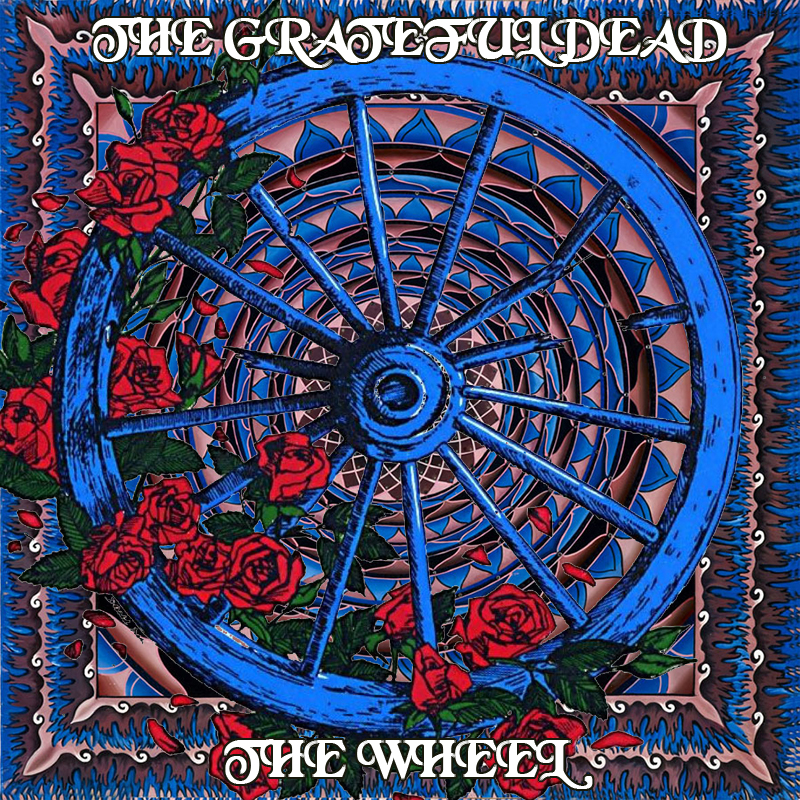
I'm very pleased at how this album cover came out. When I decided to name the album "The Wheel," I went looking for wheel-related artwork. I found a blue wheel with some red roses on it, which seemed fitting since roses are one of many Dead visual symbols. But just having that seemed too bland, so I went looking for mandala artwork, since that's another circular thing that fits with the Dead ethos. I found a nice one, overlaid the blue wheel on top of it, and the two seemed to fit perfectly. :)

Thursday, December 5, 2019

The Grateful Dead - Ramble On Rose - Non-Album Tracks (1971-1972)

As I've mentioned previously, the Grateful Dead wrote a remarkable number of great songs in the early 1970s, and in my opinion that was the peak of their career, but a large number of them weren't released on any studio album at the time. So I've made four albums that cover the gap between the "American Beauty" album in 1970 and "Wake of the Flood" in 1973. This is the third of those four albums.

The other day, the Reconstructor blog (https://the-reconstructor.blogspot.com/) posted a similar album to this one. According to that blog, the Dead were planning on releasing a studio album in 1972 that would have been titled "Rambling Rose." But instead of going to the studio to record their new songs, they decided to release a live album instead, and "Europe '72" was the result. I'm not sure why they wanted to call the album "Rambling Rose" when they had a song with the title "Ramble On Rose," but the again, the song does include the lyric "Did you say your name is Rambling Rose?"

I went with the album title "Ramble On Rose" because I found a really great cover art picture at the "What If" blog (https://whatif-misc.blogspot.com/) a year ago, and I asked back then if I could use it too. So now here we finally are. That locked me in to using "Ramble On Rose" for the album title.

Anyway, regardless of title, this is another great album that should be a must-have for any fan of the band. As I did with the other albums from this era, I was careful to have a mix of songs sung by Jerry Garcia, Bob Weir, and Ron "Pigpen" McKernan, with Garcia's songs dominating. For each album of these four, I'd include all original songs plus one cover. In this case, the cover is "Morning Dew."

Generally speaking, I've tried hard to avoid using the exact same versions of the songs that are on the 1972 solo albums by Garcia and Weir. Both those albums are so good that every Dead fan should own them and treat them just like Dead albums. (Actually, the Weir album, "Ace," is basically a Dead album of Weir songs, since the full band appears on every song.) But I had to make an exception this time for the song "Cassidy." The Dead didn't play the song for the first time until 1974, which is too late to fit into this album's time frame. Plus, the studio version from "Ace" is fantastic.

There are only seven songs here, but they're long, so the album is 48 and a half minutes long. That would have been unusually long for a single album in 1972, but it was doable. ("L.A. Woman" by the Doors from 1971 was a bit longer.)

01 Ramble On Rose (Grateful Dead)
02 Cassidy (Bob Weir)
03 The Stranger [Two Souls in Communion] (Grateful Dead)
04 Black-Throated Wind (Grateful Dead)
05 He's Gone (Grateful Dead)
06 Looks like Rain (Grateful Dead)
07 Morning Dew (Grateful Dead)

https://www.upload.ee/files/15118833/TGratefulD_1972_RambleOnRse_atse.zip.html

As mentioned above, thanks to the "What If" blog for the excellent cover art. I did change it slightly in that some parts of the text was darker than others, and I made it all equally dark.

Sunday, November 24, 2019

The Grateful Dead - Empty Pages - Non-Album Tracks (1971-1972)

A few weeks back, I posted an album I titled "Bird Song." It's the first of four albums I've made of the many original Grateful Dead songs around 1971 and 1972 that didn't get released on any studio album. This is the second album in that series. That time (roughly 1970 to 1973) was the peak of the band's songwriting and performance abilities, so all the songs here are excellent.

If you're a fan of the Grateful Dead, you'll probably recognize nearly all of the songs here. Most of them were on the popular live albums "Skull and Roses" and "Europe '72," though in a couple of cases I've chosen alternate versions. One song that is lesser known despite being a band original is "Empty Pages." It was written and sung by band member Ron "Pigpen" McKernan.

All the songs here were taken from officially released live albums - the band seemingly has hundreds from this time period. Thus, the sound quality is excellent. But I've tried to remove the audience cheering as much as possible, to create the impression that this is a studio album much like "Workingman's Dead" and "American Beauty." Actually, many of the live songs from "Europe '72" were tinkered with in the studio, for instance adding better backing vocals, so some of these are live/studio hybrids.

I've tried to be careful to make sure there's a typical mix of songs sung by band members Jerry Garcia, Bob Weir, and McKernan. I think I succeeded with that.

All the songs are originals, except I've allowed myself to include one cover song per album during this era. In this case, I've included "Me and My Uncle," which is so closely identified with the Dead that probably most people think it's one of theirs. (Strangely, it was written by John Phillips of the Mamas and the Papas in 1964, but that band never recorded the song.)

01 Bertha (Grateful Dead)
02 Wharf Rat (Grateful Dead)
03 Me and My Uncle (Grateful Dead)
04 Loser (Grateful Dead)
05 Mr. Charlie (Grateful Dead)
06 Sugaree (Grateful Dead)
07 Empty Pages (Grateful Dead)
08 Jack Straw (Grateful Dead)

https://www.upload.ee/files/15118679/TGratefulD_1971-1972_EmptyPges_atse.zip.html


Around 1972, the band authorized an official guitar book of the band's songs. I had a copy for a while, and it was great because in addition to having the chords and music of lots of wonderful songs, it also had illustrations for each song, done by many of the same artists that did celebrated concert posters for the band. I made the cover art using one such illustration from the book (but with some rearranging). Then added the "Grateful Dead" text from elsewhere in the book, and added the "Empty Pages" text with the same font.

Sunday, October 6, 2019

The Grateful Dead - Bird Song - Non-Album Tracks (1970-1971)

Robert Hunter, who wrote most of the lyrics for the Grateful Dead, died last week. In tribute to his legacy, I'm posting more from the Dead.

From about 1970 to 1972, the Grateful Dead had a tremendous burst of creativity. Yet the band only released two studio albums during that time, both in 1970: "Workingman's Dead" and "American Beauty." They should have put out a lot more. Instead, the band's two main singer-songwriters, Jerry Garcia and Bob Weir, each put out solo albums in 1971 that were filled with songs that would become standards for the band. Plus, a lot of new songs were put on live albums, especially "Skulls and Roses" and "Europe '72."

I've given myself the goal of compiling all those original songs onto studio albums in a similar vein to "Workingman's Dead" and "American Beauty." Like those albums, I've tried to create albums that are about 40 minutes long each, with short versions of songs compared to the band's usual live standards.

On the downside, there are very few publicly available studio outtakes. Also, I've avoided using the recordings from the two solo albums unless there's no other option, because I figure most Dead fans should have those albums already. But on the upside, there are mountains of officially released live recordings from that time in pristine sound quality. They can easily be made to sound like studio takes by removing the crowd noise. Besides, the Dead were played better live anyway, which is why they favored live albums at the time.

I've come up with so much original material from 1970 to 1972 that I was able to make four stray tracks albums! This is the first one. Well, almost all original material. For each of those four albums, I've allowed myself to include one cover song, if it's a song so closely identified with the band that many people assume they wrote it. In this case, it's "Goin' Down the Road Feelin' Bad."

Note that in addition to all those new originals, the band also played a ton of cover songs in those years. I plan to do something with the best of those later. Furthermore, the band played even more interesting songs in an acoustic format, mostly in 1970. I have plans for that too. But I want to deal with the original stray tracks first.

In order to figure out which songs to put on which of these four albums I'm making from that era, I consulted a list detailing the exact dates each song was played live for the first time. Then I divided those into four groups, one for each album. However, in some cases I moved a song from one group to another in order to have a good balance of songs sung by Jerry Garcia, Bob Weir, and Ron 'Pigpen' McKennan.

Note that two of the recordings - "Deal" and "Greatest Story Ever Told" - date from 1972. But that's just a matter of finding the best live recordings. Both songs had their debuts in February 1971.

By the way, "Tastebud" is a very little known and rarely played original song by McKennan. It was first done in 1966, and I had a version of it on a stray tracks album covering that time period. But it was only played live a few times, and no version of it was released at the time. The band then brought it out of mothballs and tried it again in the studio in early 1970 with the idea of putting it on "Workingman's Dead," only to leave it unreleased again. I've included that version.

01 Bird Song (Grateful Dead)
02 Mason's Children (Grateful Dead)
03 Tastebud (Grateful Dead)
04 To Lay Me Down (Grateful Dead)
05 Greatest Story Ever Told (Grateful Dead)
06 Deal (Grateful Dead)
07 Goin' Down the Road Feelin' Bad (Grateful Dead)
08 Playing in the Band (Grateful Dead)

https://www.upload.ee/files/15379267/TGratefulD_1970-1971_BrdSong_atse.zip.html

For the cover art, I used some nice fan art. Unfortunately, it's been a while since I found it, and I don't remember who did it or where it came from. I do remember that I added the wood in the background, in imitation of the look of the "American Beauty" cover.

Tuesday, March 19, 2019

The Grateful Dead - The Seven - Non-Album Tracks (1968-1969)

So far, I've posted a few Grateful Dead albums here and there, mostly from their earliest era (1965 to 1966). I've got a lot more from them to post, and I'm going to try to move forward more chronologically from here on out. There isn't much in the way of stray tracks from 1967, so this is what comes next.

This album is a mix of studio and live material, with nearly all of the performances being unreleased, despite the band having a seemingly infinite number of official albums, the vast majority of them live. The first song here, "Clementine," is an obscure Phil Lesh/Robert Hunter original that was released on the "So Many Roads" box set. The second song, "Dark Star," is of course very well known to any Deadhead, but this is the studio B-side version. It's less than three minutes long, which sounds absurd for that song, but this version has its charm.

Another highlight is "The Eleven," a Jerry Garcia/Robert Hunter original that only appeared on the live album "Live/Dead." But this is an unreleased studio version. "The Seven" is an even rarer original instrumental. Both it and "The Eleven" are named after the unusual time signatures the songs are played in.

The rest of the songs are cover versions. Since the songs are ordered chronologically, one can see a shift over the course of the album from psychedelic music to country and folky music. So this mirrors the dramatic shift in styles from the album "Aoxomoxoa" in 1969 to "Workingman's Dead" in 1970.

By the way, I named this album "The Seven" since that's the title of one of the songs. But I chose that song title because I thought it has a nice double meaning: for most of the 1960s, the Grateful Dead has six band members, but from November 1968 to January 1970, which covers most of the time of this album, they had seven, thanks to the addition of Tom Constanten. 

Note that this version of the blues classic "Big Boss Man" wasn't exactly performed by the Grateful Dead, but it sure sounds like it because the lead vocals and lead guitar were done by Jerry Garcia. It was recorded at the San Francisco home where most of the members of the Jefferson Airplane lived. Garcia was joined by fellow Dead member drummer Mickey Hart, as well as Jorma Kaukonen and Jack Casady from the Jefferson Airplane. The Dead played this song from time to time, but the lead vocalist always was Ron "Pigpen" McKernan. This is an interesting version because Garcia sang it.

This album is 54 minutes long, not including the bonus track.

Speaking of the bonus track, "What's Become of the Baby" was included on the band's 1969 studio album "Aoxomoxoa." But that version is so distorted with studio effects that it's kind of a mess. The song was only done live once, in 1969. That version is more interesting, in my opinion, so that's the bonus track version here.

01 Clementine (Grateful Dead)
02 Dark Star (Grateful Dead)
03 Death Letter Blues (Grateful Dead)
04 The Eleven (Grateful Dead)
05 Who's Lovin' You Tonight (Grateful Dead)
07 Seasons of My Heart (Grateful Dead)
08 The Seven [Instrumental] (Grateful Dead)
09 Big Boss Man (Jerry Garcia with Mickey Hart, Jorma Kaukonen & Jack Casady)
10 I'm a Lovin' Man (Grateful Dead)
11 He Was a Friend of Mine (Grateful Dead)

What's Become of the Baby (Grateful Dead)

https://www.upload.ee/files/15118720/TGratefulD_1968-1969_The_Sevn_atse.zip.html

I made the cover from a 2015 Grateful Dead concert poster. I made some significant changes, especially squishing the entire image vertically to get a rectangular poster into a square frame. I also changed the coloring of certain parts, and of course changed the text.

Saturday, September 22, 2018

The Grateful Dead - Midnight Hour - Non-Album Tracks (1966)

Here's the second of two albums dealing with the best of the cover songs performed by the Grateful Dead in 1965 and 1966. This album just covers the second half of 1966.

I said this only covers "the best of the cover songs," so let me explain what I mean by that. The Dead played tons of songs in 1966. (Very little survives of them from 1965, other than some studio recordings.) The website www.setlists.fm, lists 70 different songs played by the band in 1966, compared to only 33 in 1967. Twelve of those were originals, which I compiled on the album I called "Mindbender." That still leaves nearly 60 songs, and between this and the other covers album I just posted, I've only included 25 songs.

So how and why did I whittle this down to only 25 songs? I wanted to make these two albums something I'd like to listen to a lot. So the first thing I did was remove nearly all the songs that the Dead would go on to perform lots of times later in their career, because I (and any typical fan of the group) would already be very familiar with those. There are lots of songs like that, such as "Viola Lee Blues," "Me and My Uncle," "Cold Rain and Snow," "Sitting on Top of the World." and so on.

I did include a couple of songs like that for various reasons. For instance, I included "Good Lovin'" because it was sung by Bob Weir, whereas Ron 'Pigpen' McKernan would sing it for the next bunch of years until he died in 1973. I included "Dancing in the Street" and "In the Midnight Hour" because I wanted a couple of lively songs where the band got to stretch out and jam, since that was a key part of their 1966 sound, where they often tried to balance being both daneecable and jammy.

There's another big bunch of songs I didn't include either because there were no recordings at all, or none of high enough sound quality.

There are also many songs that I just didn't feel were good enough for inclusion. One thing I strove for was to have some balance between songs sung by Jerry Garcia, Weir, and McKernan, even though McKernan tends to dominate. There were a bunch of McKernan-led bluesy songs that weren't that different from each other. Had I included a lot of those, it would have changed the overall sound of the album from lively and danceable into slow and bluesy. I did include some of those however, especially when I thought Garcia's lead guitar work was particularly impressive.

On the first album, all but one of the performances have been officially released. But on this one, about half are still unreleased. Those are all taken from a series of concerts at The Matrix in San Francisco in late November and early December 1966. These concerts are all excellent soundboards (I assume recorded by Stanley). I surprised that nothing from those concerts have been officially released (yet?).

By the way, there's one song here, "It's My Own Fault," taken from one of those Matrix shows, where the voice of the lead vocalist is unclear. It's definitely not McKernan, and it doesn't sound like Weir or Garcia either. Doing some Googling, I see that some people speculate it either was someone else in the band who rarely sang lead, or it was some unknown guest vocalist. It's definitely the Dead playing though, as you can tell from Garcia's great guitar work.

Oh, one other note. The version of "In the Midnight Hour" comes from an official release (the "30 Trips Around the Sun" box set), but it's edited by me. That's because that version started out playing fast, then about a minute in there was some kind of tape glitch, followed by some wobbly sounds, and then the rest of the song was at a slow pace and a different pitch. That sounded bad to me, no doubt due to some tape damage, so I cut out the worst couple of minutes. Then I changed the tempo and pitch of the first part to match the rest and created a seamless edit. The result is a couple of minutes shorter than the official version (yet still 13 minutes long), but I think it sounds a lot better.

01 Nobody's Fault but Mine (Grateful Dead)
02 Keep Rolling By (Grateful Dead)
03 He Was a Friend of Mine (Grateful Dead)
04 One Kind Favor [See that My Grave Is Kept Clean] (Grateful Dead)
05 Overseas Stomp [The Lindy] (Grateful Dead)
06 I Just Want to Make Love to You (Grateful Dead)
07 Big Boy Pete (Grateful Dead)
08 It's a Sin (Grateful Dead)
09 You Don't Love Me (Grateful Dead)
10 It's My Own Fault (Grateful Dead)
11 In the Midnight Hour [Edit] (Grateful Dead)

https://www.upload.ee/files/15118603/TGratefulD_1966_MidnghtHour_atse.zip.html


I called this "Midnight Hour" because I couldn't think of a better name. None of the song titles worked that well, I felt. If you have a better title suggestion, please let me know.

Thanks to Peter at the Albums I Wish Existed blog for the cover art.

The Grateful Dead - Don't Ease Me In - Non-Album Cover Versions (1965-1966)

I just posted an album of the Grateful Dead's original songs from 1965 and 1966. But during that time period, the Dead were much more of a covers band. So I have two albums to post of the best cover songs from that time. There are so many that both albums are nearly an hour long, and there are many songs I didn't include. This is the first of the two.

In 1965 and 1966, rock and roll was very di
fferent from how it would be once the psychedelic era peaked in 1967. People came to concerts mostly to dance. That was true even for the Dead, despite the fact that their occasional famous "Acid Test" performances began in early 1966. So the band's set list had more short, lively songs and fewer long jammy ones. Also, the band was much more steeped in rhythm and blues. That was the forte of Ron 'Pigpen' McKernan, so he dominated the band in a way he never did again. Probably a majority of the songs the band played were sung by him.

That said, the band was quite consistent throughout its career. From the very beginning, Jerry Garcia's lead guitar playing was a big draw, and he sang a lot of songs as well. Bob Weir also had a prominent singing role right from the start.

Some of these songs come from studio sources, but more of them are from live sources. However, I've removed the crowd noise to make it a consistent listen. The sound quality is surprisingly good for time, probably because key people like Owsley Stanley began recording soundboards of their concerts from early 1966.

As I mentioned, I have so much material of their cover songs that I've made two albums. I've put them in chronological order, so this covers late 1965 to early 1966.

By the way, I couldn't think of a really good album title. I went with "Don't Ease Me In" because that was the A-side of the band's only single in 1966 (and their only official release in this time period).

01 Early Morning Rain (Grateful Dead)
02 I Know You Rider (Grateful Dead)
03 Hey Little One (Grateful Dead)
04 On the Road Again (Grateful Dead)
05 Promised Land (Grateful Dead)
06 Empty Heart (Grateful Dead)
07 Don't Ease Me In (Grateful Dead)
08 Stealin' (Grateful Dead)
09 Gangster of Love (Grateful Dead)
10 Don't Mess Up a Good Thing (Grateful Dead)
11 Dancing in the Street (Grateful Dead)
12 Hi-Heel Sneakers (Grateful Dead)
13 It's All Over Now, Baby Blue (Grateful Dead)
14 Next Time You See Me (Grateful Dead)

https://www.upload.ee/files/15118597/TGratefulD_1965-1966_DontEseM_In_atse.zip.html

Thanks to Peter from the Albums I Wish Existed blog for the cover art.