Showing posts with label Albert King. Show all posts

Monday, March 31, 2025

Journey with Albert King and Friends - PBS Soundstage, Aragon Ballroom, Chicago, IL, 7-9-1978

When I think of Journey, I think of a lot of good hit songs, but I also think of slick "corporate rock," and I'm not a big fan of the latter. However, I've recently discovered that Journey was way more interesting than I'd thought in their early years, especially 1978. That's because 1978 was the year they did the "Super Jam II" concert consisting almost entirely of unexpected cover versions, and it was also the year they did this "PBS Soundstage" concert. Parts of it were typical of Journey concerts from that year. But they also had Albert King as their special guest on a few songs. I certainly never would have expected a Journey and Albert King collection! So kudos to them.

And they didn't just have Albert King as their special guest. He was the main guest star, and sang a couple of songs. However, some other great blues musicians were included as well: Pinetop Perkins, Luther Allison, and Jerry Portnoy. King and the others came on stage and jammed on several songs, mainly tracks six through eight here. So double kudos to Journey for shining the spotlight on all these blues musicians, most of them who made their mark in an earlier era. For instance, Pinetop Perkins, one of the greatest blues piano players ever, was born way back in 1913, so he was a senior citizen at the time of this concert.

As an aside, this was one of the last concerts the band played with Aynsley Dunbar on drums. His leaving was part of the band's transition from progressive rock to more corporate rock.

The one disappointment I have with this recording is that the last song, "I'm Gonna Move to the Outskirts of Town," is sung by Albert King, but it fades out after only a minute and a half. I looked at the video of this concert on YouTube, and there wasn't any more of it because the final credits from the TV were playing during that time. By the way, King sang "Sweet Little Angel" together with Journey lead vocalist Steve Perry. It seems this was the only time Journey ever played that song in concert.

This album is unreleased. There are videos of it for sale, but I suspect they're grey market releases.

This album is 54 minutes long.

01 Feeling That Way (Journey)
02 Anytime (Journey)
03 Winds of March (Journey)
04 Wheel in the Sky (Journey)
05 talk (Journey)
06 Overall Junction [Instrumental] (Journey with Albert King)
07 Sweet Little Angel (Journey with Albert King)
08 B Flat Blues Shuffle [Instrumental] (Journey with Albert King)
09 On a Saturday Night (Journey)
10 She Makes Me [Feel Alright] (Journey)
11 Lights (Journey)
12 I'm Gonna Move to the Outskirts of Town (Journey with Albert King)

https://pixeldrain.com/u/8feQK3dw

alternate:

https://bestfile.io/M0T7rZxySCUAw0X/file

The cover image is from this exact concert. It shows Albert King on the left and Journey lead guitarist Neal Schon on the right.

Monday, March 11, 2024

Thank You and Farewell - The Closing of the Fillmore East, Fillmore East, New York City, 6-27-1971, Part 1: Albert King

I've made it a point to try to post entire rock festivals, as these often seem to be overlooked and neglected. Here's another one. This is the concert from the final night of the legendary Fillmore East venue in New York City. I'll explain more in a bit about what it was and why it closed when it did. But suffice to say the venue went out with a bang. This final concert featured seven big name acts performing for a total of about five hours. So I've made seven albums, one for each act. This first one is blues guitarist Albert King.

All but one of the sets currently remain officially unreleased. However, the entire last night was broadcast live on the radio, so bootlegs exist with excellent sound.

The Fillmore East is closely tied to its owner, promoter Bill Graham, who was arguably the most important promoter in rock history. He was particularly instrumental in the development of the San Francisco psychedelic sound in the late 1960s. Bands like the Grateful Dead and Jefferson Airplane didn't have many good places to play at first. But Graham opened the Fillmore Auditorium in late 1965, and that became a haven for many new and upcoming bands. At first, this venue was just known as the Fillmore (named after the street it was on), but its name changed to the Fillmore West in 1968 when Graham moved it to a larger building about a mile away, around the same time he opened a similar venue in New York City, which he called the Fillmore East.

Both the Fillmore West and Fillmore East were among the most important and prestigious concert venues in the late 1960s and early 1970s. They held between 2,500 and 3,000 people, which was big enough for most of the famous rock acts of the time, but not so big to become a stadium type show, with inevitably poorer sound quality and less of a connection between the musicians and the fans. The Fillmore East in particular was well known for good acoustics, so dozens of live albums were recorded there. You can see a list at the Wikipedia article on the venue, here:

Fillmore East - Wikipedia

Unfortunately, these two venues didn't last that long. In 1971, Graham decided to close both of them. Part of it seems to be that Graham seemed to be personally burned out after hosting concerts on both the East and West coasts nearly every night for three years. But also, the economics were changing. As rock music got increasingly popular and mainstream, the acts that had found success playing at both Fillmores were increasing graduating to playing in arenas and stadiums that could hold 10,000 or more spectators. Graham couldn't pay the acts nearly the same amount when his venues were much smaller. He could have continued with lesser known acts, but he decided to quit the business instead.

Dickey Betts of the Allman Brothers Band later had this to say about the closing of the venue. "The Fillmore East was everybody’s favorite gig to play. It was the Carnegie Hall of rock and roll. Bill Graham made a very great presentation of rock and roll, with the light shows and the curtains and the presentation of the bands and the set changes. But the Fillmore East wasn't big enough to pay any of the bands what they made other places. I think the general feeling among anyone who played there was even though we could be playing somewhere else for three times the money, we'd rather come to the Fillmore East and play because it’s such a great place to play."

As it so happens, Graham didn't stay retired for long. Within a year, he was back to promoting rock concerts, although he wasn't as closely tied to particular venues as he'd been with the Fillmores. He arguably remained the most important concert promoter until he died in a helicopter crash in 1991. The original Fillmore in San Francisco reopened in 1994, and remains a popular venue until today.

Anyway, the closing of the Fillmore West on July 4, 1971, is well documented. There were five nights of closing concerts. This resulted in a documentary film called "Fillmore" and a triple album called "Fillmore: The Last Days," released in 1972. But there was no such similar film or album for the closing of the Fillmore East, which took place just a week earlier. 

Luckily though, we have the bootleg recordings. I'm calling this album series "Thank You and Farewell," because the marquee sign in front of the Fillmore East had "thank you and farewell" written on it after the venue closed. You can see that included in the artwork at the top of the cover art for each album.

After all that, there's not a lot to say about the actual music here. In my opinion, Albert King was at his peak in the late 1960s and early 1970s. There's one classic live album from this time, "Live Wire/ Blues Power," released in 1968. But other than that, there isn't much live music from this time period, although he did release many live albums later in his career. So this is a very welcome addition, in my opinion, although it is a rather short set.

Oh, by the way, apparently, King was the very first artist to play the venue when it opened up. So that could be why he was involved in the last show.

This album is 29 minutes long.

01 talk by Bill Graham (Albert King)
02 Knock on Wood [Instrumental] (Albert King)
03 Got to Be Some Changes (Albert King)
04 Nothing but the Blues (Albert King)
05 Crosscut Saw (Albert King)
06 Personal Manager (Albert King)
07 Bye Bye Blues (Albert King)

https://www.upload.ee/files/16376043/VA-ThnkYounFrwll197101AlbrtKng.zip.html

The cover art consists of two parts. The top part is taken from a photo of the marquee sign for the venue. The "thank you and farewell" message was written on three different lines, but I used Photoshop to combine them to one line in order to save space. I also colorized the black and white photo I found, basing the colors off a color photo I found of the same sign. 

The photo of Albert King is from this exact concert, I'm happy to say.

Tuesday, November 22, 2022

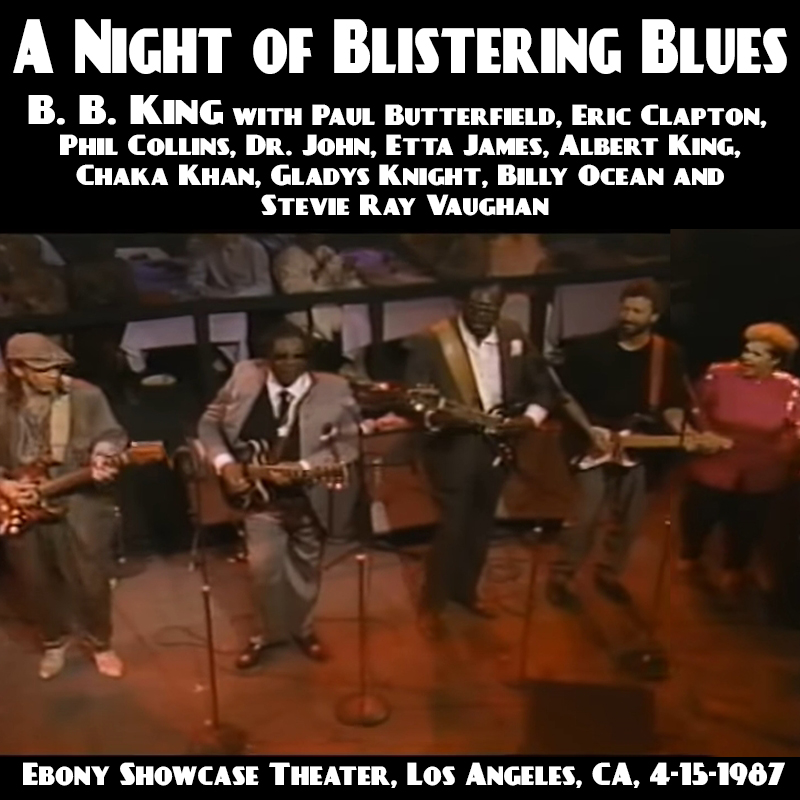
B. B. King and Friends - A Night of Blistering Blues, Ebony Showcase Theater, Los Angeles, CA, 4-15-1987

Hopefully, if you're a fan of the blues, you'll take a look at the list of artists mentioned on the cover art, say, "Wow!" and download this immediately. This concert mainly features B. B. King, who does all the talking, but his special guests are: Paul Butterfield, Eric Clapton, Phil Collins, Dr. John, Etta James, Albert King, Chaka Khan, Gladys Knight, Billy Ocean, and Stevie Ray Vaughan.

Why did all of these big names of soul and blues get together for this concert? I don't know if there was some special occasion or anniversary, but this show was filmed for a TV special shown on Cinemax, alternately called "A Night of Blistering Blues" or "A Blues Night." I've gone with the former name because it's more interesting.

Generally speaking, King did the lion's share of lead vocals. But he shared vocals with Albert King, Etta James, Billy Ocean, Gladys Knight, and Chaka Khan. I believe Phil Collins played drums on all the songs, along with another drummer. Paul Butterfield did all the harmonica playing. Eric Clapton and Stevie Ray Vaughan played lead guitar, and on more songs than just the ones they're credited on below. B. B. King and Albert King played lots of lead guitar as well.

This really was a once in a lifetime gathering of musical greats, and they rose to the occasion. I don't know why this has never been officially released as an album. The only flaw is that the last song was a blues jam with all the lead guitarists: B. B. King, Albert King, Eric Clapton, and Stevie Ray Vaughan. But unfortunately, it fades out after only a minute of guitar soloing from B. B. King. If you watch the video of this on YouTube, you'll see the credits are rolling and the recording ends when the show finishes.

This album is 56 minutes long.

01 Why I Sing the Blues (B. B. King, Albert King, Etta James, Billy Ocean, Gladys Knight & Chaka Khan)
02 talk (B. B. King)
03 Please Send Me Someone to Love (B. B. King & Gladys Knight)
04 talk (B. B. King)
05 The Thrill Is Gone (B. B. King with Eric Clapton & Phil Collins)
06 talk (B. B. King)
07 I'd Rather Go Blind (B. B. King, Dr. John & Etta James)
08 talk (B. B. King)
09 When Something Is Wrong with My Baby (B. B. King, Chaka Khan & Billy Ocean)
10 talk (B. B. King)
11 The Sky Is Crying (B. B. King, Paul Butterfield, Albert King & Stevie Ray Vaughan)
12 talk (B. B. King)
13 Something's Got a Hold on Me (B. B. King & Etta James)
14 talk (B. B. King)
15 In the Midnight Hour (B. B. King & Billy Ocean with Paul Butterfield & Stevie Ray Vaughan)
16 talk (B. B. King)
17 Ain't Nobody's Business (B. B. King, Etta James, Chaka Khan & Gladys Knight)
18 talk (B. B. King)
19 Let the Good Times Roll (B. B. King, Albert King & Etta James)
20 Take My Hand, Precious Lord (B. B. King, Etta James, Chaka Khan & Gladys Knight)
21 talk (B. B. King)
22 Blues Jam [Instrumental] (B. B. King)

https://www.upload.ee/files/16687605/BBKNG1987_NghtofBlistrinBlusEbnyShwcseThetr__4-15-1987_atse.zip.html

I haven't seen any good photos from this concert. So I took a screenshot from the YouTube video. The quality is rather low-res, but this is all there is. From right to left, you can see: Stevie Ray Vaughan, B. B. King, Albert King, Eric Clapton, and Etta James.