Showing posts with label Long John Baldry. Show all posts

Saturday, April 18, 2026

Mar Y Sol Pop Festival, Manati, Puerto Rico, 4-3-1972, Part 2: Jonathan Edwards, Long John Baldry & More

Here is the second part of the third (and last) day of the 1972 Mar Y Sol Pop Festival. This is the last album from this festival. Like the other album I put together from this third day, this is a grab-bag, consisting of relatively short sets of four music acts: Jonathan Edwards, Long John Baldry, Fran Ferrer & Puerto Rico 2010, and Osibisa.

Jonathan Edwards is a singer-songwriter who had a hit with the song "Sunshine." It went all the way to Number Four in the U.S. singles chart in 1971. That makes him a one-hit wonder. But he was (and still is) a lot more than that. I especially like his first few albums, and I've posted a concert from him. We have six songs from him here, but they only make up about 18 minutes of this album. "Sometimes in the Morning" and "Train of Glory" are from the official live album from the festival. His other songs are from the same audience bootleg as most of the other songs I've posted from this festival.

The next three songs are from British blues singer Long John Baldry. I've posted a BBC sessions album from him, as well as music from a band he was in, Steampacket. He had his biggest success in 1967, when he put out a single, "Let the Heartaches Begin," that went all the way to Number One in Britain (though it barely made the U.S. singles chart). His career was still going fairly well at the time of this concert. He had a minor hit in 1971 with the song "Don't Try to Lay No Boogie Woogie on the King of Rock and Roll." Interesting fact: half of his 1971 album "It Ain't Easy" was produced by Elton John, and the other half was produced by Rod Stewart. "Bring My Baby Back" made it to the official live album from this festival, while the other song here is from the same audience boot mentioned elsewhere.

Fran Ferrer & Puerto Rico 2010 was a salsa band from Puerto Rico. Apparently, some of their lyrics were political, but the meaning was generally missed by the mostly English speaking audience. There were other lesser known bands like this one that performed at the festival, such as Banda del K-rajo, Bang, Elephant's Memory, Michael Overly, Rubber Band, Stonehenge, and Malo. But we don't happen to have any recordings from them, and we happen to have two songs from this band. Both are from the same audience boot mentioned above.

The last song was by the band Osibisa, who were the last musical act to perform at the festival. This song made it to the official live album. Here's what Wikipedia has to say about them: Osibisa is a Ghanaian-Caribbean Afro rock band founded in London in the late 1960s by four expatriate West African and three London-based Caribbean musicians. Osibisa was the most successful and longest lived of the African-heritage bands in London... and was largely responsible for the establishment of world music and Afro-rock as a marketable genre." They would have a couple of hits in Britain later in the 1970s.

Here's their Wikipedia entry:

Osibisa - Wikipedia 

So that's the last of the music I have from this festival. But before I finish my write-up of this last album, I want to explain a bit about some interesting events that happened as the festival finished. As I mentioned in a previous write-up, the main promoter of the festival was Alex Cooley, who had promoted some other major rock festivals. But he ran into a lot of trouble with this one, including the fact that he failed to get the proper permits. The festival only happened because it would have caused more trouble for the government to have tens of thousands of angry fans who had paid to fly to Puerto Rico just to attend the festival.

Cooley later explained how the festival ended for him: "[A] guy who was working in the festival, came over to me, the last night of the festival, and said [the government] issued a warrant in San Juan and they were coming to arrest me. So they smuggled me out of there with a Volkswagen bus. I got in the bus and they put things on top of me and they took me to the airport and there were people at the airport that were very sympathetic towards this and they let them.... Of course, you'd never be able to do this now - they let them drive the Volkswagen out on to the runway. So I got out of the Volkswagen and got directly on the plane. So that's how I got out of San Juan, out of Puerto Rico."

He left in all sorts of trouble, including owing at least $40,000 in taxes that apparently never got paid.

Cooley wasn't the only one who had trouble leaving the festival. Creem Magazine reported, "People had begun making the long trek back to San Juan and points beyond after the first day of the festival, but even this steady exodus didn't avert the Tuesday tie-up at the airport. Many of the people who had purchased the $149 festival package found that their return plane tickets were good only for stand-by, thus effectively leaving the stranded until auxiliary flights could be arranged."

Luckily, the government helped take care of the people stranded at the airport. Tents were set up near the main terminal. The Red Cross, the government, and even some airline companies provided food, water and medical attention. Some bands performed for the stranded passengers. Pan American Airlines provided the flights for about 3,000 people who attended the festival from outside Puerto Rico who otherwise couldn't leave. It took several days before everyone was able to leave the country. 

No wonder the government was mad at Cooley and the other festival organizers. It's also no wonder why Puerto Rico didn't have another rock festival like this until decades later.

This album is 55 minutes long. 

01 talk (Jonathan Edwards)
02 Athens County (Jonathan Edwards)
03 Dues Day Bar (Jonathan Edwards)
04 talk (Jonathan Edwards)
05 Give Us a Song (Jonathan Edwards)
06 Shanty (Jonathan Edwards)
07 talk (Jonathan Edwards)
08 Sometimes in the Morning (Jonathan Edwards)
09 Train of Glory (Jonathan Edwards)
10 It Ain't Easy (Long John Baldry)
11 talk (Long John Baldry)
12 Bring My Baby Back (Long John Baldry)
13 Hemos Dicho Basta [Incomplete] (Fran Ferrer & Puerto Rico 2010)
14 Ya Se Van (Fran Ferrer & Puerto Rico 2010)
15 Y Sharp [Instrumental] (Osibisa)

https://pixeldrain.com/u/ZSLiFptp

alternate:

https://bestfile.io/en/iaLTJsYB36ObzqH/file

The cover image of Jonathan Edwards is from this exact concert. 

Thursday, February 24, 2022

Long John Baldry - BBC Sessions (1963-1968)

This is kind of a companion to the Steampacket BBC sessions album I already posted. Long John Baldy was a key member of the Steampacket, which existed from 1965 to 1966. So his solo career essentially was put on hold for about a year and a half while he focused on that group. Thus, this is divided into two parts. The first eight songs are from 1963 to early 1965, and the remaining songs are from late 1966 to 1968.

As an American, I hadn't heard much about Long John Baldry prior to putting this album together. But he's better known in Britain, mainly for his 1967 song "Let the Heartaches Begin," which was a Number One hit there. That song is a ballad, but he's also known as being an early leading light in Britain for promoting the blues and R&B. 

For the first section of songs from 1963 to 1965, only the first one, "My Babe," plus tracks 9 through 11, are from actual BBC sessions. He did more BBC sessions around that time, but they seem to have been lost or never recorded. That the first song survived because it was part of a BBC special heavily featuring the Beatles called "Pop Go the Beatles," so it probably survived because of Beatles fans recording it. The other three tracks survived because they date from the "Top of the Pops" radio show in early 1965, and pretty much all of those recordings have survived since about mid-1964.

Most of the rest of the early songs here come from appearances on the British TV show "Hullabaloo." It seems the band Cyril Davies R&B All-Stars played one song per week for one season. Cyril Davies was another British leading light for the blues, but he died due to health issues (endocarditis) at the age of 31 in 1964, and there is very little recorded by him before his death. He was mainly a harmonica player, so Baldry joined his band as a lead vocalist. After Davies died, Baldry basically took over his band and renamed them the Hoochie Coochie Men. (For tracks 9 through 11, he was backed by the Hoochie Coochie Men, although I didn't label those songs as such.) After some more personnel changes, they morphed into the Steampacket.

I included as many of these early Hullabaloo performances I could find, but there are more that either weren't recorded or I can't find. British folk guitarist Davy Graham was on many of the same shows, and in one case here Baldy sang while Graham played the acoustic guitar.

The second half, the 1966 to 1968 songs, are all BBC recordings. Most of them come from four BBC sessions, but track 18, "Call It Stormy Monday," is from an unknown BBC TV show. There is at least one more BBC session from around this time that doesn't seem to have survived.

All the songs here are officially unreleased. The sound quality is generally excellent. My musical associate MZ improved the equalization for some of the songs here, as well as some on the Steampacket BBC session I posted.

This album is an hour and four minutes long.

UPDATE: On December 21, 2024, I massively updated the mp3 download file. I found a new source of material, and went from having 14 tracks to 24. Additionally, I improved the sound quality of some of the others.

01 My Babe (Long John Baldry)
02 Movin' On (Cyril Davies R&B All-Stars with Long John Baldry)
03 Bo Diddley (Cyril Davies R&B All-Stars with Long John Baldry)
04 Careless Love (Long John Baldry & Davy Graham)
05 Hallelujah All My Blues Have Gone (Cyril Davies R&B All-Stars with Long John Baldry)
06 Leave My Woman Alone (Cyril Davies R&B All-Stars with Long John Baldry)
07 The Night Time Is the Right Time (Cyril Davies R&B All-Stars with Long John Baldry)
08 The 2.19 (Long John Baldry)
09 Turn On Your Love Light [Edit] (Long John Baldry)
10 Men Speak Your Piece (Long John Baldry)
11 I’m On to You Baby (Long John Baldry)
12 Cuckoo (Long John Baldry)
13 Turn On Your Love Light (Long John Baldry)
14 Morning Dew [Edit] (Long John Baldry)
15 Let the Heartaches Begin (Long John Baldry)
16 Bad Luck Soul (Long John Baldry)
17 How Sweet It Is [To Be Loved by You] (Long John Baldry)
18 Call It Stormy Monday (Long John Baldry)
19 Mexico (Long John Baldry)
20 Morning of the Carnival [Edit] (Long John Baldry)
21 Janine [Edit] (Long John Baldry)
22 Better by Far [Edit] (Long John Baldry)
23 When the Sun Comes Shining Thru (Long John Baldry)
24 The Drifter (Long John Baldry)

https://pixeldrain.com/u/SCAsZ9NQ

alternate:

https://bestfile.io/en/i6IePocKHihHgic/file

The cover photo of Baldry dates to 1967, but I don't know any other details.

The Steampacket - BBC Sessions (1965-1966)

I've already posted an album of stray tracks by the Steampacket. If you want to know more about them, please look at that album posting. 

In short, they were a kind of super group, in that Rod Stewart, Long John Baldry, Brian Auger, and Julie Driscoll were members. But it wasn't really a supergroup, because only Long John Baldry was famous enough at the time to appear sometimes on British TV at the time. He and especially the others would become much more famous later. The group was only together for about a year in 1965 and 1966. Stewart and Baldry split for various reasons, including the inability to get the legal rights for all four of them to record together, since they were signed to different record companies. Auger, Driscoll, and the rest of the band stayed together as "Julie Driscoll, Brian Auger, and the Trinity," and had a lot of commercial success in the late 1960s.

When I posted that other album by Steampacket, it gathered up pretty much all I could find by them other than their BBC recordings. That's so I could present their BBC stuff separately here. Unfortunately, there isn't much. They only did two BBC sessions for a total of seven songs.

I've added to that two songs that were done in concert and were broadcast on the US TV show "Shindig." Unfortunately, while the BBC tracks sound fine, those two are a lot rougher. There's plenty of audience screaming all the way through. That's especially the case for the second song, "I Feel Alright," because they were joined on stage by Eric Burdon, lead singer of the Animals, and Steve Winwood, lead singer of the Spencer Davis Group. Both of those bands had considerably more commercial success at the time. For that song, you can hear Burdon, Winwood, Baldry, Stewart, and Driscoll all sing lead vocals at various points. So I figure it's historically important, even if the sound quality isn't great. If you want to watch it instead, you can find the video of YouTube.

It's too bad the Steampacket didn't stay together longer or record more, because they made for an interesting combination. Auger didn't sing much, generally sticking to playing the organ. But Stewart, Baldry, and Driscoll all take turns singing lead on the various songs here.

Two of the songs, "It's Alright" and "Going to a Go Go," have "[Edit]" in them because of the usual problem of BBC DJs talking over the music. And I did the usual fix of using the X-Minus audio editing program to wipe those vocals. I also added "[Edit]" to the first two songs because I made some edits in the audio editing program Audacity to try to improve the poor sound. Mainly, after separating the lead vocals out from the rest, I boosted those vocals relative to everything else to try to make them easier to hear over the and screaming and overall chaos. If you think this sounds bad, you should hear how they sounded before those edits. 

Even with the two live songs added, this album is only 25 minutes long. All of it is officially unreleased. I would have loved to add more, but this is all I could find. If you know of anything I've missed, please let me know.

01 Dear Lord Remember Me [Edit] (Steampacket)
02 I Feel Alright [Edit] (Steampacket with Eric Burdon & Stevie Winwood)
03 How Long Will It Last (Steampacket)
04 In the Midnight Hour (Steampacket)
05 It's Alright [Edit] (Steampacket)
06 Everything's Gonna Be Alright (Steampacket)
07 I Didn't Want to Have to Do It (Steampacket)
08 Going to a Go Go [Edit] (Steampacket)
09 The Drifter (Steampacket)

https://pixeldrain.com/u/pVay8X8i

alternate:

https://bestfile.io/en/WojISvheDXiHQvx/file

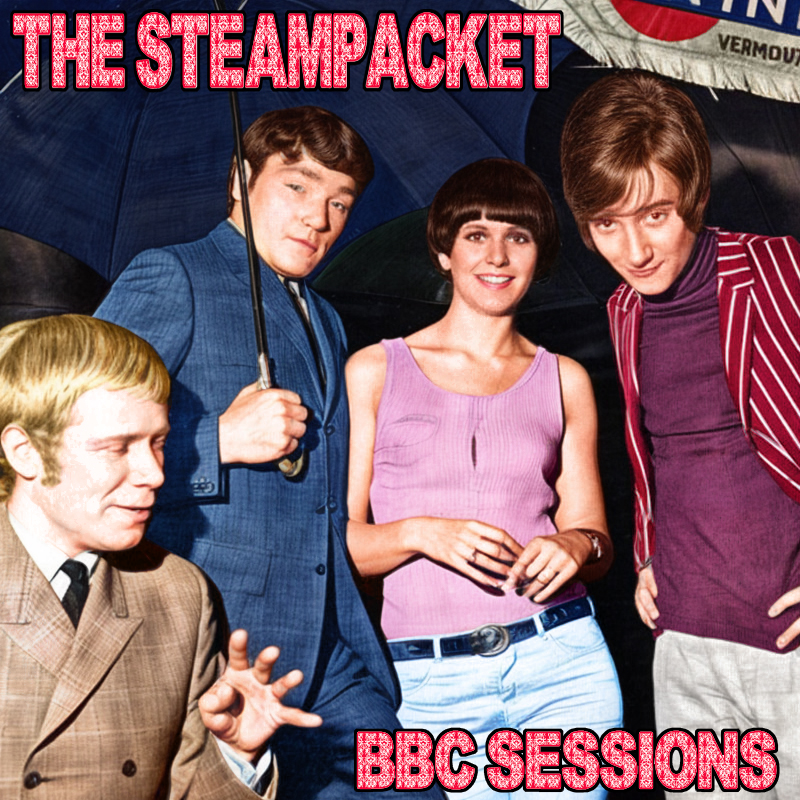
For the Idle Race BBC album I just posted, I was complaining about how hard it is to find even one decent color photo of a band like that. That does much more so for the Steampacket, since they were an even more obscure band. For the Steampacket stray tracks album I've posted here already, I selected a black and white photo and colorized it. For this cover, I selected a different black and white photo and colorized it too. 

I don't know of any genuine color photos of the group, although I have seen some very badly done colorized efforts (much worse than mine!). I have seen a color version of the two Shindig live songs here, but the picture quality was so low-res and generally bad that I decided not to use that. I also used the same exact font type and colors as with the Steampacket stray tracks album I made, for a bit of artistic consistency between the two albums.

Friday, March 19, 2021

The Steampacket (Rod Stewart, Julie Driscoll, Brian Auger & Long John Baldry) - Dear Lord Remember Me - Non-Album Tracks (1965-1966)

Have you ever heard of the Steampacket? If you have, then kudos to the depth of your musical knowledge, because few people still remember them. They were a British R&B band that existed for about a year, from 1965 to 1966. The band was made up of vocalists Rod Stewart, Long John Baldry, Julie Driscoll, and Brian Auger, supported on instruments by Vic Briggs, Ricky Fenson, and Micky Waller. At the time, the band members were relatively unknown, with Long John Baldry probably being the best known member. But after the band broke up, some of them would go on to much greater fame. Rod Stewart, in particular would become a superstar, but Julie Driscoll and Brian Auger would end up famous as well, especially in Britain, and Long John Baldry maintained a music career for decades. As a result, the band has been called "the world's first musical supergroup," but that's only true with 20/20 hindsight.

The Steampacket was unusual because it consisted of not one, not two, not three, but FOUR lead singers! It was less a band and more like a "musical revue." Some black R&B concert tours in the US at the time had this revue format where a band would back up an alternating series of lead singers in one concert, in order to keep things interesting for the audience. The Steampacket was an attempt to bring this format to Britain. Apparently it worked well in concert. The problem was that the four lead singers were signed to different labels, so it was a legal nightmare to get permission to record an album, or even a single. As a result, the band never did officially release any music while it still existed. Rod Stewart left first in frustration over this problem, in early 1966, followed by Long John Baldry a few months later. Julie Driscoll and Brian Auger stayed together, but by late 1966 they changed their name to "Julie Driscoll, Brian Auger and the Trinity." They had lots of success with that new name from 1967 to 1969.

Unfortunately, it was rare to record concerts in 1965 and 1966, and no such recordings of the band apparently have survived (other than video footage of one song where they were on stage for an encore with some other bands). After Rod Stewart became famous, some official recordings of the Steampacket did come out, usually deceptively presented with Stewart's name in big letters and the Steampacket name a small afterthought. Apparently, these were demos the band made in late 1965. They had plans to tour the US (though I don't think that actually happened), and the demos were made to show concert bookers there the band's talent. Many archival albums appeared from the 1970s onwards, generally consisting of the same bunch of songs repackaged in different ways, with different titles. The ones that happened to be the most widespread only had one or two songs sung by Stewart, and the rest were instrumentals dominated by organist Brian Auger, so they were only a pale shadow of what the band was capable of.

After digging around, I found some more recordings of the band that are much less well known. Most importantly, in 2019, a double album called "The Definitive Steampacket Recordings" came out, but it's only available through Brian Auger's website. It has lots of songs sung by Driscoll, Auger, and/or Baldry. But despite the title, it's not "definitive." It includes some songs that aren't by the Steampacket (but involve Auger from the same time period), and leaves off others that are. I found a whole other batch of songs that were all sung by Stewart. So I've combined those two sources, and mixed them together in order to prevent a long string of Stewart-sung songs. That said, he still sings the majority of the songs here, overall. So if you're a Stewart fan, you should definitely enjoy this. Note that many songs on that "Definitive" album are organ-based instrumentals by Auger. I'm not a fan of that style at all, so I left those off. All the songs here have vocals.

In my opinion, this is the first time one can make a strong case for the Steampacket as the musical revue it was meant to be and not just as a backing band for some early Rod Stewart performances. This is probably as close as we're going to get to the Steampacket studio album that should have been, but never was. 

The vast majority or maybe all of the songs here are covers, usually of American soul music. By the way, note that I've given the song "Baby Take Me" the subtitle "The Real Thing." That's because this song has the exact same melody and arrangement of "The Real Thing" - a song written by Ashford, Simpson and Armstead which was a minor hit for Tina Britt in 1965 - except this version has totally different lyrics and a different title.

Note that I don't think I've ever posted an album at this blog while knowing so little about its contents. All I know for sure is that these songs were recorded by the Steampacket in 1965 or 1966. Were they all part of that demo tape made for the planned US tour, or were there other recording sessions? I have no idea. I'm putting "1966" in the mp3 tags as a guess that this music would have been released in that year, but I could just have easily put "1965." If you have any more info about these songs and when and where they were recorded, please let me know. And if you know of songs I'd missed (other than Auger's instrumentals), please let me know that too.

I do know of some other songs the band recorded that I'm not including here, by the way. I'm referring to two BBC sessions the band did, one in 1965 and one in 1966. Most of the songs on those are different than the songs here. I plan on posting their BBC sessions eventually, despite the fact that it's less than 20 minutes of music. I'd like to save those from obscurity, since they remain unreleased.

This album is 44 minutes long. I've titled it "Dear Lord Remember Me" after one of the song titles, but also as a kind of commentary on how obscure the band is and how their music shouldn't be forgotten.

01 Bright Lights, Big City (Steampacket)
02 Ain't That Lovin' You, Baby (Steampacket)
03 Baby, Baby (Steampacket)
04 Baby Take Me [The Real Thing] (Steampacket)
05 Just Got Some (Steampacket)
06 Can I Get a Witness (Steampacket)
07 Dear Lord Remember Me (Steampacket)
08 Shake (Steampacket)
09 You're a Wonderful One (Steampacket)
10 Baby Don't You Do It [Don't Do It] (Steampacket)
11 In the Midnight Hour (Steampacket)
12 Don't You Tell Nobody (Steampacket)
13 Up Above My Head (Steampacket)
14 Mopper's Blues (Steampacket)
15 Keep Your Hands Off Her (Steampacket)

https://pixeldrain.com/u/8HpY3yQn

alternate:

https://bestfile.io/en/QrsP2i6jZaRRDR3/file

Given how forgotten this band is, it didn't surprise me to find that very few photos of the band exist, and all of those that do exist are black and white. I took the one I liked the best and colorized it. From left to right, that's Rod Stewart, Long John Baldry, Julie Driscoll, and Brian Auger.