Showing posts with label George Harrison. Show all posts

Thursday, September 10, 2026

John Lennon, Paul McCartney, George Harrison & Ringo Starr - Solo Rockers, Volume 2 (1969-2026) (A Mike Solof Guest Post)

Here is the second out of three albums where guest poster Mike Solof gathered together rockers from the solo careers of the Beatles. I've already explained pretty much everything you need to know in the write-up to "Volume 1," so I'll keep this write-up short.

All the songs here have been officially released, except for "Dispute and Violence." This was a collaboration between George Harrison and Ravi Shankar that was performed during Harrison's 1974 concert tour. 

This album is an hour and one minute long. 

Note that, for this album and the others in this series and the ballads series, Mike wanted the track numbering to continue from album to album. That way, you can put them in one folder and listen to them as a single album if you want. 

15 So Glad to See You Here (Paul McCartney)
16 What You Got (John Lennon)
17 Wake Up My Love (George Harrison)
18 One (Ringo Starr)
19 Nineteen Hundred and Eighty-Five (Paul McCartney)
20 Devil's Radio (George Harrison)
21 Instant Karma [We All Shine On] (John Lennon)
22 Have You Seen My Baby (Ringo Starr)
23 Girls School (Paul McCartney)
24 Tight A$ (John Lennon)
25 Cloud 9 (George Harrison)
26 Oh My My (Ringo Starr)
27 Monkberry Moon Delight (Paul McCartney)
28 I Don't Wanna Face It [Mike's Mix 2025] (John Lennon)
29 Dispute and Violence (George Harrison & Ravi Shankar)
30 Only Mama Knows (Paul McCartney)

https://pixeldrain.com/u/jjye47MU

alternate: 

https://bestfile.io/en/L7Adyk612Rd8gDn/file

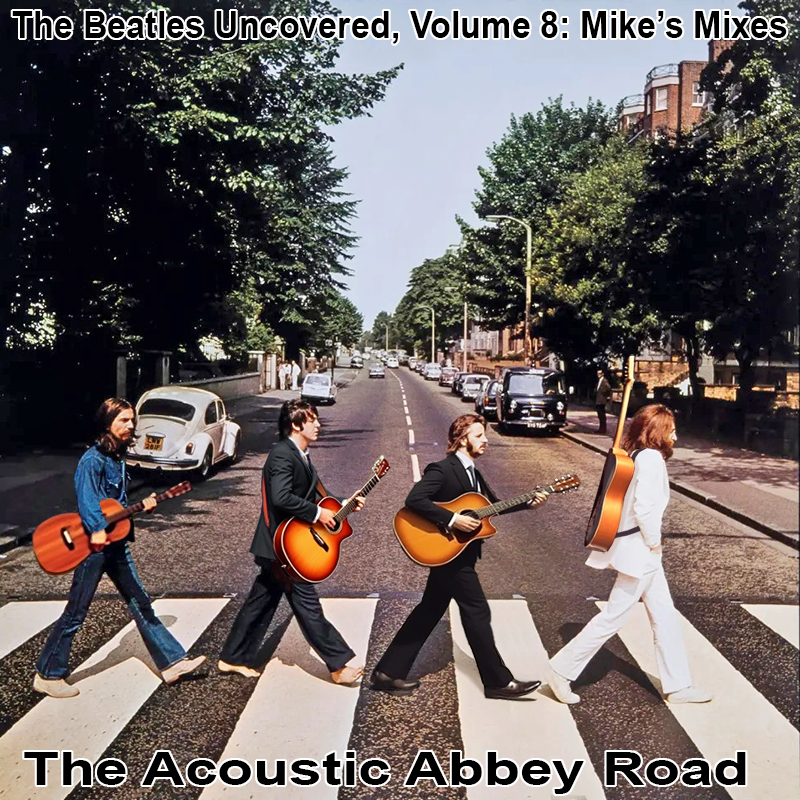
The cover image is another one Mike made using AI, imagining Beatles reunions that never happened. In my opinion, this one has a late 1970s vibe.

Wednesday, September 9, 2026

John Lennon, Paul McCartney, George Harrison & Ringo Starr - Solo Ballads, Volume 1 (1969-2026) (A Mike Solof Guest Post)

Yesterday, I posted "Solo Rockers, Volume 1," featuring rocking songs from the solo careers of the four Beatles. It was created by guest poster Mike Solof. This is the exact same concept, also done by Mike, but with ballads. There are different definitions of ballads, but in this case we're talking about love songs usually done in a more mellow mode than the rockers.

For the rockers, Mike's selection of songs was pretty straightforward. But when it came to picking ballads from the Beatles' solo careers, it was harder going. He found enough for three volumes, the same as for the rockers. But in some cases, he chose to make some new "Mike's Mix" edits of songs that toned down or removed drums and some other elements to help the songs fit into the ballad mode. His edit of "Blow Away" by George Harrison on this volume is a good example. The original, which was a hit in 1979, is pretty close to a rocker. But Mike's edit transforms it pretty dramatically, and hopefully allows you to appreciate the song in a new way. 

This album is 53 minutes long.

01 Bluebird (Paul McCartney)
02 Never without You [Mike's Mix 2026] (Ringo Starr)
03 Here Comes the Moon [Mike's Mix 2025] (George Harrison)
04 Every Man Has a Woman Who Loves Him [Mike's Mix 2025] (John Lennon)
05 So Bad (Lindsay Pagano & Paul McCartney)
06 I'm Yours (Ringo Starr)
07 Blow Away [Mike's Mix 2026] (George Harrison)
08 Heaven on a Sunday (Paul McCartney)
09 Old Dirt Road [Mike's Mix 2025] (John Lennon)
10 Little Willow (Paul McCartney)
11 I'll Still Love You (Ringo Starr)
12 Dark Sweet Lady (George Harrison)
13 Love [Take 31] (John Lennon)
14 Baby's Request (Paul McCartney)

https://pixeldrain.com/u/Hi6PcHRM

alternate:

https://bestfile.io/en/opD0riXacqTFSaL/file

Mike chose some more AI artwork that he found on the Internet for the cover.

Monday, September 7, 2026

John Lennon, Paul McCartney, George Harrison & Ringo Starr - Solo Rockers, Volume 1 (1969-2026) (A Mike Solof Guest Post)

In the 1970s, the Beatles remained extremely popular but there was no new Beatles music to sell, so the record companies repackaged their music in different ways. For instance, in 1976, an album called "Rock n' Roll Music" was released, containing all rocking Beatles songs. And in 1977, another one came out called "Love Songs." A similar one came out in most countries but the U.S. in 1980 called "The Beatles Ballads." Guest poster Mike Solof was inspired by these albums to create similar albums, but for the Beatles' solo careers. He's taken roughly equal numbers of songs by the four ex-Beatles and mixed them together. This was enough for three albums of rockers and another three albums of ballads. 

But wait, there's more! Paul McCartney has been prolific, and stubbornly refuses to die. (Ha ha) As a result, Mike also made an extra album each just for more rockers and ballads from him. So here's the first of eight albums. We'll start with some rockers.

Note there's nothing really new here. These are just already released songs, but hopefully repackaged in an interesting way. Just like those 1970s repackaged Beatles albums. By the way, interesting fact: "Rock n' Roll Music" went all the way to Number Two on the U.S. album chart in 1976, and was only kept out of the top spot by the Paul McCartney and Wings album "Wings at the Speed of Sound." 

As usual with Mike's posts, please check out the PDF file he's included with the download zip. 

This album is 54 minutes long. 

01 Save Us (Paul McCartney)
02 Rock and Roll People (John Lennon)
03 Horse to the Water (George Harrison)
04 You're Sixteen [You're Beautiful and You're Mine] (Ringo Starr)
05 The Mess [Reworked] (Paul McCartney)
06 Cleanup Time (John Lennon and Yoko Ono)
07 Cockamamie Business (George Harrison)
08 Lonely Road (Paul McCartney)
09 Snookeroo (Ringo Starr)
10 Cold Turkey (John Lennon)
11 Helen Wheels (Paul McCartney)
12 All Those Years Ago [Paul on Vocals, Ringo on Drums] (George Harrison)
13 After All These Years (Ringo Starr)
14 Big Barn Bed (Paul McCartney)

https://pixeldrain.com/u/tuCsvKEk

alternate: 

https://bestfile.io/en/plP5cXglEj9HZci/file

Mike is more of a fan of making new AI pictures than I am. In 1969, the Beatles played a short concert on top of Abbey Road studios in London. For this one, he asked an AI program to make an image of an imaginary Beatles reunion on that rooftop many decades later. Mike was particularly pleased at how the AI creatively added two big beer bottles at their feet. 

Wednesday, June 3, 2026

Covered: George Harrison, Volume 6: 2015-2025

Here's the sixth and last "Covered" album for George Harrison.

Most people love the Beatles, and pretty much all their songs. So all of the songs Harrison wrote that were done by the Beatles have gotten good cover versions in this series. But, with the exception of his very popular album "All Things Must Pass," his solo career has gotten much less attention, and thus fewer covers. I've strived to include covers of all the songs I like from him. I couldn't always find even a decent cover, but I was successful most of the time.

In my opinion, Harrison was a very fascinating songwriter. On one hand, being in the Beatles, he learned from Paul McCartney and John Lennon how to write very catchy and poppy melodies. But on the other hand, he had a natural tendency to write songs with unusual and complicated chords. This led to Lennon repeatedly complaining how difficult it was to learn how to play Harrison's songs. On Harrison's best songs, he somehow managed to combine being catchy and poppy with unusual and complicated chords and other musical moves. That's not easy to pull off. 

But unfortunately, that has been another big reason many Harrison songs haven't been covered that much. He almost never wrote three or four chord songs. Out of the six volumes, this is the one where I have the most of his obscure and rarely covered songs, usually from his solo career. That's because, when looking for cover versions, my last resort is to find unreleased versions by lesser known musicians on YouTube. Most of those have taken place in the last ten years or so (as I write this in June 2026). Songs that fall into that category on this volume include "Nowhere to Go," "Cosmic Empire," "Poor Little Girl," "Miss O'Dell," "Beautiful Girl," and more. However, I always maintained quality control. There are a few more Harrison songs I wanted to include where none of the cover versions I found were good enough, in my opinion.

Two of the songs here have "[Edit]" in them. For "Circles" by Pete Zolli, there was some drumming on the song that I didn't like. Something about it seemed off. So I used the MVSEP program to remove the drumming. I thought the song was better that way. And for "Miss O'Dell" by Christopher Clause, this is a nice song, but little known, since it only ever came out as a B-side. So I didn't have many covers options. The version by Clause is very good. However, it was something he did live in the studio and then posted on YouTube. And in the live version, he kept making brief talking asides during the instrumental parts of the song. I thought all that talking was unnecessary and distracted from the song, so I used MVSEP to get rid of that, and just keep the singing.

It's very sad that Harrison died as young as he did. It's also a shame, from a musical point of view, That from 1982 until his death in 2001, he only put out two albums of new songs. We could have had so much more music from him. But at least what he did was usually of a high quality. His Beatles songs will never be forgotten. But I hope this series helps people better appreciate the songs he wrote in his solo career as well.

This album is an hour and two minutes long. 

01 Crackerbox Palace (Jonathan Di Renzo)
02 This Is Love (Suburban Skies)
03 You Know What to Do (Weeklings)
04 Only a Northern Song (Walker's Run)
05 Fish on the Sand (Allah-Las)
06 Nowhere to Go (Danny McEvoy)
07 Piggies (Morgan James)
08 You Like Me Too Much (Randy Bachman)
09 Cosmic Empire (Mac Randall)
10 Not Guilty (Jeffrey Detrick)
11 Run of the Mill (Deer Tick)
12 Rising Sun (Jeff Andrews)
13 Devil's Been Busy (Leeroy)
14 Poor Little Girl (Judge Timbers)
15 Circles [Edit] (Pete Zolli)
16 End of the Line (Dominique Cotten)
17 Miss O'Dell [Edit] (Christopher Clause)
18 Beautiful Girl (Rod Switzer)

https://pixeldrain.com/u/WPizpn7X 

alternate:

https://bestfile.io/en/NMFjWDMwTqQklwz/file

The cover image is from about 2000.

Tuesday, June 2, 2026

Covered: George Harrison, Volume 5: 2010-2014

Here's the fifth "Covered" album out of six for ex-Beatle George Harrison.

As I mentioned in my write-up to the previous album, since Harrison tragically died in 2001, the volumes that come after that are playing catch up, with covers from all points in his music career. In fact, most of the songs here are from his Beatles years or from his great "All Things Must Pass" album, making this a particularly strong volume of familiar songs.

However, there's one song here that very few people will recognize, probably not even die-hard fans: "Silence Is Its Own Reply." Admittedly, including it here is a bit of a stretch, but I decided to do so anyway because it's a good song, and it's unlikely you'll find it elsewhere.

There's an interesting story behind this song. Around 1967 or 1968, Harrison wrote about ten lines of song lyrics on a piece of paper, and gave it the title "Silence Is Its Own Reply." At the time, author Hunter Davies was writing an authorized biography about the Beatles. While writing that, he asked for writing samples from each of the Beatles. These lyrics were given to him to show Harrison's writing. Davies published his book, simply called "The Beatles," in 1968, but the lyrics weren't included or mentioned. Then, decades later, around 2009, Davies rediscovered the lyrics while combing through his archives of papers as he prepared to write an updated version of his Beatles book. He mentioned the lyrics in a BBC interview. The BBC DJ was intrigued, and got a copy of the lyrics. That DJ then passed the lyrics on to a singer-songwriter named Dean Johnson, and gave him the opportunity to finish the song. 

Johnson did, and I think the result is very good. Keep in mind that only the title and the first verse were written by Harrison. Johnson came up with the melody and the lyrics for a second verse and bridge. But I think that still counts as a legitimate co-write. Unfortunately though, it seems that the song was never officially released, probably due to legal complications arising from Harrison's contribution. But I found a version Johnson performed for the BBC, cleaned up the sound some, and I'm including it here.

Adding to the interest, at first glance, the lyrics appear to be about romance. But when Johnson was asked about the meaning of the song, he had this to say: "The lyrics are of a personal nature and were first thought to be a song of unrequited love but, in hindsight, they seem to allude to George's uneasy relationship with John Lennon. This is substantiated by first-hand observations by Hunter Davies and by people close to Harrison." He said he did his best to follow through with the original meaning Harrison gave to the song.

In case you're curious, here's the portion of the lyrics written by Harrison:

I'm happy to say that it's only a dream
When I come across people like you
It's only a dream and you make it obscene
With the things that you think and you do
You're so unaware of the pain that I bear
And jealous for what you can't do
There's times when I feel that you haven't a hope
But I also know that isn't true

And every time I ask you why
Silence is its own reply 

Here's a newspaper article about the song: 

https://www.wirralglobe.co.uk/news/4687467.wirrals-dean-finishes-lost-george-harrison-song/

The only other comment I have to make about this album is that two other songs here are also officially unreleased, "Any Road" by Phil Lesh and Friends, and "Heading for the Light" by Susan Cowsill. Both had sound quality issues. I think I was able to fix those problems for "Any Road." But "Heading for the Light" still sounds pretty rough. However, it's one of my favorite Harrison songs from later in his career, so I had to at least include a version. If anyone finds a better version that it's a virtual carbon copy of the original, please let me know and I'll use that instead. (And it definitely is mostly written by Harrison, despite being credited to all of the Traveling Wilburys.) 

This album is one hour long. 

01 All Those Years Ago (Emmy the Great)
02 Apple Scruffs (Billie Amit)
03 Think for Yourself (Christine Collester)
04 Your Love Is Forever (Trevor Moss & Hannah Lou)
05 I Need You (Webb Sisters)
06 Silence Is Its Own Reply (Dean Johnson)
07 Awaiting on You All (Michael Carpenter)
08 Ding Dong, Ding Dong (Popdudes)
09 Art of Dying (Black Rebel Motorcycle Club)
10 Any Road (Phil Lesh & Friends)
11 Beware of Darkness (Ann Wilson)
12 Heading for the Light (Susan Cowsill)
13 Ballad of Sir Frankie Crisp [Let It Roll] (Jonathan Bates & Dhani Harrison)
14 Behind That Locked Door (Norah Jones)
15 It's All Too Much (Flaming Lips)

https://pixeldrain.com/u/YkPbKTAT 

alternate:

https://bestfile.io/en/AT5KAwbiaqxUmKA/file

The cover image is from "circa 2000."

Sunday, May 31, 2026

Covered: George Harrison, Volume 4: 2004-2010

Here is the fourth out of six "Covered" volumes for George Harrison.

Unfortunately, before the start of the time period of this volume, Harrison had already died. (He died in 2001 all too young, at the age of 58.) That means he wasn't putting out any more new music. So for this volume and the next two, we're basically playing catch up, with covers from earlier parts of his music career, including going back to his years with the Beatles.

The first song here is a special treat. It comes from the Rock and Roll Hall of Fame ceremony in 2004, because Harrison was posthumously inducted that year. This version of "While My Guitar Gently Weeps" has a lot of stars peforming on it, including some I didn't include in the song title, due to wanting to keep it short, like Steve Winwood and Dhani Harrison. But what really makes this version stand out is the wild guitar soloing by Prince. A lot of people were impressed, as you can see by the fact the YouTube video is up to 140 million views when I'm writing this in May 2026. But this version remains unreleased. 

Generally speaking, I try hard to only include one version of each song in a Covered series like this. But every now and then, there are cases where I can't resist adding more than one. For this series, I have two versions of "Something" (on Volumes 1 and 2, by Shirley Bassey and James Brown). I also have two versions of "If I Needed Someone." I included the Hollies version of that song on Volume 1, because they had a hit with it back in 1965. It made the Top Twenty in Britain. That was Harrison's first hit song, actually. 

However, I'm including a second version of that song here, even though it's not one of his most popular songs. That's because in 2004, Roger McGuinn did a version of it. McGuinn used to be the main singer for the Byrds, and Harrison wrote the song with a very obvious Byrds influence. It was one he openly acknowledged from the start. He even sent McGuinn an advanced copy of the song, along with a thank you note. So it's nice to finally hear what the Byrds might have done with this Byrdsy song.   

This album is an hour and one minute long.

01 While My Guitar Gently Weeps (Tom Petty, Jeff Lynne & Prince)
02 All Things Must Pass (Paul McCartney)
03 If I Needed Someone (Roger McGuinn)
04 Love Comes to Everyone (Eric Clapton)
05 Handle with Care (Jenny Lewis with the Watson Twins)
06 Stuck Inside a Cloud (Herb Eimerman)
07 Dark Sweet Lady (Nelson Bragg)
08 I Want to Tell You (Thea Gilmore)
09 Blue Jay Way (Secret Machines)
10 Within You, Without You (Patti Smith)
11 That's the Way It Goes (Joe Brown)
12 I Live for You (Tift Merritt)
13 Blow Away (Den Fiori)
14 Hear Me Lord (Chip Mergott)
15 Deep Blue (Carolina Lima)
16 Be Here Now (Robyn Hitchcock)

https://pixeldrain.com/u/61Dy14BG

alternate: 

https://bestfile.io/esiuW1bolSkXUjR/file

The cover image is from 1991.  

Friday, May 29, 2026

Covered: George Harrison, Volume 3: 1990-2003

This is the third out of six "Covered" volumes for George Harrison.

I had a lot to say about the development of Harrison's songwriting in Volumes 1 and 2. But after a flurry of activity in the late 1980s with his very successful "Cloud Nine" album and two albums with the Traveling Wilburys, his music career slowed waaaay down for the rest of his life. In fact, after a short tour of Japan with Eric Clapton in 1992, he pretty much retired from the music business for the rest of his life. He made slow progress on another studio album, "Brainwashed," but it wasn't released until 2002, a year after his death. 

Yet even though he spent many years away from music (with 15 years between his last two solo albums!), he did enough to get inducted into the Rock and Roll Hall of Fame in 2004 for his solo career, in addition to already being inducted in 1987 for being a member of the Beatles.

That brings us to his unfortunate death. He died on November 29, 2001, at the age of 58. On December 30, 1999, Harrison was attacked in his home by an insane man. He was stabbed over 40 times, and barely survived. He died in 2001 of lung cancer, probably a result of a life of smoking. But friends and family say he was physically strong until the knife attack on him in 1999, and quite weak after that. So they blamed the attack for putting him in a condition where he was unable to fight off the cancer.

At any rate, Harrison's songs weren't covered much in most of the time frame here. Only the first four songs in this volume were recorded prior to his death in 2001. But after he died, there was a flood of tribute concerts and cover versions to celebrate his great musical career.

One thing I want to address here is his role in the Traveling Wilburys, the short-lived supergroup consisting of Harrison, Bob Dylan, Tom Petty, Jeff Lynne, and Roy Orbison. I've tried to include covers of all the good songs Harrison wrote or co-wrote from his Beatles career and his solo career, at least when there are worthy cover versions of them. But with the Traveling Wilburys, I wanted to be more selective. Technically, all the songs on both of that band's albums were co-written by all the members. But in reality, most of them were primarily, or sometimes entirely, written by one member. So it doesn't make sense for me to include a cover of a song like "Tweeter and the Monkey Man" here, when that one clearly sounds like a Bob Dylan song. 

Thus, I did a little digging to figure out which Traveling Wilburys songs could be considered written or co-written by Harrison. Luckily, the band members gave some interviews where they talked about the songwriting process and who did what. I may well have missed some information though, so if anyone thinks I missed some songs by this band that are worthy of inclusion, please let me know.

Another problem I ran into with the Traveling Wilburys is that a few of their songs have been covered a lot, but many of them have very few covers. I had particular trouble with the song "Wilbury Twist." I found a Tom Petty interview where he explained that he co-wrote that one with Harrison, so that meant it merited inclusion. But I didn't find any cover versions I liked. So in the end, I just included the Traveling Wilburys version. I have a rule not to include songs by the songwriter highlighted by the "Covered" series unless there's some special reason. But in this case, a majority of the lead vocals are sung by other members in the band, so it's not exactly a cover of Harrison being the main singer anyway. 

This album is one hour long.

01 Wilbury Twist (Traveling Wilburys)
02 That Kind of Woman (Gary Moore)
03 Cheer Down (Rainer, Joey Burns & John Convertino)
04 I Me Mine (Elliott Smith)
05 Horse to the Water (Jools Holland, Sam Brown & Jim Capaldi)
06 For You Blue (Paul McCartney)
07 Isn't It a Pity (Eric Clapton & Billy Preston)
08 You (Lisa Mychols)
09 When We Was Fab (Wendy Ip)
10 Love You To (Marshall Crenshaw)
11 Wah-Wah (Jeff Lynne & Eric Clapton)
12 Savoy Truffle (They Might Be Giants)
13 Old Brown Shoe (Leslie West)
14 Devil's Radio (Masters of Reality)
15 Give Me Love [Give Me Peace on Earth] (Dave Davies)
16 Long, Long, Long (Elliott Smith)

https://pixeldrain.com/u/TKHomhYi 

alternate:

https://bestfile.io/en/2USkcxm1qimgtCf/file

The cover image is from 1986. 

Thursday, May 28, 2026

Covered: George Harrison, Volume 2: 1972-1989

Here's the second volume out of six "Covered" albums celebrating the songwriting of George Harrison.

When this album starts, in 1972, Harrison was seemingly on top of the world. His 1970 solo album "All Things Must Pass" was a huge critical and commercial success, hitting Number One in the U.S., Britain, and many countries. It surprised many by outselling the solo albums of John Lennon and Paul McCartney. 

For the first half of the 1970s, Harrison maintained a very active musical career. In addition to putting out his own solo albums, he produced and/or played on albums by other musical acts. We can see that here, especially with his help for fellow ex-Beatle Ringo Starr. There are no less than five songs here performed by Starr. 

"Back Off Boogaloo" follows the pattern of "Octopus's Garden" and "It Don't Come Easy" on the previous volume, in that it was solely credited to Starr when in fact it was co-written by Harrison. It was a big hit in 1972, especially in Britain, where it made it all the way to Number Two in the singles chart. But while those two songs I just mentioned are still credited only to Starr, in 2017, the official credits for "Back Off Boogaloo" changed to be a co-write with Harrison.

The same pattern continued for Starr's next big hit, "Photograph," which went all the way to Number One in 1973 in the U.S., Canada, and other countries. But this one was the first one to be officially credited to Starr and Harrison from the very beginning. Like all the other Starr songs mentioned above, it seems Starr started it, but needed a lot of help from Harrison to finish it off. Starr later said he was good at writing a verse or two, and a chorus, but then he often would get stuck. He also said of Harrison helping his songwriting in this era, "I only know three chords and he'd stick four more in, and they'd all think I was a genius."

But Harrison also wrote or co-wrote songs for others during this time period: "The Holdup" by David Bromberg, "So Sad (No Love of His Own)" by Alvin Lee and Mylon Lefevre, "Far East Man" by Ron Wood, and "I'll Still Love You (When Every Song Is Sung)" by Cilla Black. In all those cases, the cover versions included here came first. For "So Sad" and "Far East Man," Harrison released his own versions a year or two later.

Here's a fun fact about the version of "Something" by James Brown. That great song has been covered around 1,000 times, making it one of the most covered songs of all time. But Harrison said that Brown's version was his favorite out of all the covers he'd heard. In an interview many years later, he said, "There are a lot of really good versions of 'Something.' But the one that is just a killer, and nobody even knows about it except for a few friends of mine, is the James Brown version of it. He put it out as the flip side to a revamped version of 'Think.' And you gotta play it, it's just unbelievable." He even sent Brown a postcard complimenting him on it and suggesting that it should be released as an A-side instead.

Unfortunately, in the mid-1970s, Harrison lost a lot of the passion he'd had for his music career up until then. Here's a quote taken from a Wikipedia article: "Writing for Rolling Stone in 2002, Mikal Gilmore commented that 'the crises [Harrison] faced in the mid-1970s changed him,' and that depression was a key factor. Depression permeated many of the songs that Harrison wrote during this period, an issue that was not helped by his continued heavy drinking and cocaine use." As a result, he mostly stopped writing songs for others, and put out fewer albums himself. This trend deepened in the 1980s, when he only put out three studio albums, compared to six in the 1970s (with one of them being a double album).

As a result, Harrison's music didn't get the same attention in the 1980s, so there weren't as many covers. That's especially the case since he did very little to promote his career. The only concert tour he took in the 1970s and 1980s was in 1974. Only the last three songs here are from the 1980s. One of those, by the way, "Run So Far," was written for a 1989 album by Eric Clapton. However, Harrison's own version would be released in 2002.

This album is one hour long. 

01 Back Off Boogaloo (Ringo Starr)
02 What Is Life (Olivia Newton-John)
03 The Holdup (David Bromberg)
04 Photograph (Ringo Starr)
05 Something (James Brown)
06 Don't Let Me Wait Too Long (Rotten to the Core)
07 You and Me [Babe] (Ringo Starr)
08 I'd Have You Anytime (Ralfi Pagan)
09 So Sad [No Love of His Own] (Alvin Lee & Mylon Lefevre)
10 Sunshine Life for Me [Sail Away Raymond] (Ringo Starr)
11 Far East Man (Ron Wood)
12 I'll Still Love You [When Every Song Is Sung] (Cilla Black)
13 Dark Horse (Thomas Harris)
14 Wrack My Brain (Ringo Starr)
15 Cloud Nine (Gary B.B. Coleman)
16 Run So Far (Eric Clapton)

https://pixeldrain.com/u/PETt92E9 

alternate: 

https://bestfile.io/en/dkyCmpiTQNxZADj/file

The cover image is from the 1970s, but I don't know the exact year. 

Covered: George Harrison, Volume 1: 1964-1971

It's time that I tackle a truly great songwriter for the "Covered" series: George Harrison. I hope and assume that anyone reading the blog already knows that he was a member of the Beatles. This series includes songs he wrote while in the Beatles with songs from his long solo career afterwards. I found enough for six volumes.

Harrison is such a famous musician that I'm not going to try to sum up his life or even just his music career. But I do want to write some about the early evolution of his songwriting.

When it came to writing songs, he was a late bloomer. In the Beatles, John Lennon and Paul McCartney wrote about 100 songs separately or together before the Beatles released their first album in 1963. (A lot of them were discarded.) Harrison was watching and learning from one of the greatest songwriting teams of all time. But apparently it wasn't until 1963 when he wrote his first complete song, or at least one he considered good enough to show to the other Beatles. His "Don't Bother Me" would appear on the band's second album, "With The Beatles." He wrote it while sick in bed during the summer of 1963. He later said that it was as an exercise to see if he could write a song, and "at least it showed me that all I needed to do was keep on writing, and then maybe eventually I would write something good."

But despite this early success (which, in fact, was a good song), the next two Beatles albums went by without any original Harrison songs on them. (He occasionally sang cover versions on Beatles recordings instead.) He later said that he lacked confidence and found it hard to compete with what he called the many "wondrous hits" written by the Lennon-McCartney team. But then the 1965 Beatles album "Help!" contained two of his songs. From that point on, every Beatles album contained at least one of his songs, usually two, and once three. (There were four on 1968's "The White Album," but that can be seen as two albums with two of his songs each.) He also had the occasional song come out on a B-side or archival release. Ultimately, 22 of his songs were released while the Beatles were together, out of 188 original songs by the band in total. But a few more of his songs trickled out in archival releases, such as "You Know What to Do," "Not Guilty," and "All Things Must Pass." There are still more of his songs the Beatles tried in the studio but remain unreleased. Most of those eventually appeared on his solo albums.

Unfortunately, for many years, Lennon and McCartney underestimated Harrison's songwriting, and didn't do much to encourage him. The two of them were writing so many excellent songs that they weren't keen to find room for many of Harrison's songs as well. But by 1969, that changed. Harrison's two songs for the "Abbey Road" album that year, "Something" and "Here Comes the Sun," aren't just great Beatles songs, they're some of the best and most acclaimed songs of all time. "Something" is one of the most frequently covered songs ever, and as I write this in 2026, "Here Comes the Sun" is the most listened Beatles song on Spotify. 

As a result, Lennon and McCartney could no longer downplay Harrison's songwriting talent. Lennon called "Something" the best song on "Abbey Road." And, in 1969, McCartney said, "I think that until now, until this year, our songs have been better than George's. Now this year his songs are at least as good as ours." Also, decades later, McCartney had this to say: "It was easy to underestimate George because me and John... had always written most of the stuff... and George was a late bloomer as far as writing was concerned. He wasn't that interested in the beginning but then he started to get interested and, boy, did he bloom, you know? He wrote some of the greatest songs ever."

On September 8, 1969, the Beatles had an important meeting about their future plans. Ringo Starr couldn't attend, so the other Beatles made a tape recording of the meeting. That means a recording of exactly what was said has survived. In the meeting, due to the undeniable success of Harrison's songs on "Abbey Road," Harrison was treated as a songwriting equal to Lennon and McCartney, perhaps for the first time within the band. 

Lennon had been drifting away from the Beatles for some time, distracted by his relationship with Yoko Ono and hobbled by a heroin addiction. But in the meeting, he suggested the Beatles record a new album and a new single before the end of 1969, which would have been an ambitious schedule. He also suggested that he, McCartney, and Harrison get four songs each on every Beatles album moving forward, with Starr getting one or two if he wanted. (At this point, Starr had only written two songs on Beatles albums credited solely to him.)

Here's an entire article about that meeting. It's fascinating reading if you're a Beatles fan, with a lot of discussion about Harrison's songwriting and his role in the band: 

https://www.guitarplayer.com/guitarists/john-lennon-plan-to-keep-the-beatles-together

Unfortunately though, later that month, Lennon took part in a rock festival in Toronto, Canada, as a solo artist. That experience went so well for him that it gave him the confidence to want to leave the Beatles and have a solo career instead. About a month after that, he told the other Beatles he was leaving the band, although they kept that a secret for another six months due to wanting to present a united front in a legal dispute they were having with their record company.

However, even after Lennon's announcement he was leaving, there was still a chance the Beatles would continue, releasing more solo albums mixed with Beatles albums where Lennon, McCartney, and Harrison would get four albums each. Here's the audio of a radio interview Harrison did in March 1970 where he talked about the Beatles getting back together later in 1970 to record another album after all four of them did solo albums:

https://www.youtube.com/watch?v=F-fNA3Ee5eM 

Unfortunately, growing problems prevented that from happening, most especially due to financial conflicts between the band members as they fought over management and ended up suing each other. But that meant that by 1970, Harrison had a big backlog of excellent songs he'd been writing. Many of them came out on his classic and very successful solo album "All Things Must Pass" later in 1970. (Technically, it was a triple album, but it's basically a double album of songs because the third album just contains some long jam sessions.) A lot of those were written much earlier, but had been ignored by the other Beatles. For instance, "Isn't It a Pity" was written back in 1966, and had been rejected by the others for both the "Revolver" and "Sgt. Pepper's" albums!

Anyway, let me steer this more to discussing the songs on this volume. Across the six volumes in this series, I have included ALL the songs Harrison wrote for the Beatles, but most of them don't show up until later volumes, just because what I considered the best cover versions didn't happen until years later. Instead, this volume has many songs that Harrison was writing with and/or for other musical acts at the time, since usually the best (and often the only) versions were the first ones. So, for instance, "Sour Milk Sea" was a song he wrote for Jackie Lomax, though Lomax's 1968 single of it didn't make the charts. He co-wrote "Badge" with Eric Clapton, and it was released by the band Clapton was in at the time, Cream. 

"Hurdy Gurdy Man" is an interesting case. Donovan wrote it when he was vacationing in India with the Beatles and others in 1968. It was a big hit, making the Top Five in both the U.S. and Britain that year. But it turns out Harrison helped him out, writing a verse of the song by himself. But when the song came out as a single, the Harrison verse was missing. It was cut by the producer, due to the pressure of keeping a single under three minutes. Donovan later regretted this, saying it was the best verse in the song. He has often performed the Harrison verse in concert ever since. Apparently, Harrison was also very disappointed the verse wasn't included. I've used a live solo acoustic version from 1973 that includes that verse. But I put it in 1968 chronologically, since that's when Donovan's version of the song first came out (and when the Harrison verse should have come out as well).

"Octopus's Garden" is another tricky case. Technically, and legally, that song was written solely by Ringo Starr, and was included on the Beatles' "Abbey Road" album. But, in fact, it's pretty obvious to me that while the original idea was Starr's, Harrison played a key role finishing the song. At the time, Starr had barely done any songwriting, and he needed help. Harrison did Starr a favor by not asking for a songwriting credit. In both the "Let It Be" and "The Beatles: Get Back" films, one can actually see footage of Harrison helping him write the song while also teaching songwriting techniques.

Basically, the exact same thing happened with "It Don't Come Easy." The song was released as a solo single by Starr in 1971, and it made the Top Five in both the U.S. and Britain. Here's an except from the Wikipedia entry about the song: "Although Starr received sole writing credit for 'It Don't Come Easy,' Beatles historian Bruce Spizer writes that he had 'substantial, but uncredited, assistance' from his bandmate George Harrison. In author Robert Rodriguez's description, the official songwriting credit was long thought to be 'bogus' and, notwithstanding Starr's involvement, a sign of Harrison's 'great generosity' in wanting to help the drummer establish himself independently of the Beatles." Starr started writing it in 1968 by himself, but he had trouble finishing songs. I would guess Harrison wrote half or more of it.

A couple of songs here you might not recognize, even if you're a big fan of Harrison's music, because he never released his own versions of them: "Ain't That Cute" by Doris Troy, "Sing One for the Lord" by Billy Preston, and "I'm Your Spiritual Breadman" by Ashton, Gardner and Dyke. In each case, he was involved in the production and/or recording of albums by those artists, and got involved enough to write or co-write some songs. "Try Some, Buy Some" by Ronnie Spector was another case of that, but he eventually did release his own version of that one.

This album is 59 minutes long.

01 Don't Bother Me (Gregory Phillips)
02 If I Needed Someone (Hollies)
03 Sour Milk Sea (Jackie Lomax)
04 Hurdy Gurdy Man (Donovan)
05 Badge (Cream)
06 Octopus's Garden (Ringo Starr)
07 My Sweet Lord (Billy Preston)
08 Something (Shirley Bassey)
09 Ain't That Cute (Doris Troy)
10 Sing One for the Lord (Billy Preston)
11 Here Comes the Sun (Richie Havens)
12 Taxman (Junior Parker)
13 It Don't Come Easy (Ringo Starr)
14 I'm Your Spiritual Breadman (Ashton, Gardner & Dyke)
15 Try Some, Buy Some (Ronnie Spector)
16 Let It Down (Stone the Crows)
17 The Inner Light (Jimmy McGriff & Junior Parker)

https://pixeldrain.com/u/MtrvVGxu

alternate:

https://bestfile.io/en/IIi6h8Vu3ZIF8Yh/file

The cover image is from 1965.

Tuesday, May 12, 2026

Taj Mahal with John Fogerty, Bob Dylan, George Harrison, and Jesse Ed Davis - Palomino Club, Los Angeles, CA, 2-19-1987

This is a pretty amazing Taj Mahal concert, because just look at who his special guests were: John Fogerty, Bob Dylan, AND George Harrison! And all three of them stayed on stage for the vast majority of the concert, with Fogerty and Harrison singing several songs each. (Dylan was content just to play guitar and sing backing vocals.) I had known about this concert for a long time, but I'd never had it in my collection due to sound quality issues. But recently I revisited it, because advances in audio editing technology enabled me to make some improvements. Now, it sounds like a soundboard, even though the sound quality still is not ideal.

I found an extensive quote about this concert that George Harrison gave to Q Magazine in 1988, so I'll start with that:

"I'll tell you what happened there. I'd gone to America, and Bob [Dylan] rang me and said, you know, did I want to come out for an evening and see Taj Mahal who was playing at the Palomino? So we went there and had a few of these Mexican beers, and had a few more. And Jesse Ed Davis, who played guitar on 'Watching the River Flow,' is in the audience, and Bob says, 'Hey, why don't we all get up and play - we've had a few beers, right - and you can sing!' So we get up there and I'm in the spotlight and Bob's hanging back in the shadows and I start singing: 'What’s the matter with me? I don't have much to say...' and every time I get near the microphone, Dylan comes running up and just starts singing this rubbish in my ear, trying to throw me off. But it was really funny because when I got pushed on stage at Wembley [in London, with Tom Petty and the Heartbreakers and Dylan] and sang a bit of 'Rainy Day Women' I couldn't remember the words and just made up this stuff. And Bob came up to me afterwards, backstage, and said, 'So you got even with me!' But it was nice to recapture the feeling of what it was like on stage to make sure I could go back into that situation in the future."

Most of that is correct, but a couple of things he said were slightly off. We can tell a lot about what really happened because the video of this entire recording is available on YouTube, though the picture quality is extremely poor. It seems Jesse Ed Davis - a very talented lead guitarist who had worked with many big names since the late 1960s - was already there as part of Taj Mahal's backing band from the start of the recording. Then, after just the first song, Harrison went up on stage. It seems he went up unprompted, and there was absolutely no comment made by Mahal or anyone else about him being there. But if you watch the video, you can see Mahal give him an electric guitar and help him get in position to play by the start of the second song, "Checkin' Up on My Baby."

For a few songs, it was Taj Mahal and four members of his backing band on stage (Jesse Ed Davis, Mark Shark, Bobby Tsukamoto, and Gary Ray), plus Harrison. Then, before the start of "Matchbox," Mahal very strongly encouraged Dylan to also join them on stage, teasing him that he was going to come get him if he didn't. So Dylan went on stage, got a guitar, and started playing it.

Halfway through "Matchbox," Harrison surprised by taking over lead vocals for most of the rest of the song. Then, near the very end of the song, John Fogerty went on stage too. He was plugged in and ready to join in by the start of the next song, "Lucille." Once again though, there's no mention by Mahal or anyone else about him being there.

Up until that point, it had basically been a Taj Mahal concert. And Mahal was the sole lead singer for the next few songs. But Harrison, Dylan, and Fogerty stayed on stage for the entire rest of the concert. And from "Knock on Wood" to the end of the concert, 11 songs in all, Harrison and Fogerty stepped up and basically dominated. They sang lead on all but two of the songs from that point on.

However, if you're a Dylan fan, there's a lot less here for you. He was definitely involved playing guitar. If you watch the video, you can see he even got a couple of the songs started. And he did sing some backing vocals. But he seemed determined not to sing any lead vocals. When Harrison started singing "Watching the River Flow," it happened just as Harrison described in the above quote: Dylan basically shouted nonsense words right into Harrison's ear, playfully trying to get him to screw up! Perhaps Harrison, being a huge Dylan fan, started that song because he knew that Jesse Ed Davis played the guitar solo on Dylan's studio version, recorded in 1971. Davis got to reprise his solo in this performance.

One historic aspect of this concert was that it caused John Fogerty play a Creedence Clearwater Revival (CCR) song in public for the first time in 15 years. Many years later, he explained how it happened:

"I'd gone there to see Taj Mahal, who I love, and sat down. And at some point, I heard a rumor that George Harrison was there, that he was kind of in this cloak room. So I went in and talked to George for a little bit, and that was really fun. Then I went back and sat down. Then I heard a rumor that Bob Dylan was somewhere in the room. I didn't know until much later that actually George and Bob were really tight, they were great friends, and they had arrived together."

Fogerty watched from the audience as first Harrison and then Dylan joined Mahal on stage. "I'm usually kinda shy, but for some reason I thought, 'Man, I hope they have another guitar! Please call me up there!' I just wanted to get up there. It just looked historic and a lot of fun."

Apparently, Mahal saw Fogerty in the audience and gave him a signal to come up. After a while, the crowd wanted the famous guests to play some of their original songs. As mentioned above, Dylan's "Watching the River Flow" was played, although that seemed to be against Dylan's wishes. Then Harrison sang "Honey Don't." Although it was originally by Carl Perkins, it had been recorded by the Beatles. Plus, Harrison had helped sing "Matchbox," which also had been recorded by the Beatles. So now the pressure was on for Fogerty to do one of his songs. 

Fogerty further explained, "And then the audience started going, 'John, John! C'mon! Play "Proud Mary!" And this was during the time that I had sworn off playing my own songs from the Creedence days because of legal and emotional entanglements. I'm really being kind of, let's say, stubborn about it. But suddenly Bob Dylan turns me and he goes, 'John, if you don't play "Proud Mary," everybody's gonna think it's a Tina Turner song.' And I looked at him, and by God, I played 'Proud Mary.'" 

Clearly, he had fun. After the song finished, you can hear him say, "Eat your heart out, Tina!" 

Fogerty had just done a concert tour in 1986 for the first time since 1972. He wouldn't do another full tour until 1997. But later in 1987, he would take part in "Welcome Home," a benefit concert, and he would play more CCR songs for it. And he would keep playing them from that point on. So this Taj Mahal concert was a turning point for him, breaking his stubbornness about not wanting to give any royalties to his record company for the CCR songs. And while Dylan didn't do much singing on stage, his involvement may have been the key factor that got Fogerty singing his old songs again.

Now, let's get to sound quality. From what I understand, the owner of the Palomino Club saw something special was likely to happen, and began videotaping the concert. (He probably missed some Taj Mahal songs before the first one that shows up here.) So it has been recorded for posterity due to the video tape. That video later got converted to audio, and made into a popular bootleg under the name the "Silver Wilburys." However, that only included about half of the songs here, generally the later ones starring the famous guests. So I found a YouTube video to get the audio for the entire thing.

The sound quality was pretty good, but there was a lot of hiss, and some other issues. I ran all of it through the MVSEP program, using the "Denoise" filter to get rid of most of the hiss. Then I ran it through another filter to get rid of even more hiss. I also made some other adjustments, like boosting the lead vocals relative to the instruments. I think it sounds a lot better now. 

Additionally, there was a lot of dead air between songs. The musicians on stage were winging it, so it took time for them to decide what song to play next, then determine what key to play it in, and things like that. Most of that discussion couldn't be heard at all. Plus, there was a lot of guitar tuning. So I cut out some of that, when it started to really drag between songs. But still, I kept most it, especially whenever any talking on stage could be heard. I also turned down the volume of the guitar noodling between songs, so one could better hear what else was going on.

I made an additional edit on the song "Proud Mary," enough to add "[Edit]" to the song title. Taj Mahal was helping with the singing. On the other songs, this was fine. But this song was Fogerty's moment, singing a CCR song for the first time in 15 years, and Mahal's vocal ad-libs were a distraction for the most part. I read a comment on the YouTube video of this concert that likened his singing on that song to the way Yoko Ono sometimes ruined a John Lennon song. I had to agree. So, using MVSEP again, I cut out just the parts of his vocals that annoyed me. For instance, at one point, Mahal began singing one part of the song when Fogerty sang another part of the song. Needless to say, Fogerty sang the correct part. 

When listening to this, please keep in mind the spirit of this performance. After the first few songs, which Taj Mahal and his band knew well, it's safe to assume that the rest involved everyone winging it. So you have some mistakes that even an average bar band wouldn't make, like how Taj Mahal forgot half the lyrics to "Johnny B. Goode." But that wasn't point. Some legendary musical figures were just having fun on stage (including both Harrison and Fogerty playing some guitar solos). This is pretty much the only and only time in rock music history these people did anything like this. 

This album is an hour and 48 minutes long. 

Here's another photo from the concert. 

01 Leaving Trunk (Taj Mahal)
02 talk (Taj Mahal)
03 Checkin' Up on My Baby (Taj Mahal)
04 She Caught the Katy and Left Me a Mule to Ride (Taj Mahal)
05 Farther on Down the Road [You Will Accompany Me] (Jesse Ed Davis with Taj Mahal)
06 You're Gonna Need Somebody on Your Bond (Taj Mahal)
07 talk (Taj Mahal)
08 Matchbox - Gone, Gone, Gone (George Harrison & Taj Mahal)
09 talk (Everyone)
10 Lucille (Taj Mahal)
11 Crosscut Saw (Taj Mahal)
12 talk (Everyone)
13 Bacon Fat (Taj Mahal)
14 talk (Everyone)
15 Knock on Wood (John Fogerty with Taj Mahal)
16 talk (Everyone)
17 In the Midnight Hour (John Fogerty with Taj Mahal)
18 talk (Everyone)
19 Honey Don't (George Harrison)
20 talk (Everyone)
21 Blue Suede Shoes (John Fogerty & George Harrison)
22 talk (Everyone)
23 Watching the River Flow (George Harrison with Bob Dylan)
24 talk (Everyone)
25 Proud Mary [Edit] (John Fogerty with Taj Mahal)
26 talk (John Fogerty)
27 Johnny B. Goode (Taj Mahal)
28 talk (Everyone)
29 Willie and the Hand Jive (Taj Mahal)
30 Peggy Sue (George Harrison with Bob Dylan)
31 talk (Everyone)
32 Dizzy Miss Lizzy (George Harrison)
33 talk (Everyone)
34 Twist and Shout (John Fogerty & Taj Mahal)
35 talk (Taj Mahal)

https://pixeldrain.com/u/nStUSnDq 

alternate: 

https://bestfile.io/en/GV7bA4Zovc8wkh7/file

I was only about to find two photos of this concert that looked even halfway decent. I posted the best one as the cover, even though it only shows Dylan, Harrison, and a member of the backing band standing between them. I posted the other one up above the song list. It sounds the overall club environment, but you can barely make out who is on stage.

There also are a couple of photos of all the band members together back stage, which must have been taken after the concert, since Fogerty said he wasn't sure the likes of Dylan and Harrison were there when the concert began. The Native American musician John Trudell is in the picture as well. He was probably there to see Jesse Ed Davis, another Native American, who played on Trudell's albums. Unfortunately, Davis had a lot of problems with drug addiction. He died of a drug overdose a year after this concert took place.

Thursday, January 29, 2026

Various Artists - Rock and Roll Hall of Fame Induction Ceremony, Waldorf Astoria, New York City, 1-20-1988

Yesterday (January 28, 2026), Bruce Springsteen dropped a new song about the current problems with ICE in Minneapolis, called "Streets of Minneapolis." It's good to see a protest song that addresses current issues, since there haven't been many of those in recent years. (He wrote, recorded, and released it in four days!) Here's a link, if you haven't heard it already:

https://www.youtube.com/watch?v=wWKSoxG1K7w 

Anyway, I wanted to post something from Springsteen after hearing that inspiring song. However, some recent computer problems I've been having have flared up again, which means I currently can't use Photoshop, which in turn means I can't make new album covers until that's fixed. So I looked around to see if I had some Springsteen-related album ready to go, cover and all. Luckily, I did. (I have soooo many albums I could post tomorrow, if only I had the time to finish them off. Sigh!) This one doesn't have a ton of Springsteen content, but it's a really interesting (thought short) concert. So, in a way, my current computer issues have an upside in that they're getting me to finally post this.

Now, finally, to the music. The Rock and Roll Hall of Fame started in the early 1980s. In 1986, they had their first induction ceremony, complete with a short concert featuring some of the inductees and other famous musicians. This has become a yearly tradition. Some concerts have been a lot more memorable than others. In my opinion, the ones from 1988 and 1989 were the most interesting, with the biggest star power. I haven't collected the others (though I very may well do so with some of them in the future), but I've made albums of those two. This is the 1988 one.

1988 was a really big year for the Hall of Fame, because their rule is that artists are only eligible for induction 25 years after their first record (be it a single or album). And when they were making their decisions in 1987 for this ceremony, that meant they were looking at the artists who put out their first records in 1962. It just so happens that was the first year of recordings for the Beatles, Bob Dylan, and the Beach Boys! Those are three of the biggest and most influential musical acts of all time. The Drifters and the Supremes were inducted that year as well, plus some non-performers, like Berry Gordy.

The induction ceremony had a lot of intrigue and drama in it. The Beatles are arguably the biggest (and best, IMHO!) musical act ever, so they were the main focus here, even overshadowing Dylan and the other very big names. Since John Lennon was assassinated in 1980, he was represented by his wife Yoko Ono, and his sons Julian Lennon and Sean Lennon, and each of them gave short speeches. Ex-Beatles George Harrison and Ringo Starr were there, and also gave speeches. 

However, the big no-show was Paul McCartney. He was in the middle of a lawsuit still connected to the break-up of the band back in 1970, so he felt he couldn't attend due to that. He put out a statement: "I was keen to go to and pick up my award, but after 20 years the Beatles still have some business differences which I had hoped would have been settled by now. Unfortunately, they haven't been [settled], so I would feel like a complete hypocrite waving and smiling with [Harrison and Starr] at a fake reunion." 

It turns out the lawsuit, which involved the division of profits from record sales, was settled a year later. So that was unfortunate timing as far as this concert goes. But at least that opened the door to the "Anthology" collaboration between the ex-Beatles a few years later.

Normally, when I post albums like this, I skip long speeches and focus on the music. But I'm making an exception here. I didn't include all the induction speeches, but I thought the ones relating to the induction of the Beatles and Dylan were important enough to include. They're all together at the beginning of this album, and they are about 19 minutes long in total. If you don't want to hear them, or just hear them once or twice, there's still about 40 minutes of music after that.

A big element of the drama involved Mike Love, a member of the Beach Boys. Love is one of the most notorious assholes in rock and roll, something I've discussed in other posts. But he really outdid himself this time. He appeared to be drunk, and used his induction speech to insult various famous musicians in the audience. This led to a funny quip from Dylan during his acceptance speech: when he listed people he wanted to thank, he thanked Love for not mentioning him in his speech!

Anyway, there are lots of interesting stories about what happened during this event. But instead of trying to summarize them all here, I'll just point out to an article from Rolling Stone Magazine that does a good job:

Rock and Roll Hall of Fame 

I've also posted a text file in the download zip that has the text to that article.

Regarding the music here, everything was professionally recorded, so the sound quality is excellent. However, I found the lead vocals were rather low in most of the songs, so I boosted that up with the help of the MVSEP program. Also, there was a problem in the performance of "Stop in the Name of Love." Mary Wilson of the Supremes was asked to sing the song (since Diana Ross was another prominent no show). But it was clear for this songs, as well as all the other songs, that there hadn't been any practice beforehand, so everyone was just winging it. For the first chorus at the start of the song, Wilson sang the song in one key, while the band (or at least most of it) played in another key. That sounds pretty painful to my ears. So I erased that, and patched in a chorus from later in the song. That's why that one song has "[Edit]" in its title.

Oh, also, during all the talking between songs, where band leader Paul Shaffer was trying to direct things, one or more people on stage kept playing guitar so loudly that it nearly drowned out what anyone was saying. So for most of those tracks, I used MVSEP to lower the volume of the guitar enough to make the talking more audible.  

The songs "I Saw Her Standing There" and "(I Can't Get No) Satisfaction" were officially released on the compilation album "Rock and Roll Hall of Fame, Volume 1: 1986-1991." Everything else here remains unreleased.

By the way, when it comes to the song list below, I only listed the name of the main lead singers. For all the songs, there was one of the most amazing gatherings of musical talent ever seen on one stage together. But it's next to impossible to figure out who was on stage doing what, other than the lead vocals. So that's why I kept the credits in the titles relatively simple. 

However, just as one example, it was Jeff Beck who started playing the "(I Can't Get No) Satisfaction" riff that led to that song being played, right when it seemed everyone was leaving the stage. Some of the others who were on stage at least part of the time but don't get mentioned in the song titles include: Neil Young, Paul Simon, Johnny Moore, Joe Blunt, Clyde Brown, Tom Fogerty, Les Paul, Arlo Guthrie, Yoko Ono, Ringo Starr, Little Richard, Peter Wolf,  Dave Edmunds, Jeff Lynne, Julian Lennon, Sean Lennon, Little Steven, and Clarence Clemons.  

This album is an hour and six minutes long. 

01 talk (Mick Jagger)
02 talk (Ringo Starr)
03 talk (George Harrison)
04 talk (Yoko Ono)
05 talk (Julian Lennon)
06 talk (Sean Lennon)
07 talk (Bruce Springsteen)
08 talk (Bob Dylan)
09 Twist and Shout (Johnny Moore)
10 All Along the Watchtower (Bob Dylan with George Harrison)
11 talk (Paul Shaffer)
12 I Saw Her Standing There (Billy Joel & Bruce Springsteen)
13 talk (Paul Shaffer)
14 Stand by Me (Ben E. King & Julian Lennon)
15 talk (Paul Shaffer)
16 Stop in the Name of Love [Edit] (Mary Wilson)
17 talk (Paul Shaffer)
18 Whole Lotta Shakin' Goin' On - Hound Dog - Honey Hush (Elton John)
19 talk (Paul Shaffer)
20 Barbara Ann (Beach Boys)
21 talk (Paul Shaffer & John Fogerty)
22 Born on the Bayou (John Fogerty with Bruce Springsteen)
23 talk (Paul Shaffer & John Fogerty)
24 Like a Rolling Stone (Bob Dylan with Bruce Springsteen)
25 talk (Paul Shaffer)
26 [I Can't Get No] Satisfaction (Mick Jagger with Bruce Springsteen)

https://pixeldrain.com/u/SpmdHRju

alternate:

https://bestfile.io/yv9ChPKPJqpFcYT/file

The cover photo is from this exact concert. From right to left: Bob Dylan, George Harrison, and Mick Jagger.

Tuesday, August 19, 2025

The Beatles - Grugahalle, Essen, Germany, 6-25-1966

I usually don't post music by the Beatles here, even though they're my favorite musical act of all time. I generally leave that to guest poster Mike Solof, plus there are zillions of other Beatles bootlegs out there. But I'm making an exception in this case. This is a soundboard bootleg that only became publicly available in the last month or so (as I write this in August 2025). In terms of sound quality, it has to be the best of any 1966 live Beatles recording, and it sounds better than most of their other live stuff, including much of those that are officially released. 

Even if you already downloaded this elsewhere, I recommend you download this version, since it has the significant improvement of making the drumming audible.

That said, this should come with a warning, because the Beatles played raggedly in their 1966 concerts in general, and this one is no exception. The problem was, they'd been performing to screaming fans, mostly consisting of teenage girls, for three years by this time, and they were sick of it. They could barely hear themselves playing, due to all that screaming as well as very poor sound systems. So, while they still played with energy, they didn't worry about nailing their harmony vocals and being careful not to make mistakes and so on. They figured nobody would notice or care about the details. 

On the plus side, the set lists in their 1966 concerts got a lot more interesting, in my opinion. They still played a few songs they'd been playing in concerts since at least 1964, but they were also playing challenging brand new songs. For instance, "Paperback Writer" had only been released as a single two months earlier. While they didn't play any songs from their "Revolver" album, as it wouldn't be released until August, they did play a couple from their most recent album "Rubber Soul," such as "Nowhere Man" and "If I Needed Someone," as well as the recent single "Day Tripper."

The one main complaint people have had about this bootleg is the drums are very low in the mix. So I used the MVSEP program to boost the drums relative to everything else. In some places on a few of the songs though, the drums were so low that there wasn't enough there for the program to find. The only song where I didn't boost the drum volume was "I Wanna Be Your Man." Since that one was sung by the drummer Ringo Starr, I'm guessing his vocals microphone picked up a lot of the drumming too. Also, by fixing the drumming volume, one interesting thing that comes through is "Yesterday." On record, and usually in concert, it was just Paul McCartney's vocals and acoustic guitar, plus sometimes strings. But this version was arranged for a full band, including drums.

Also, "If I Needed Someone" has "[Edit]" in its title because there were some sound problems going on during that song, leading to some roadie loudly saying "One, two" in the middle of the song, probably because that person was testing if a microphone was working. So I just got rid of that jarring voice while keeping everything else the same.

This album is 31 minutes long. 

01 talk (Beatles)
02 Rock and Roll Music (Beatles)
03 She's a Woman (Beatles)
04 talk (Beatles)
05 If I Needed Someone [Edit] (Beatles)
06 talk (Beatles)
07 Day Tripper (Beatles)
08 Baby's in Black (Beatles)
09 talk (Beatles)
10 I Feel Fine (Beatles)
11 talk (Beatles)
12 Yesterday (Beatles)
13 talk (Beatles)
14 I Wanna Be Your Man (Beatles)
15 talk (Beatles)
16 Nowhere Man (Beatles)
17 talk (Beatles)
18 Paperback Writer (Beatles)
19 talk (Beatles)
20 I'm Down (Beatles)

https://pixeldrain.com/u/ZfZcCuJD

alternate:

https://bestfile.io/bizGeJf2w0o4heY/file

It's a really lucky break that I was able to find a color photo of this exact concert. I found a bunch of black and white ones, but just one color one, but one was all I needed.

Tuesday, March 18, 2025

The Beatles - The Beatles Uncovered, Volume 11: Mike's Mixes (1963-2023) (A Mike Solof Guest Post)

Here we go again. Like a dancing fool who just can't stop dancing, Mike Solof just can't stop editing Beatles songs. By now, you should know the drill. Mike takes songs by the Beatles, and well as a few from their solo careers, and remixes them in ways to bring out aspects you may not have appreciated before.

He really outdid himself with the first song here, "Run So Far." That song, written by George Harrison, first appeared on an Eric Clapton album in 1989. Then it appeared on a Harrison album in 2003. Discovering the two versions were in the same key, Mike combined the lead vocals to create a truly unique acappella mash-up, thanks to over 300 edits for just three minutes of music. Check it out! Then enjoy all the other interesting mixes.

Oh, and as usual, if you want to know more details, like what the edits are for each song, check out the PDF including in the download.

This album is 56 minutes long.

01 Run So Far [Mike's Mix 2025] (George Harrison and Eric Clapton)
02 Now and Then [Orchestra Version] [Mike's Mix 2025] (Beatles)
03 Piggies [Mike's Mix 2025] (Beatles)
04 Drive My Car [Mike's Mix 2025] (Beatles)
05 From Me to You [Mike's Mix 2025] (Beatles)
06 Good Day Sunshine [Mike's Mix 2025] (Beatles)
07 Rocky Raccoon [Mike's Mix 2025] (Beatles)
08 Rock and Roll Music [Mike's Mix 2025] (Beatles)
09 All My Loving [Mike's Mix 2025] (Beatles)
10 Norwegian Wood [Mike's Mix 2025] (Beatles)
11 Blackbird [Mike's Mix 2025] (Beatles)
12 You Know My Name [Look Up the Number] [Mike's Mix 2025] (Beatles)
13 Yer Blues [Mike's Mix 2025] (Beatles)
14 Got to Get You into My Life [Band Version] [Mike's Mix 2025] (Beatles)
15 Maybe I'm Amazed [Mike's Mix 2025] (Paul McCartney)
16 The Long and Winding Road [De-Spectorized Version] [Mike's Mix 2025] (Beatles)
17 No. 9 Dream [Mike's Mix 2025] (John Lennon)
18 Maggie Mae [Mike's Mix 2025] (Beatles)

https://pixeldrain.com/u/dmbRp1er

alternate:

https://bestfile.io/en/a1g6298C9uDpe0J/file

Mike selected the cover photo. I'm sure it's from 1969, but I don't know any details.

Tuesday, March 4, 2025

The Beatles - The Beatles Uncovered, Volume 10: Mike's Mixes (1963-1979) (A Mike Solof Guest Post)

Here we go again with another Beatles Uncovered album by guest poster Mike Solof.

With this being the tenth volume, hopefully you know the drill by now. Mike remixes Beatles songs to bring out aspects that are generally underappreciated. Sometimes, he even pulls up interesting little bits that you almost certainly never even knew where there in the first place. Most of the songs here are from the Beatles, but there are a few songs from their solo careers included as well.

Also as usual, if you want to know more, check out the PDF included with the download files. Mike has written explanations of the edits for all the songs.

This album is 58 minutes long.

01 I Am the Walrus [Mike's Mix 2025] (Beatles)
02 Two of Us [Mike's Mix 2025] (Beatles)
03 For You Blue [Mike's Mix 2025] (Beatles)
04 Can't Buy Me Love [Take 2] [Mike's Mix 2025] (Beatles)
05 I've Got a Feeling [Mike's Mix 2025] (Beatles)
06 Steel and Glass [Mike's Mix 2025] (John Lennon)
07 Eight Days a Week [Mike's Mix 2025] (Beatles)
08 Rain [Mike's Mix 2025] (Beatles)
09 Don't Pass Me By [Mike's Mix 2025] (Beatles)
10 Here, There and Everywhere [Mike's Mix 2025] (Beatles)
11 Here Comes the Moon [Mike's Mix 2025] (George Harrison)
12 She Loves You [Mike's Mix 2025] (Beatles)
13 Dear Prudence [Mike's Mix 2025] (Beatles)
14 The Continuing Story of Bungalow Bill [Mike's Mix 2025] (Beatles)
15 My Dark Hour [Original Mix] [Mike's Mix 2025] (Steve Miller & Paul McCartney)
16 Blue Jay Way [Mike's Mix 2025] (Beatles)
17 Being for the Benefit of Mr. Kite [Mike's Mix 2025] (Beatles)

https://pixeldrain.com/u/zU1o2nr7

alternate:

https://bestfile.io/en/lYmltO8gfuedMoA/file

The cover art is some art that Mike and I found while Googling about the Beatles and cats on the Internet. I don't know who originally made it. It's a parody of the "Beatles for Sale" album cover.

Tuesday, February 25, 2025

The Beatles - The Beatles Uncovered, Volume 9: Mike's Mixes (1964-1979) (A Mike Solof Guest Post)

It's time for another volume of "The Beatles Uncovered" by guest poster Mike Solof. We've made it to Volume 9, and Mike already has two more almost ready to go.

As usual, Mike has taken some Beatles songs, as well as a few songs from their solo careers, and remixed them to bring out hidden or little noticed aspects. You probably know the drill by now, if you've listened to any of his previous volumes in this series.

I don't feel the need to say much more, because Mike has detailed notes about the edits to each song in the PDF file he's included with the download zip, just as he's done with previous volumes.

This album is 59 minutes long.

01 A Day in the Life [Mike's Mix 2025] (Beatles)
02 Doctor Robert [Mike's Mix 2025] (Beatles)
03 If I Needed Someone [Mike's Mix 2025] (Beatles)
04 Revolution No. 1 [Mike's Mix 2025] (Beatles)
05 And I Love Her [Mike's Mix 2025] (Beatles)
06 Every Night [Mike's Mix 2025] (Paul McCartney)
07 Back in the U.S.S.R. [Mike's Mix 2025] (Beatles)
08 Ob-La-Di Ob-La-Da [Mike's Mix 2025] (Beatles)
09 Oh, Darling [Mike's Mix 2025] (Beatles)
10 Faster [Mike's Mix 2025] (George Harrison)
11 Good Night [Take 10 - Vocals Only Mix] [Mike's Mix 2025] (Beatles)
12 Cry Baby Cry [Mike's Mix 2025] (Beatles)
13 Come Together [Mike's Mix 2025] (Beatles)
14 I Me Mine [Mike's Mix 2025] (Beatles)
15 Happiness Is a Warm Gun [Mike's Mix 2025] (Beatles)
16 Scared [Mike's Mix 2025] (John Lennon)
17 A Hard Day's Night [Mike's Mix 2025] (Beatles)
18 Tomorrow Never Knows [Mike's Mix 2025] (Beatles) 

https://pixeldrain.com/u/XTQXMfLK

alternate:

https://bestfile.io/en/i7v7TLnEJ9v7eos/file

If you want an explanation for the, uh, rather unusual cover photo, you'll have to read the PDF file included in the download.

Friday, February 21, 2025

The Beatles - Star-Club, Hamburg, Germany, 12-1962

I've been on the verge of posting this very early live Beatles album for a few months now. One reason is the sound quality. Bluntly speaking, the sound quality is pretty bad compared to just about everything else I've posted at this blog. But the good news is, thanks to recent advancements in audio editing technology, it sounds better than it ever has before. Still, this is not for the casual fan. 

The second reason is the story behind this recording is very complicated, and I lacked the enthusiasm for a long write-up. So I ultimately decided to skip most of what I was thinking of writing. Instead, I can point you to a Wikipedia article for the short version:

Live! at the Star-Club in Hamburg, Germany; 1962 - Wikipedia 

But if you want to dig deeper, I've included a PDF of a lengthy but I think interesting article from Record Collector Magazine about the long and tangled story about this recording.

Before I go any further, I want to say: all hail Lord Reith! The only reason I'm posting this is because a super Beatles fan by that name has made repeated efforts to improve this recording, each one sounding better than the last. The most recent one is from late 2024 (as I write this in February 2025). All I'm basically doing is posting what he did, with minor changes. He even is the one who came up with the PDF of the article mentioned above. I've also included a text file from him that explains some more about what he did. If you want to find more of his Beatles-centric audio editing, search for his name at the Beatlegs forum. He's one of the best at this audio editing stuff, for sure.

Here's a link to that forum:

https://forum.beatlegdb.com/

Anyway, while I'm not going to write a tome about this recording, I will give the basics. As most Beatles fans know, the Beatles honed their musical skills playing in small clubs in Hamburg, Germany, from 1960 to 1962, before they became famous. This recording comes from December 1962, when they were on the brink of fame. Their drummer Pete Best had recently been replaced by Ringo Starr, who plays drums on everything here. Their debut single "Love Me Do" was released in October 1962, and reached Number 17 in the British charts around the time these recordings were made. In fact, the Beatles didn't want to play in Hamburg anymore, but they felt obliged to finish off a contract they'd signed many months earlier.

Their stay this time was relatively short. They played from December 18th until December 31st. Nobody knows the exact dates these recordings were made, except that they come from that time period. What happened was, recording equipment was set up, and every now and then someone hit the record button, and nobody kept track of details. There are three big continuous chunks, probably recorded on different nights. Plus, there are some extra individual songs recorded here and there. 

So what we ended up with was a luck of the draw thing. For instance, no recording of "Love Me Do" made it, despite that being their sole hit single at the time that they certainly must have played. And we only got a couple of originals, "I Saw Her Standing There" and "Ask Me Why." But what really makes this fascinating is the Beatles played a bunch of cover songs. Some covers made their early studio albums or singles, and some were done later at the BBC and thus recordings survived, but for many, maybe half of the songs here, these are the only Beatles versions we have. 

Note that this version isn't complete. If you want that, check out Lord Reith's version at the Beatlegs forum. I didn't cut out much, but I cut out a few songs that had sound problems, or were otherwise problematic, such as a version of "Road Runner" that barely got started and then petered out after less than a minute. I also cut out some dead time between songs when nobody was talking. But I tried to keep as much as possible. For instance, there are three versions of "A Taste of Honey" here because each one is somewhat different. One is the standard Beatles version. Another has a little-known extra verse. And another has singer Tony Sheridan guesting on it. (The Beatles backed him in the studio for a couple of songs in 1962.)

I also tried to make some improvements to Lord Reith's edits. I couldn't do much with the actual songs. But for the times between songs, I separated out just the talking (using the UVR5 program) from everything else, then lowered the volume of everything else. That helped somewhat, but be warned that the banter between songs is often unintelligible due to the poor sound quality.

Finally, I have a bit to say about the history of this recording. The actual recording was done by Adrian Barber, the stage manager of the club. Apparently, the Beatles gave approval in return for free beer! Barber then gave the tapes to Ted Taylor, the leader of the Dominoes, another band playing in the club at the time. Some other bands were recorded as well, but few people care about that since those other bands never made it out of obscurity. 

Taylor tried selling the tapes to record companies starting in 1973. However, there wasn't much interest due to the poor sound quality. Eventually, a rather obscure company bought the rights to the tapes, and spent about $100,000 trying to improve the sound. They had partial success at best. The album was released in 1977 with the name "The Beatles Live! at the Star-Club in Hamburg, Germany; 1962." Only 26 of the 30 different songs were included, with no duplicates. 

The Beatles then tried to sue, and years of legal battles ensued. Generally speaking, it was much like a game of whack-a-mole. Different versions of the album came out with different names and track lists in different countries, making it impossible to stop them all. In 1991 though, the massive company Sony tried to release a version. This led to more legal battles. Finally, in 1998, the Beatles won ownership of the tapes and the exclusive rights to release the material. They've just sat on them since. But after director Peter Jackson redid lots of material from the Beatles' "Get Back" sessions in 2022, he said he has the best version of this bootleg available, and he wants to use the latest cutting edge technology to make it sound truly good. Nothing has come of that since then, but who knows what the future may bring.

Anyway, if you want to know more about all that, check out the Wikipedia article above, or the PDF file included in the download. Hopefully, someday Jackson will perform a miracle on this material. In the meantime, this is the best version that's publicly available, in my opinion. 

Oh, another thing. When you listen to the vocals of the first song, you may think, "Who the heck is singing?" That's because that song, "Be-Bop-A-Lula," plus the third song, "Hallelujah, I Love Her So," were actually sung by other people and only backed by the Beatles. Horst Fascher, who sang one of those, was one of the club managers. He also was the club's bouncer and a former boxer. Fred Fascher, who sang the other one, was his brother. The Beatles relied on them for protection from unruly crowds, so letting them sing a little bit was a good way to keep them on their side.

My final comment: don't expect sonic miracles here. This is not for the casual fan, due to the sound quality. But it's fascinating if you're a die-hard Beatle fan and can handle the recording's flaws.

This album is an hour and 28 minutes long.

01 Be-Bop-A-Lula (Beatles & Fred Fascher)
02 I Saw Her Standing There (Beatles)
03 talk (Beatles) (Beatles)
04 Hallelujah, I Love Her So (Beatles & Horst Fascher)
05 talk (Beatles) (Beatles)
06 Red Hot (Beatles)
07 Sheila (Beatles)
08 talk (Beatles) (Beatles)
09 Kansas City - Hey, Hey, Hey, Hey (Beatles)
10 talk (Beatles) (Beatles)
11 Shimmy like Kate (Beatles)
12 talk (Beatles) (Beatles)
13 Reminiscing (Beatles)
14 talk (Beatles) (Beatles)
15 Red Sails in the Sunset (Beatles)
16 talk (Beatles) (Beatles)
17 Sweet Little Sixteen (Beatles)
18 talk (Beatles) (Beatles)
19 Roll Over Beethoven (Beatles)
20 talk (Beatles) (Beatles)
21 A Taste of Honey [Extra Verse Version] (Beatles)
22 Nothin' Shakin' [But the Leaves on the Trees] (Beatles)
23 I Saw Her Standing There (Beatles)
24 talk (Beatles) (Beatles)
25 To Know Her Is to Love Her [To Know Him Is to Love Him] (Beatles)
26 talk (Beatles) (Beatles)
27 Everybody's Trying to Be My Baby (Beatles)
28 talk (Beatles) (Beatles)
29 Till There Was You (Beatles)
30 talk (Beatles) (Beatles)
31 Where Have You Been All My Life (Beatles)
32 talk (Beatles) (Beatles)
33 Lend Me Your Comb (Beatles)
34 talk (Beatles) (Beatles)
35 Your Feet's Too Big (Beatles)
36 I'm Talking about You (Beatles)
37 talk (Beatles) (Beatles)
38 A Taste of Honey (Beatles)
39 talk (Beatles) (Beatles)
40 Matchbox (Beatles)
41 Little Queenie (Beatles)
42 talk (Beatles) (Beatles)
43 The Hippy Hippy Shake (Beatles)
44 talk (Beatles)
45 talk (Beatles) (Beatles)
46 A Taste of Honey (Beatles with Tony Sheridan)
47 I Remember You (Beatles)
48 talk (Beatles) (Beatles)
49 Ask Me Why (Beatles)
50 Besame Mucho (Beatles)
51 Mr. Moonlight (Beatles)
52 talk (Beatles) (Beatles)
53 Falling in Love Again (Beatles)
54 I'm Gonna Sit Right Down and Cry [Over You] (Beatles)
55 Long Tall Sally (Beatles)
56 I'm Talking about You (Beatles)
57 Twist and Shout (Beatles)

https://pixeldrain.com/u/CVJuAYuU

alternate:

https://bestfile.io/u7UoC9JNRT4FHtS/file

The cover photo shows the Beatles performing at the Star-Club at some point, though unfortunately Ringo Starr isn't included in the image. Note I used the venue's logo in the album title at the top.

Monday, November 25, 2024

The Beatles - The Beatles Uncovered, Volume 8: Mike's Mixes - The Acoustic Abbey Road (1969) (A Mike Solof Guest Post)

It's time for another guest post by Mike Solof. This one came out of a recent discussion I had with him. I told him that it's always been a wish of mine to have all acoustic versions of all the Beatles albums, much like the acoustic demos to Beatles made for the "White Album." Mike basically responded "Say no more!" and whipped up an acoustic version of the Beatles' classic 1969 album "Abbey Road." If you like this as much as I do, please encourage him to do others.

To make this, Mike used only the exact versions of the songs on the official album, no alternate versions. But interesting things are brought to light by stripping instruments away. If you want to know more, I suggest you read the PDF Mike included in the download file. He gives an explanation for what he did to every song. 

This album is 43 minutes long. Note the original "Abbey Road" is 47 minutes long. This is shorter mostly because several minutes at the end of "I Want You" weren't included, since there was nothing really acoustic about them.

01 Come Together (Beatles)
02 Something (Beatles)
03 Maxwell's Silver Hammer (Beatles)
04 Oh, Darling (Beatles)
05 Octopus's Garden (Beatles)
06 I Want You (Beatles)
07 Here Come the Sun (Beatles)
08 Because (Beatles)
09 You Never Give Me Your Money (Beatles)
10 Sun King - Mean Mr. Mustard (Beatles)
11 Polythene Pam - She Came In through the Bathroom Window (Beatles)
12 Golden Slumbers - Carry That Weight (Beatles)
13 The End (Beatles)
14 Her Majesty (Beatles)

https://spaces.hightail.com/receive/SZDdBte1ee

I came up with the idea of the album cover. Since this is an acoustic version of "Abbey Road," I thought it would be fun to change the iconic cover of the album to have the Beatles carrying acoustic guitars. Before, that just would have been a fun thought, but with the advances in AI art, it's actually doable. I used the free program Krea AI to make a bunch of variants of the cover, then picked the best bits. Then I used Photoshop to add in just those bits to the original cover.

And by the way, speaking of covers, if you open Mike's PDF, you'll see an alternate version of this with McCartney wearing giant sneakers. I made this as a joke after Mike jokingly complained about McCartney having bare feet. Mike liked the image so much that he wanted to use it for the actual cover, but cooler heads prevailed.