Wednesday, June 11, 2025

Texas International Pop Festival, Dallas International Motor Speedway, Lewisville, TX, 8-31-1969, Part 1: Incredible String Band - Herbie Mann

It's time for me to tackle more of the 1969 Texas International Pop Festival. With this album, I'm beginning the second day of the festival. So note in the album title this is "8-31-1969" instead of the 30th, and thus Part 1 (again). 

I really wanted to have one musical act per album, but this is the one exception. I was only able to find 11 minutes of the performance by the Incredible String Band, and 14 minutes of the performance by Herbie Mann, so I put them together. I don't know if they played back to back, but the odds are low that they did. At least it's known they both performed on the second day.

All the music on this album is from a soundboard bootleg source. I'd guess maybe half or less of the total music from the festival has been made public with soundboard sound quality, but it's very strange how it sometimes is only parts of sets, as is the case both times here. In some cases, I've found an audience bootleg to fill in missing pieces, but not here. So something is better than nothing, I guess.

I've already posted some Incredible String Band albums at this blog, so I don't need to introduce them. Obviously, they must have played more than two songs, but I couldn't find any complete set list for them.

Herbie Mann (who died in 2009 at the age of 73) had an unusual career. He was a jazz flutist. What was unusual was that he managed to have some pop hits, and got enough of a following to be invited to a rock festival like this one. No doubt, he wouldn't have been invited had it not been for his album "Memphis Underground," released in April 1969. Recorded in Memphis with soul musicians, it fused jazz and soul, and went on to become of the best selling jazz albums of all time. 

In this concert, all his songs were instrumentals, with his jazz flute being the lead instrument. Just like the Incredible String Band, he must have played more than two songs, but these are all we have. Here's his Wikipedia entry:

Herbie Mann - Wikipedia  

Regarding the festival in general, the attendance dropped about in half on the second day. That was largely due to the negative media coverage. The front-page headline on the morning of the second day in the Dallas Morning News was "Drugs Mar Pop Fest!" The article told of "freak-outs" and "bad trips" suffered by at least thirty youthful "hippies" who'd taken mescaline or LSD, requiring treatment in the festival's first aid tent. One of the festival's promoters later told Rolling Stone Magazine, "The press hurt us bad. I could just see parents looking up from their papers at breakfast and telling their kids, 'You're not going out there.'" In actual fact, the percentage of people having bad trips was extremely low compared to the overall size of the crowd, something that Dallas Morning News article even acknowledged deeper in the article. But one has to keep in mind the cultural conservatism in Texas at the time. It's a wonder the festival was allowed to happen at all. In fact, a similar festival planned to take place that same summer in Oklahoma City was cancelled by the authorities at the last minute.

A bigger problem was that the festival was really hot. Many people were treated for heat exhaustion, and also for cut feet, due to going barefooted. Another problem was outsiders who continued to go to the lake next to the venue to ogle at naked people skinny dipping there. But other than that, the festival ran quite smoothly compared to other festivals of similar size in that era.

Here's the list of all the music acts on the second day, in alphabetical order, since I don't know the actual order they appeared:

Chicago
James Cotton Blues Band
Delaney & Bonnie
Grand Funk Railroad
The Incredible String Band    
B.B. King
Led Zeppelin
Herbie Mann
Sam & Dave
Santana 

In addition to this album, I'm posting the sets from Led Zeppelin, Sam & Dave, and Santana. For all the others, they also performed on either the first day and/or third day as well, and I have albums from all of them on those days. So, very luckily, nothing really important is missed from this day.

This album is 26 minutes long. 

01 talk (Incredible String Band)
02 Waiting for You (Incredible String Band)
03 Black Jack Davy (Incredible String Band)
04 Tangier [Instrumental] (Herbie Mann)
05 Improvisation [Instrumental] (Herbie Mann)
06 talk (Herbie Mann)

https://pixeldrain.com/u/Qcq67t43

alternate:

https://bestfile.io/en/m59CqMvUzhl3F6i/file

Both photos are from this exact concert. On the left, that's Robin Williamson, one of the two lead singers for the Incredible String Band. On the right, that's Herbie Mann. Both of the original pictures were in black and white. I used the Kolorize program to colorize them.

Covered: John D. Loudermilk: 1956-2002

Here's another album for my "Covered" series, highlighting the talents of songwriters who got covered a lot. This one is for John D. Loudermilk.

Loudermilk is probably best known for three big hits: "Indian Reservation," a Number One hit in the U.S. for Paul Revere and the Raiders in 1971, "Ebony Eyes," a Number One hit in Britain for the Everly Brothers in 1961, and "Tobacco Road." That last one wasn't as big of a hit, although the Nashville Teens did have a hit with it in 1964. But its one of those songs lots of musical acts love to cover. Wikipedia says it "has since become a standard across several musical genres." 

However, he wrote many more hits than just those three, and his songs have been widely covered. He had a reputation for writing songs that were a little bit quirky and different from the usual.

Loudermilk was born in 1934, and grew up in a musical environment in North Carolina. In fact, two of his cousins made up the Louvin Brothers, a very famous country music duo. The first big hit of one of his songs, "A Rose and a Baby Ruth," happened in 1956, while he was 21 years old and still going to college. After that, he tried having his own career as a performing musician, and he ended up releasing many singles and albums. However, he only saw modest success that way. He had two songs that barely made it into the Top Forty in the U.S., "Sittin' in the Balcony" in 1957, and "Language of Love" in 1961, and some smaller hits. He found much more success having other musical acts record his songs. 

Most of his successes came in the late 1950s and all through the 1960s. He wrote many hits for many different musical acts. This album includes most of his best known songs, but there are plenty more that I didn't include. For instance, he wrote lots of country hits, and I was more selective with those since I'm not such a big country fan. 

Most of the songs here are the original hit versions, if they were hits. I've included a couple of lesser known songs performed by Loudermilk himself, "Road Hog" and "The Jones'," to show some of the diversity of his songwriting talent. The last really big hit he had was "Indian Reservation" in 1971. The four songs that come after than on this album are covers of songs that generally were first released a lot earlier.

It seems he retired from songwriting in the 1970s, and apparently was able to live on royalty checks. That freed him up to pursue passion projects, and he had many. For instance, in the 1990s, he devoted himself to traveling, studying ethnomusicology, chasing hurricanes, and doing research on Native American burial mounds! 

Here's the Wikipedia entry about him, if you want to know more:

John D. Loudermilk - Wikipedia 

But here's a better article that sums up his career:

LifeNotes: Songwriting Great John D. Loudermilk Passes - MusicRow.com 

This album is 50 minutes long.

01 A Rose and a Baby Ruth (George Hamilton IV)
02 Angela Jones (Johnny Ferguson)
03 Ebony Eyes (Everly Brothers)
04 Road Hog (John D. Loudermilk)
05 [He's My] Dreamboat (Connie Francis)
06 Norman (Sue Thompson)
07 Watch Your Step (Brooks O'Dell)
08 Windy and Warm (Ventures)
09 Abilene (George Hamilton IV)
10 Tobacco Road (Nashville Teens)
11 Bad News (Johnny Cash)
12 This Little Bird (Marianne Faithfull)
13 I Wanna Live (Glen Campbell)
14 The Jones' (John D. Loudermilk)
15 Indian Reservation [The Lament of the Cherokee Reservation Indian] (Paul Revere & the Raiders)
16 Break My Mind (Wreckless Eric)
17 You Call It Joggin' [I Call It Runnin' Around] (Mose Allison)
18 Then You Can Tell Me Goodbye (Maria McKee)
19 Turn Me On (Norah Jones)

https://pixeldrain.com/u/h2wgDDB2

alternate:

https://bestfile.io/en/Y1UEO9WQYOuk47p/file

There are very few color photos of Loudermilk from when he was young. So I had to resort to using the cover photo from the album "Blue Train." I don't know when the photo was taken because it's an archival album.

Sly & the Family Stone - Portland Campus Gym, University of Maine, Portland, ME, 10-24-1970

I'm posting this today because I heard that Sly Stone, leader of the band Sly and the Family Stone, died yesterday, June 9, 2025. He was 82 years old. 

There are surprisingly few good bootleg recordings for Sly and the Family Stone in their prime years. Heck, surprisingly few live recordings, period, other their their classic performance at the 1969 Woodstock festival. After hearing Stone died, I looked around bootleg sharing sites, and found this bootleg concert. It's an audience boot, which often isn't up to my sound quality standards. However, it's an unusually good audience boot. That's still not as good as a soundboard or radio show boot, but it's pretty close. 

To sweeten the pot a bit, I made a couple of fixes. For one, I reduced the crowd noise during the songs (while keeping it at the ends of songs) using the UVR5 audio editing program. I also boosted the lead vocals in some places, though it didn't need fixing for some songs. And there were a couple of drop outs where the music stopped for a second or two, and I fixed those as well. Plus, I cut out several minutes that were pretty boring at the beginning. Some of that was just lots of cheering. But also, Sly Stone gave kind of a speech at the beginning, and I chopped that down to just the more interesting parts.

By the way, this boot was recorded by someone named Joe Maloney. According to the notes that came with the version I found, the audience had to wait an hour and a quarter between the opening band and Sly and the Family Stone going on stage. This wasn't surprising, because by 1970 Sly Stone had become famous for being late to his own concerts, or missing them altogether, usually due to drug use. According to the Wikipedia article on Stone, in 1970, one fourth of the band's concerts were cancelled, while many of the others started very late.

 Maloney claims it was later found out that Stone was caught using heroin by the police during that wait time, but they ultimately decided to let him go on stage anyway to prevent the crowd from possibly rioting. I don't know if that's true - how would audience members know what happened behind the scenes, anyway? But that sort of thing did happen to Stone sometimes during this time period, because his drug use was out of control. However, Maloney claims that "As soon as the music started, 
it was like a switch had been flipped and Sly and the band came to life, turning in a performance that I still consider one of the ten best shows I've ever seen."

Sadly, the most surprising thing about Stone's death in 2025 is probably that he lived that long. He released a lot of great music in the 1960s and early 1970s, despite having a serious drug addiction from 1969 on. But drugs eventually took control of his life, and his great musical talent was largely wasted. He wrote an autobiography (or had it ghost written, probably) which was published in 2023, and a majority of it is an account of his life-long struggle with drug addiction. But still, he did great things when he was at his peak, which is amply shown in this concert.

This album is an hour and six minutes long.

01 talk (Sly & the Family Stone)
02 Thank You [Falettinme Be Mice Elf Agin] (Sly & the Family Stone)
03 M'Lady (Sly & the Family Stone)
04 talk (Sly & the Family Stone)
05 Sing a Simple Song (Sly & the Family Stone)
06 Stand (Sly & the Family Stone)
07 You Can Make It If You Try (Sly & the Family Stone)
08 Dance to the Music (Sly & the Family Stone)
09 Music Lover (Sly & the Family Stone)
10 I Want to Take You Higher (Sly & the Family Stone)
11 Hot Fun in the Summertime (Sly & the Family Stone)
12 I Want to Take You Higher [Reprise] (Sly & the Family Stone)

https://pixeldrain.com/u/h4mV4Wjb

alternate: 

https://bestfile.io/en/aRU1hZQcn3onmQ3/file

The cover is a close up of Sly Stone's head when he was young. I don't know any more details. 

Tuesday, June 10, 2025

Joan Armatrading - PBS Soundstage, WTTW Studios, Chicago, IL, 12-5-1979

It's time for another episode of the "PBS Soundstage" TV show. This one stars Joan Armatrading.

This concert took place at a strange time for Armatrading. She had been releasing an album a year for most of the 1970s, but she didn't release one in 1979. This was due to a financial dispute with her record company, which was later resolved. To fill the gap, a live album called "Steppin' Out" was released in Britain. But the record company didn't deem her popular enough to release the album there (though it did get released there many years later). Also to fill the gap, an EP was released in November 1979. One song on that, "Rosie," was a hit in 1980. This concert included a version of "Rosie," as well as "Love Song," which was otherwise only included on the "Steppin' Out" live album.

It's been a while since I put this album together, so I don't remember why two of the songs have "[Edit]" in their titles. Probably, it was due to voiceovers, since that was all too common a practice for this TV show. The sound quality is very good, despite this remaining unreleased. 

This album is 58 minutes long. 

01 Barefoot and Pregnant [Edit] (Joan Armatrading)
02 Rosie (Joan Armatrading)
03 talk (Joan Armatrading)
04 Cool Blue Stole My Heart [Edit] (Joan Armatrading)
05 talk (Joan Armatrading)
06 Back to the Night (Joan Armatrading)
07 Baby I (Joan Armatrading)
08 Love Song (Joan Armatrading)
09 Mama Mercy (Joan Armatrading)
10 Love and Affection (Joan Armatrading)
11 Show Some Emotion (Joan Armatrading)
12 You Rope Me, You Tie Me (Joan Armatrading)
13 Kissin' and a Huggin' (Joan Armatrading)
14 Tall in the Saddle (Joan Armatrading)

https://pixeldrain.com/u/66RaLUo2 

alternate: 

https://bestfile.io/en/DYKHlGSZ0nKXtNE/file

The cover photo is from a concert in Chicago, but not this concert. It's from the Park West venue, in July 1979. The original version was in black and white. But I colorized it with the help of the Kolorize program.

Monday, June 9, 2025

Don McLean - BBC Sessions, Volume 4: In Concert, Hard Rock Club, Manchester, Britain, 7-26-1975

I got a request today to post more of Don McLean's BBC stuff. I had one ready to go, so here it is. It's a short concert from 1975.

1975 was kind of an odd time for the BBC to want to broadcast a Don McLean concert. He'd had two huge hits in 1972 ("American Pie" and "Vincent") and two smaller ones in 1973 ("Dreidel" and "If We Try"), but then no more through the time of this concert. In fact, he didn't even release a new album in 1975. His previous album was "Homeless Brother" in 1974. He did have one very minor hit with the song "Wonderful Baby" from that album, but that isn't included here. However, some of the other songs are from that album, like "La La Love You," "Homeless Brother," and "The Legend of Andrew McGrew."

This is a solo acoustic concert, just McLean and his guitar. It also is fully unreleased.

This album is 48 minutes long.

UPDATE: On June 14, 2025, I updated the mp3 download file for this album. For one thing, I changed the name of the album from "Volume 2" to "Volume 4" after discovering two more BBC concerts I'd previously missed. I also added three songs I'd missed, "Banjo Instrumental," "Over the Mountains," and "Masters of War." 

01 talk (Don McLean)
02 Bronco Bill's Lament (Don McLean)
03 Empty Chairs (Don McLean)
04 La La Love You (Don McLean)
05 American Pie (Don McLean)
06 talk (Don McLean)
07 Homeless Brother (Don McLean)
08 Respectable (Don McLean)
09 Over the Waterfall - Arkansas Traveller [Instrumental] (Don McLean)
10 Over the Mountains (Don McLean)
11 Masters of War (Don McLean)
12 talk (Don McLean)
13 The Legend of Andrew McGrew (Don McLean)
14 Babylon (Don McLean)
15 This Little Light of Mine (Don McLean)
16 Vincent (Don McLean)

https://pixeldrain.com/u/2pVCWnzd

alternate:

https://bestfile.io/rlAsPaYpjsvqSSz/file

The cover photo shows Don McLean at the Grand Gala in Amsterdam, Netherlands on February 15, 1974.

Saturday, June 7, 2025

The Fortunes - BBC Sessions, Volume 2: 1966-1967

This is a second volume of the British band the Fortunes performing for the BBC. Like the first volume, it consists entirely of studio sessions.

As I mentioned in Volume 1, the Fortunes had a rather strange history of success, compared to other bands similar to them at the time. They had three hits in 1965 and 1966. But then, for many years, they had no hits at all, only to have some more hits in 1971 and 1972. Yet, despite that dry spell, the BBC kept putting them on their broadcasts. 

All the songs here are from the "Top of the Pops" radio show. That show is pretty much unique in how the vast majority of the broadcasts from this era survived in pristine condition, and that's the case with these.

During this time period, the band wasn't popular enough to put out albums, due to the lack of hits. In fact, they'd have no studio album between 1965 and 1970. For a lot of the songs here, no studio version was ever released on either singles or albums. That's especially the case for cover versions, like "Working in a Coalmine," "Opus 17," "I Couldn't Live without Your Love," "If I Were a Carpenter," "I Can't Help Myself," and "Waterloo Sunset."

All of the performances here have been officially released on the album "Live at the BBC." However, many of these versions are edited by me, to get rid of the BBC DJs talking over the beginnings or ends of songs. As usual, I used the UVR5 program to fix those, all ten songs with "[Edit]" in their titles.

This album is 49 minutes long.

01 Maria (Fortunes)
02 You Gave Me Somebody to Love (Fortunes)
03 Silent Street (Fortunes)
04 Opus 17 [Edit] (Fortunes)
05 Working in a Coalmine [Edit] (Fortunes)
06 Is It Really Worth Your While (Fortunes)
07 I Couldn't Live without Your Love [Edit] (Fortunes)
08 If I Were a Carpenter (Fortunes)
09 Sleeping Partner (Fortunes)
10 It's the Time of the Year [Edit] (Fortunes)
11 Just Give Me Something to Remind Me [Edit] (Fortunes)
12 I Know Just How You Feel (Fortunes)
13 Try a Little Harder (Fortunes)
14 Just One Smile [Edit] (Fortunes)
15 I Can't Help Myself [Sugar Pie Honey Bunch] [Edit] (Fortunes)
16 Waterloo Sunset [Edit] (Fortunes)
17 Just Another Dream [Edit] (Fortunes)
18 To Love Somebody [Edit] (Fortunes)

https://pixeldrain.com/u/3oEtHrqX

alternate: 

https://bestfile.io/qiN8p2yHjZEgebP/file

I don't know anything about this cover photo of the band except that it's "circa 1967." I used Photoshop to extended it at both the top and bottom. The AI couldn't extend the flower pattern on one of the jackets, which is why that stops.

The Wallflowers - PBS Soundstage, WTTW Studios, Chicago, IL, 5-3-2005

I'm posting episodes of the PBS TV show "Soundstage" in more or less random order. This time, the Wallflowers came up. If you're not familiar, the best known fact about the Wallflowers is that the band's lead singer and songwriter, Jakob Dylan, is the son of music legend Bob Dylan. It's easy to hear the connection in their similar voices. But Jakob wasn't just coasting on his father's fame, because the band has done a lot of good music, including a few hits that could be considered classics.

The Wallflowers are best known for one album, "Bringing Down the Horse." Released in 1996, it sold four million copies in the U.S. alone, more than any album by Jakob's illustrious father. This concert took place in the same month as the release of another album, "Rebel, Sweetheart." The album got some critical praise, but unfortunately by this time the sales had dropped greatly compared to 1996. Most of the songs performed are from that album, with some better known songs from earlier albums mixed in. Unfortunately, two of the band's biggest hits, "6th Avenue Heartache" and a cover of David Bowie's "'Heroes,'" are not included here.

Despite being unreleased, the sound quality is excellent, and there were no problems. The length does seem about five minutes short compared to most other episodes from around this time though, so I wonder if a song is missing. 

This album is 53 minutes long.

01 Sleepwalker (Wallflowers)
02 Everything I Need (Wallflowers)
03 talk (Wallflowers)
04 Here He Comes [Confessions of a Drunken Marionette] (Wallflowers)
05 We're Already There (Wallflowers)
06 Nearly Beloved (Wallflowers)
07 Empire in My Mind (Wallflowers)
08 Letters from the Wasteland (Wallflowers)
09 talk (Wallflowers)
10 Hand Me Down (Wallflowers)
11 talk (Wallflowers)
12 One Headlight (Wallflowers)
13 The Beautiful Side of Somewhere (Wallflowers)
14 The Passenger (Wallflowers)
15 talk (Wallflowers)
16 Three Marlenas (Wallflowers)

https://pixeldrain.com/u/tEjzdCDu 

alternate: 

https://bestfile.io/WUKoKPJomMJlQ7F/file

The cover photo of Jakob Dylan is from this exact concert.

Friday, June 6, 2025

Linda Ronstadt with Marian McPartland - Mechanics Hall, Worchester, MA, 4-10-2005

I recently posted an album from the start of Linda Ronstadt's music career. Here's one from near the end of her career. This is an unreleased concert of her singing jazz standards, backed only by the piano playing of Marian McPartland.

Marian McPartland was a jazz pianist for a long, long time. At the time of this concert, she was almost ninety years old! She died in 2013, at the age of 95. From 1978 to 2011, she hosted a music show on NPR radio called "Marian McPartland's Piano Jazz." This is from an episode of that show. It was recorded in 2013, but for some reason it wasn't broadcast until years later. (I also posted a concert of Norah Jones on McPartland's show, which you can do a search here for.) 

In late 2004, Linda Ronstadt released a studio album of jazz standards called "Hummin' to Myself." It was similar in style to the three albums she made with Nelson Riddle in the 1980s, and she said many of the songs were ones she never got around to doing back in those years. Ronstadt's voice was still in fine form for the album and this concert. But as it turns out, that wouldn't be the case for long. The last album she did was in 2006, the last time she sang on stage was in 2009, and her last studio recording is from about 2010. She gradually lost the ability to sing, due to a degenerative condition called "progressive supranuclear palsy." 

This concert had a lot of discussion between Ronstadt and McPartland between songs. In fact, it was too much talking for my tastes. So I cut out a lot of it. Much of it was easy to cut, parts that consisted of McPartland identifying the name of her radio show and talking about NPR. But also, there were many minutes in which the entire life story of Ronstadt was discussed in detail, amongst other things. I wanted to keep the focus on the songs that were being played. So I kept the talking that was relevant to that, and got rid of everything else. If you want to hear the whole thing, there are other versions of this bootleg that can be easily found.

I was surprised that only three songs performed were from the "Hummin' to Myself" album: "Tell Him I Said Hello," "I Fall in Love Too Easily," and "Miss Otis Regrets." Most or all of the other songs are from the three albums she did with Nelson Riddle in the 1980s, mentioned above. There also is an instrumental near the end composed by McParland that doesn't involve Ronstadt.

This album is 45 minutes long. 

01 talk (Linda Ronstadt with Marian McPartland)
02 Tell Him I Said Hello (Linda Ronstadt with Marian McPartland)
03 talk (Linda Ronstadt with Marian McPartland)
04 I Fall in Love Too Easily (Linda Ronstadt with Marian McPartland)
05 talk (Linda Ronstadt with Marian McPartland)
06 Guess I'll Hang My Tears Out to Dry (Linda Ronstadt with Marian McPartland)
07 talk (Linda Ronstadt with Marian McPartland)
08 Someone to Watch Over Me (Linda Ronstadt with Marian McPartland)
09 talk (Linda Ronstadt with Marian McPartland)
10 Get Out of Town (Linda Ronstadt with Marian McPartland)
11 talk (Linda Ronstadt with Marian McPartland)
12 Lush Life (Linda Ronstadt with Marian McPartland)
13 talk (Linda Ronstadt with Marian McPartland)
14 What'll I Do (Linda Ronstadt with Marian McPartland)
15 talk (Linda Ronstadt with Marian McPartland)
16 Miss Otis Regrets (Linda Ronstadt with Marian McPartland)
17 talk (Linda Ronstadt with Marian McPartland)
18 Portrait of Linda Ronstadt [Instrumental] (Linda Ronstadt with Marian McPartland)
19 talk (Linda Ronstadt with Marian McPartland)
20 I'll Be Seeing You (Linda Ronstadt with Marian McPartland) 

https://pixeldrain.com/u/KmjYudaT

alternate:

https://bestfile.io/mvPCnFdHXrnQ5Af/file

The cover photo is from the Bridge School Benefit concert at Shoreline Amphitheater, in Mountain View, California, on October 29, 2005.

Texas International Pop Festival, Dallas International Motor Speedway, Lewisville, TX, 8-30-1969, Part 5: Canned Heat

The fifth and final album from the first day of the 1969 Texas International Pop Festival is a set by the blues band Canned Heat. But don't worry, this is just the end of the first day of a three-day festival, so there's a lot more to come.

I know from various reports that Canned Heat were the last act of the first night. That meant they were a big deal, since they got an even more prized spot than Janis Joplin, who already was a big star. And they certainly were a very popular band by this time. They had two hit songs in 1968, "Going Up the Country," and "On the Road Again." They also made an impact performing at the Woodstock festival two weeks earlier.

The good news is, this is a soundboard recording, so the sound quality is excellent. The bad news is that it's incomplete, being just a little over half an hour long. Although no songs are cut off, there are several reasons I'm sure this is only about half of their performance. One is that they played for about an hour and ten minutes at the Woodstock festival, and a similar amount at the Atlanta festival, so it stands to reason they played a similar amount of time here. Also, this recording doesn't include versions of their two hit songs, "Going Up the Country" and "On the Road Again," but we know they played both of them at Woodstock. Finally, I found a mention that they didn't leave the stage until about 4:30 in the morning. The previous act, Janis Joplin, started shortly before one A.M. There's only half an hour recording of her set and half an hour recording of this one, and that isn't nearly until music to fill up three and a half hours.

It's likely this was the first half of the set, with their more popular songs coming towards the end, and thus missing here. I have no idea why a soundboard recording of some parts of some sets have survived and other parts are missing, but we should be grateful we have at least this much. Most of the other big festivals of 1969, like ones in Atlanta and Atlantic City, have been almost totally forgotten because of a lack of recordings, including bootlegs. (There are official live albums of Jimi Hendrix and the Allman Brothers at the Atlanta festival, but the 1970 festival, not the 1969 one.)

This album is 31 minutes long.

01 talk (Canned Heat)
02 Bullfrog Blues (Canned Heat)
03 Rollin' and Tumblin' (Canned Heat)
04 talk (Canned Heat)
05 Blind Owl Blues (Canned Heat)

https://pixeldrain.com/u/BBab7mrP

alternate: 

https://bestfile.io/en/4CjV5Bq6OpiH3RT/file

The cover photo is from this exact concert. It shows Bob "Bear" Hite, one of the band's two lead singers. The original was black and white, and blurry and low-res. I colorized it using the Kolorize program. Then I ran it through the Krea AI multiple times, filling in a lot of detail.

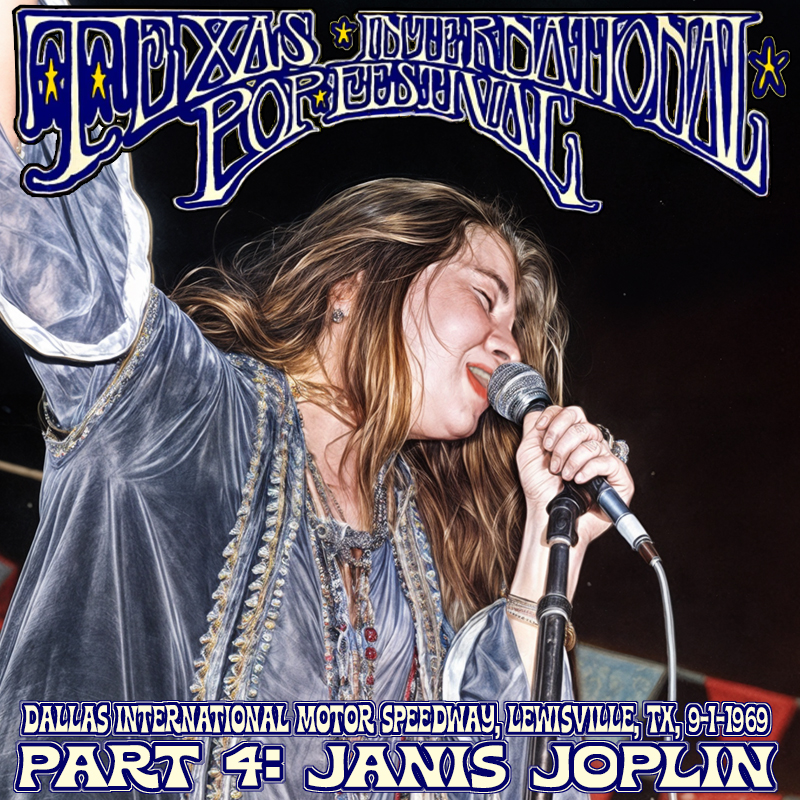
Texas International Pop Festival, Dallas International Motor Speedway, Lewisville, TX, 8-30-1969, Part 4: Janis Joplin

Here's the fourth album from the first day of the 1969 Texas International Pop Festival. It's a set by Janis Joplin. This time, I'm more sure about the order, since I know this was the second to last set of the day. 

Janis Joplin was the star of the first day of the festival, and probably the most anticipated act of the entire festival. She had been one of the standout acts at Woodstock two weeks earlier, and she was well known for her on-stage charisma. She had been a part of the band Big Brother and the Holding Company, but she went solo at the end of 1968. At the time of this concert, she hadn't yet released her first solo album, "I Got Dem Ol' Kozmic Blues Again Mama!" But it was due to come out less than two weeks after this concert, so many of the songs she played were from that album.

Even though Joplin was a big star, her set started late into the night. That's because the organizers of the festival screwed up with the timing. The audience was let in shortly before noon, but the first act didn't began playing until about four P.M. Then there were big delays between acts. As a result, Joplin took to the stage close to one in the morning. The set here seems short, at a little over half an hour, but that's because it's incomplete. It's known that the last song she performed was "Piece of My Heart," and she also played "Work Me, Lord," and neither of them are included here. So it's possible some other songs are missing as well. Just two weeks earlier, her set at the Woodstock festival lasted slightly over an hour, so it's likely she played a similar amount of time at this festival.

Her performance lived up to expectations, and she left the stage to a long standing ovation. 

The concert was a particularly emotional one for Joplin, because she had been born and raised in Texas. Growing up in Port Arthur, off the Gulf of Mexico about three hundred miles away, she had been very unhappy because she already was a hippie of sorts in the early 1960s and she didn't know anyone else unconventional like her. After performing "Work Me, Lord," which I mentioned isn't included here, she reportedly happily told the crowd, "You're looking great! Texas never looked like this when I lived here, man. But man, look at you now!" 

She moved from Texas to California in 1966. After the concert, she told reporters that this was only the second time she'd been back to Texas after moving. She said, ""I had to get out man, they were fuc*ing me over." She also said that she planned to visit her family in Port Arthur in the days after the concert.

The recording is a soundboard that sounds excellent. The only problem, as mentioned above, is that it's incomplete. At least none of the songs here got cut off.  

This album is 32 minutes long. 

01 talk (Janis Joplin)
02 Raise Your Hand (Janis Joplin)
03 As Good as You Been to This World (Janis Joplin)
04 talk (Janis Joplin)
05 Try [Just a Little Bit Harder] (Janis Joplin)
06 talk (Janis Joplin)
07 Maybe (Janis Joplin)
08 To Love Somebody (Janis Joplin)
09 Summertime (Janis Joplin)

https://pixeldrain.com/u/HzzKCy8p

alternate: 

https://bestfile.io/en/2GAZ3CYz1CpjVQ0/file

The cover photo is from this exact concert. It was in black and white, so I used the Kolorize program to colorize it. I also used the Krea AI program to improve the detail. 

Texas International Pop Festival, Dallas International Motor Speedway, Lewisville, TX, 8-30-1969, Part 3: Rotary Connection

Here's the third album from the first day of the 1969 Texas International Pop Festival. As is typical of this festival, I don't know the exact order of the acts, so I'm making an educated guess. This is a set of the band Rotary Connection.

Rotary Connection was an American psychedelic soul band that existed from 1966 to 1973. They had some critical acclaim, but they never had any hit singles or big selling albums. In retrospect, probably the best known thing about this band is that Minnie Riperton was one of its two lead singers. She had a Number One single in the U.S. in 1974 with the song "Lovin' You," then died of cancer at a young age in 1979. 

Riperton was known for her voice, which had a truly incredible five-octave range. The band's other main lead singer, Sidney Barnes, had a good soulful voice as well. However, they didn't do a lot of original material. Their two studio albums released prior to this concert consisted entirely of cover versions, and their set here mostly consisted of covers. The concert was probably the pinnacle of their career, and the largest crowd they played for, by far. 

This recording is from an excellent soundboard source. That's a lucky thing, because no official live album was ever released by them, and this seems to be their one and only bootleg recording.

Here's their Wikipedia entry:

Rotary Connection - Wikipedia 

This album is 53 minutes long. 

01 Lady Jane (Rotary Connection)
02 talk (Rotary Connection)
03 Ruby Tuesday (Rotary Connection)
04 talk (Rotary Connection)
05 Call It Stormy Monday (Rotary Connection)
06 talk (Rotary Connection)
07 The Whole Creation - Call It Stormy Monday [Reprise] (Rotary Connection)
08 Sunshine of Your Love (Rotary Connection)
09 talk (Rotary Connection)
10 Let the People Talk (Rotary Connection)

https://pixeldrain.com/u/izPE66n4

alternate:

https://bestfile.io/en/4CjV5Bq6OpiH3RT/file

The cover image is from this exact concert. I was only able to find this one black and white photo, so I colorized it using the Kolorize program. Then I improved it with the use of the Photoshop and Krea AI programs.

Thursday, June 5, 2025

Texas International Pop Festival, Dallas International Motor Speedway, Lewisville, TX, 8-30-1969, Part 2: James Cotton

Here's the second album from the first day of the 1969 Texas International Pop Festival. It features blues musician James Cotton. (Technically speaking, the act was called the James Cotton Blues Band.)

As I mentioned with the first album I posted from this festival, I don't actually know the exact order of the sets. One problem is that only some of the sets from the festival survive. Here are all the sets from the first day, in alphabetical order:

Canned Heat
Chicago
James Cotton
Grand Funk Railroad
Janis Joplin
B.B. King
Herbie Mann
Rotary Connection
Sam & Dave 

Out of those, I don't have Grand Funk Railroad, B.B. King, Herbie Mann, and Sam and Dave. However, luckily, many acts at the festival performed more than one set, and I have at least some of the sets from everyone in that list. I do know a few things, such as the fact that Janis Joplin was second to last, and Canned Heat was last. So this spot is an educated guess.

One nice thing about this festival compared to Woodstock and other 1969 rock festivals is that there was more musical variety, especially the inclusion of blues, jazz, and soul acts. This album is a good example. Cotton didn't perform at Woodstock.

This is the first album I've posted from James Cotton. He first came to attention playing harmonica in Howlin' Wolf's band, then Muddy Waters' band. He was the bandleader for Waters from 1955 to 1965, when he left for a solo career. As you can guess from his links to Howlin' Wolf and Muddy Waters, he was one of the best harmonica players in the blues scene, as well as singing lead vocals. 

Here's the Wikipedia entry, if you want to know more about him: 

James Cotton - Wikipedia 

The entire set is from a soundboard source. I edited it a bit, boosting the lead vocals relative to the instruments, using the UVR5 program. In this festival, Cotton generally played blues classics, with a couple of soul classics, along with a few originals.

Cotton also played a set on August 31st, but no recording of that one seems to have survived. 

This album is an hour and one minute long. 

01 Cut You Loose [Instrumental] (James Cotton)
02 Fallin' Rain [Instrumental] (James Cotton)
03 Heart Attack (James Cotton)
04 Knock On Wood (James Cotton)
05 talk (James Cotton)
06 Nine Below Zero (James Cotton)
07 talk (James Cotton)
08 Dust My Broom (James Cotton)
09 The Creeper (James Cotton)
10 Turn On Your Lovelight (James Cotton)
11 Please, Please, Please (James Cotton) 

https://pixeldrain.com/u/4n85myW6

alternate: 

https://bestfile.io/en/0qC27AO3taKh1mX/file

The cover photo of Cotton is from this exact concert. I could only find a black and white photo of him. However, I also found a very low-res video of a bit of his performance. It was enough for me to figure out the color of his shirt. I used the Kolorize program to colorize the image, then I used the Krea AI program to improve the image quality.

Texas International Pop Festival, Dallas International Motor Speedway, Lewisville, TX, 8-30-1969, Part 1: Chicago

Many months ago, in late 2024, I got everything ready to post the 1969 Texas International Pop Festival here at this blog. But I've been putting it off and putting it off, because it's a lot to deal with. I have no less than 19 albums to post from the festival! So rather than keep delaying, I've finally decided to post it in chunks, to make it a more manageable task. This first chunk starts with a set by Chicago.

1969 was the first big year of large rock festivals, and it was arguably the best year, before problems with hard drugs and commercialism crept in. One 1969 festival overshadows all others: Woodstock. Certainly, that had the biggest cultural impact. But in terms of the actual music, there were some other festivals that were almost as good. The problem is, most of these other festivals weren't recorded, or if they were the recordings either are poor audience bootlegs or they're sitting in some record company vault. The Texas International Pop Festival is the one big exception to this. For some reason, soundboard bootlegs exist for much of the festival (though certainly not all of it), and high quality audience bootlegs can fill in some of the important missing bits. Between the sheer number of quality acts in the festival, and the quality of the recordings, this is a "must have" for anyone interested in the music from the era, in my opinion.

Since this is the first album I'm posting from the festival, let me give some background to the festival as a whole. There were over 40 rock festivals in 1969, most of them in the summer, but there were only a handful of really big ones. The first really big one took place in Atlanta in July, the Atlanta International Pop Festival. A 25 year old Texan named Angus G. Wayne III attended. He was the son Angus G. Wayne, the founder of the Six Flags Over Texas amusement park, so he had some money, and he wanted to get into the music promotion business. He loved the Atlanta festival and decided Texas needed one. So he immediately joined with Alex Cooley, the main promoter of the Atlanta festival, to quickly put one together before the summer ended. 

Wayne and Cooley didn't have much time, and they didn't have much money. They only had $120,000 to pay for the music acts. But that much money went a long way back then, apparently, because they were able to put together a stellar line-up of 26 different acts for a three-day festival, while spending no more than $10,000 on any one act. For the location, they chose a racetrack in Huntsville, a town of only 8,000 people on the outskirts of the Dallas-Ft. Worth area.

As chance would have it, another big festival took place two weeks before the Lewisville one: Woodstock! At the time the Lewisville festival was planned, the planners had no idea what a big deal Woodstock would be. It definitely increased interest in their festival too. Many people who missed out on Woodstock came from all over the U.S. and beyond to at least attend this similar festival.

But at the same time, Woodstock increased negative publicity on what they were trying to do. Keep in mind that Texas was a very politically and cultural conservative state back then, even more than it is now. That went doubly so for rural towns like Lewisville. The promoters got all the necessary permits before the Woodstock festival. Once the conservative leadership of Lewisville heard the news coming out of Woodstock, they tried to stop it, but there were too late. However, there was a concerted push to at least bad-mouth the festival, especially in the media. For instance, the Dallas Morning News published an editorial before the festival, titled "Nausea at Lewisville." 

Here's just a short except from that editorial, which reads today almost like an over-the-top parody of intolerant conservatism: 

"Young people assembling to hear music is one thing. Young people assembling in unspeakable costumes, half-naked, bare-footed, defying propriety, and scorning morality is another. ... Who and where are their parents? Where do these young people get the money to loaf around the country in their smelly regalia? ... The great majority of youngsters in this area are at home where they ought to be, mowing yards, working part-time jobs, and preparing for useful lives. In the meantime, the lewd and loose in Lewisville will swing and sway. They are to be pitied."

Due to that sort of backlash, many people were scared off from attending, especially due to parents who wouldn't let them go. The promoters were hoping for 200,000 or more to attend, but the real attendance was more like 120,000. Tickets were $6 per day, which was cheap even for the era. The promoters ultimately lost money, mostly due to increased insurance and security costs due to fears generated by the conservative backlash. 

But still, it was widely seen as a successful festival. The weather was sunny all three days, which meant no mud, and the crowd was cheery and peaceful. Only one person died (due to heat exhaustion, not drug use). The police were overwhelmed by the sheer numbers and generally stayed outside the venue. That meant drug use inside the venue was rampant, but mostly just pot and psychedelics, because hard core drugs like heroin hadn't become a big problem with hippies yet.

The main "problem" was that some men and women went skinny dipping in an adjacent lake each day of the festival. This drew lots of curious outsiders, who rushed to the lake to see naked people. The police actually spent most of their time and energy trying to keep reactionary onlookers away from the nude bathers, who probably only numbered a couple dozen at most.

So that's the basic gist about the festival. If you want to know more, here's the Wikipedia page:

Texas International Pop Festival - Wikipedia 

But I found a fan site about the festival that's more interesting: 

https://www.austinnewsstory.com/TIPF/pop.htm

That had links to a longer essay about the festival. The links are dead, but I found an archived version. Most of the information I'll be writing about the festival comes from this multiple-page account, which starts here: 

https://web.archive.org/web/20160831184630/http://www.watermelon-kid.com/history/dallas/features/sonbeth/SixtiesDallas-sonbeth2.htm

Now, let's get to this album, and the surviving recording of it. Chicago released their first album, called "Chicago Transit Authority," in 1969. (The band was also called "Chicago Transit Authority" at the time, but I'm choosing to ignore that because they quickly changed their name when the real Chicago Transit Authority, a government entity, threatened to sue them.) At first, the band was unknown, but they began to slowly grow in popularity due to lots of touring, especially at festivals like this one. In fact, their first album wouldn't peak in the album charts until 1971, two years after it was released! So it's a safe bet that few people in the audience knew of the band beforehand, but they were well received.

The recording for this album is rather unusual for the festival because it comes from three different sources. Some acts played twice, or even occasionally three times, over the three days of the festival. Chicago was one of these acts, playing sets on both the first day, August 30, and the second day, August 31. The first eight tracks here are from a soundboard of the August 30th set. Tracks nine and ten are from a soundboard of the August 31st set. The last three tracks are from an audience bootleg, also from August 31st. (There were a few more songs from the audience boot that I didn't include since there are soundboard versions from August 30th.) 

Those last three tracks don't sound as good as the others, but they still sound fairly good. The audience boot was a pretty good one for the era. But also, I used some tricks to make them sound better. I used the MVSEP program to reduce the crowd noise during the songs. I also used the UVR5 program to boost the lead vocals relative to the instruments.

Note that I'm not entirely sure of the order of music acts at the festival, but I have a rough idea, thanks to that longer essay linked to above, and other sources. Chicago didn't open the festival; Grand Funk Railroad did. However, their set from this day isn't available (though a later one is). But Chicago was one of the first, I think. If anyone knows the exact order of the musical acts, please let me know (especially before I post the rest of the festival). It probably was late in the day by the time the band got on stage though, since the first act, Grand Funk Railroad, didn't start until about four in the afternoon.

This album is 53 minutes long.

01 talk (Chicago)
02 Introduction (Chicago)
03 Does Anybody Really Know What Time It Is (Chicago)
04 South California Purples (Chicago)
05 talk (Chicago)
06 Beginnings (Chicago)
07 talk (Chicago)
08 25 or 6 to 4 [Edit] (Chicago)
09 talk (Chicago)
10 I'm a Man (Chicago)
11 talk (Chicago)
12 Questions 67 and 68 (Chicago)
13 Poem 58 (Chicago) 

https://pixeldrain.com/u/zyQpygBQ

alternate: 

https://bestfile.io/en/17ZYS81wzAIujz2/file

I had a hard time finding a good photo of Chicago. It's not easy finding good photos of them because they have so many band members, scattered all over the stage. So instead of using a really crappy photo of just one or two band members, I chose a shot of the audience. I think it's a good introduction to showing what the festival looked like as a whole. I used the Krea AI program to improve the details.

As for the text, the top part is taken directly from a concert poster for the festival. I then tried to match that style with the text at the bottom. 

Richard Thompson - BBC Sessions, Volume 5: Andy Kershaw Show, Strawberry Sound, Manchester, Britain, 1-7-1987

Here's another album I'm posting sooner rather than later due to the BBC poll. It's another BBC album by Richard Thompson, from 1987.

This one is kind of a strange one, because it's a single performance, but it's not from a concert. Instead, it's from an appearance on the Andy Kershaw Show. It's long enough to make up an album, though a short one. Unfortunately, whatever banter there may have been between songs has been lost. (If you have that, let me know!) And there's no applause, since it was done in a radio station.

The song quality is excellent. That's because it comes from the official album "Live at the BBC." Most of the songs here were included on the previous three BBC volumes, since the time frame isn't that different. (For instance, this took place less than two months after the concert in "Volume 4.") But those were generally done electric, with a full band, while these are all solo acoustic versions.

This album is 37 minutes long. 

UPDATE: On November 8, 2025, I updated the mp3 download file. The music is exactly the same. But I found an earlier volume in this series that I'd missed, so the volume number changed. That meant the title, cover art, and mp3 tags changed too. 

01 Withered and Died (Richard Thompson)
02 When the Spell Is Broken (Richard Thompson)
03 Simple Again (Richard Thompson)
04 Ghosts in the Wind (Richard Thompson)
05 Valerie (Richard Thompson)
06 Turning of the Tide (Richard Thompson)
07 She Twists the Knife Again (Richard Thompson)
08 Two Left Feet (Richard Thompson)
09 Shoot Out the Lights (Richard Thompson)
10 The End of the Rainbow (Richard Thompson)

https://pixeldrain.com/u/E3uMV61p

alternate: 

https://bestfile.io/en/5wRLZdHe0jFaLnq/file

The cover photo shows Thompson at the 1987 New Orleans Jazz and Heritage Festival in New Orleans, Louisiana, on May 03,1987.

Covered: Aaron Schroeder: 1956-1978

Until recently, I had never heard of Aaron Schroeder. I'll bet that's the same for you. But he was the songwriter behind a lot of classic hits, especially for Elvis Presley, so here's a "Covered" album about him.

Aaron Schroeder was born in New York City in 1926. Once he became an adult, he went straight into songwriting. It's said that he wrote more than 1,500 songs, with about 500 of them recorded by professional musicians. 

He got an early connection with Elvis Presley, writing songs for him in 1956, a year after Presley became a star. He went on to write 16 songs done by him. That's the second most of anybody, behind only the great songwriting team of Jerry Leiber and Mike Stoller. (Check out the Covered albums I made for them.) He wrote or co-wrote no less than five Number One songs for Presley, more than anybody: "I Got Stung," "A Big Hunk o' Love," "Stuck on You," "It's Now or Never," and "Good Luck Charm." (Although note that "I Got Stung" was only Number One in Britain, not the U.S.) Unfortunately, he broke with Presley in 1962 due to a dispute about royalty rates. Presley's manager, Tom Parker, was notoriously stingy about paying for good songs.

Undoubtedly, Schroeder's biggest success was "It's Now or Never." That single sold about 20 million copies, making it the seventh best selling single of all time by anybody, as of 2025. The music was based on an Italian song written in the 1800s, "O Sole Mio." Presley heard the Italian version while stationed in Europe as a U.S. soldier. He liked it and wanted to sing an English version. Schroeder co-wrote the English lyrics (which were not a translation of the Italian) with another professional songwriter, Wally Gold, in less than half an hour. 

Schroeder generally co-wrote songs, and Gold was his most frequent collaborator. The two of them also co-wrote "It's My Party," "Good Luck Charm," "It's Now or Never," "Because They're Young," and others. And speaking of "It's My Party" (another Number One hit), Schroeder is not officially credited as a songwriter for that song, but it's well known that he was involved. The story is that both Schroeder and Gold took part, finishing a song started by a freelance songwriter named Seymour Gottlieb. But they were only given one songwriting portion between the two of them, so they flipped a coin for it, and Schroeder lost!

Schroeder's songwriting career declined after the early 1960s. But that's probably because he devoted most of his time to other music business. He started his own record label, Musicor Records. It was only moderately successful, but it did release a series of hits by Gene Pitney. He got even more involved with music publishing. Together with his wife Abby, he helped the music careers of many other performers and composers through their publishing agency, including Barry White, Randy Newman, Al Kooper, Blood, Sweat & Tears, and Jimi Hendrix. 

He did occasionally keep a hand in songwriting well into the 1970s. The three last songs on this album are examples of that. Note by the way that "Love's Theme" was a Number One hit as an instrumental for Love Unlimited in 1974. Schroeder wasn't involved with that, but he wrote the lyrics for a version that group put out on their next album, so that's the version I included here.

It seems Schroeder could be pretty ruthless as a music publisher. Another songwriter I've profiled in this "Covered" series, Tony Macaulay, had a protracted legal battle with Schroeder's publishing company in the early 1970s, claiming the terms of his contract weren't being fully honored. Macaulay won the battle in 1974, in a landmark decision which encouraged other artists to challenge the terms of their contracts. 

Schroeder died in 2009 at the age of 89. 

Here's the Wikipedia entry about Schroeder, which mentions the coin flip story:

Aaron Schroeder - Wikipedia    

This album is 45 minutes long.

01 Cincinnati Fireball (Johnny Burnette)
02 Got a Lot o' Livin' to Do (Elvis Presley)
03 My Boy Elvis (Janis Martin)
04 I Got Stung (Elvis Presley)
05 Glad All Over (Carl Perkins)
06 A Big Hunk o' Love (Elvis Presley)
07 Rubber Ball (Bobby Vee)
08 Because They're Young (Duane Eddy)
09 Time and the River (Nat King Cole)
10 Stuck on You (Elvis Presley)
11 It's Now or Never (Elvis Presley)
12 Half Heaven, Half Heartache (Gene Pitney)
13 Good Luck Charm (Elvis Presley)
14 It's My Party (Lesley Gore)
15 Love's Theme (Love Unlimited)
16 Move Me No Mountain (Dionne Warwick)
17 She Can Put Her Shoes Under My Bed [Anytime] (Johnny Duncan)

https://pixeldrain.com/u/64nmrvaP

alternate:

https://bestfile.io/en/GRsIF8DWiDTBOT8/file

Aaron Schroeder is such an obscure and forgotten figure that it's lucky I was able to find any photo of him at all. The one I could find (which you can see in his Wikipedia article) was black and white and generally low-res. I colorized it via the Kolorize program. Then I had to do a lot of work with Photoshop and Krea AI to get the half decent result you see here.  

Elkie Brooks - BBC Sessions, Volume 1: 1964-1977

I recently got a request from a commenter for a BBC album by Elkie Brooks. I was happy to see that, because I had already made three BBC albums for her. It's just that there's a very big backlog on getting albums posted, generally speaking. So here's the first one. It's a collection of BBC studio sessions.

This is a rather strange album in terms of which years the music is from. Elkie Brooks had a solo career as a singer in the 1960s, without much success. Then she was a part of the band Vinegar Joe from 1971 to 1974. That band had two lead singers, her and Robert Palmer. (I've already posted two BBC Vinegar Joe albums, by the way.) Then she resumed her solo career in 1975. So this album has a big time gap. The first ten songs are from 1964 to 1966, and the last five are from 1976 and 1977.

The first song here, "Nothing Left to Do but Cry," is the only one not done for the BBC. It's from the US TV show "Shindig!" In 1964, they did a rare episode from London, and she was a part of that. The next nine songs are from the "Top of the Pops" radio show. All of these have been officially released, on the obscure various artists album "British Beat Girls Live on Air: 1965-1970." The first six songs are from two 1965 sessions and the last three are from a 1966 session. A bunch of these had BBC DJ Brian Matthew talking over the beginnings and ends of songs. So I used the UVR5 audio editing program to wipe out the talking while keeping the music. Those are the four songs with "[Edit]" in their titles.

Brooks had a lot of vocal talent, but she didn't have any hits, so by 1967 she was no longer popular enough to make a prominent BBC radio show like "Top of the Pops." So it wasn't until 1976 when there was another BBC session (or at least one that survived). She performed four songs for DJ John Peel's show. Peel generally liked to promote up and coming musical acts, not those who were stars already. But in 1976, still had yet to be involved with a single hit, so I guess she was still up and coming.

That all changed in 1977, however. She finally had her first hit with "Pearl's a Singer," after more than ten years of failed singles. That made her a star, and many more hits soon followed. But while "Pearl's a Singer" is the last song here, the rest will have to wait for a later volume in this series. 

This album is 45 minutes long. 

01 Nothing Left to Do but Cry (Elkie Brooks)
02 Getting Mighty Crowded (Elkie Brooks)
03 The Way You Do the Things You Do (Elkie Brooks)
04 Yeh Yeh [Edit] (Elkie Brooks)
05 All My Life (Elkie Brooks)
06 Breaking Point [Edit] (Elkie Brooks)
07 I Put a Spell on You (Elkie Brooks)
08 Love's Just a Broken Heart [Edit] (Elkie Brooks)
09 Baby Let Me Love You (Elkie Brooks)
10 Bye Bye Blues [Edit] (Elkie Brooks)
11 Jigsaw Baby (Elkie Brooks)
12 Lilac Wine (Elkie Brooks)
13 Try a Little Love (Elkie Brooks)
14 Where Do We Go from Here [Rich Man's Woman] (Elkie Brooks)
15 Pearl's a Singer (Elkie Brooks)  

https://pixeldrain.com/u/3hQd3mfg

alternate:

https://bestfile.io/en/oEuU29weTGQCjEV/file

The cover photo is from August 1964. 

Wednesday, June 4, 2025

John Fogerty - Weeping in the Promised Land - Non-Album Tracks (2013-2022)

I recently got a request from a commenter to post more of my non-album track albums by John Fogerty. I only have one more by him before we get to the present day, more or less. So here it is. (And by the way, I still have lots of these stray track albums to post by various musical acts, but they've been on the backburner compared to BBC albums and other things recently.)

In 2013, the year of the first song in this album, Fogerty was 68 years old. In 2022, the year of the last song in this album, he was 77 years old. As I write this in 2025, he still has a strong voice and plays lead guitar very well, but it's obvious his songwriting creativity has slowed way down. He hasn't released an album of new original songs since 2007. So the songs here mostly consist of cover versions, plus acoustic versions of songs from earlier in his career, with only a couple new originals ("The Holy Grail" and "Weeping in the Promised Land").

The first song, "Sharp Dressed Man," is a ZZ Top song done with Billy Gibbons, the lead vocalist and lead guitarist in ZZ Top. Both Fogerty and Gibbons sang and played lead guitar on it. It's unreleased, from a bootleg. "New Orleans" is a cover of a 1960s hit performed in concert for a Dr. John tribute album. "Give Peace a Chance" and "In My Life" are John Lennon songs done for a Lennon tribute concert in 2015. They come from an official album of highlights of that concert. Tracks 5, 6, 11, and 12 are unreleased acoustic versions of hits Fogerty had earlier in his career, mostly from when he a member of Creedence Clearwater Revival. They're from radio or Internet shows. "Long as I Can See the Light" is particularly interesting since it was played on piano instead of guitar as usual. 

"Love and War" is a song performed with country star Brad Paisley from his 2017 album, also called "Love and War." "I Won't Back Down" is a cover of the classic Tom Petty song. This is from an concert bootleg, and the sound quality is a little poorer than the other songs. "The Holy Grail" is a single from 2018, and "Weeping in the Promised Land" is a single from 2021. 

"With a Little Help from My Friends" is a cover of the Beatles song from the 2019 official live album "50 Year Trip: Live at Red Rocks." However, it is done in the same style as Joe Cocker's famous hit cover version. "Walk, Don't Run," is a cover on the famous instrumental hit by the Ventures. Fogerty only performed it once in concert, on January 22, 2022, because it was done in honor of the lead guitarist for the Ventures, Don Wilson, who died earlier in the day. Finally, "The City of New Orleans" is yet another cover song of a classic, done from a various artists collection of train songs in 2022.

This album is 49 minutes long.

01 Sharp Dressed Man (John Fogerty & Billy Gibbons)
02 New Orleans (John Fogerty)
03 Give Peace a Chance (John Fogerty)
04 In My Life (John Fogerty)
05 Have You Ever Seen the Rain [Acoustic Version] (John Fogerty)
06 Centerfield [Acoustic Version] (John Fogerty)
07 Love and War (Brad Paisley & John Fogerty)
08 I Won't Back Down (John Fogerty)
09 The Holy Grail (John Fogerty with Billy Gibbons)
10 With a Little Help from My Friends (John Fogerty)
11 Bad Moon Rising [Acoustic Version] (John Fogerty)
12 Long as I Can See the Light [Piano Version] (John Fogerty)
13 Weeping in the Promised Land (John Fogerty)
14 Walk, Don't Run [Instrumental] (John Fogerty)
15 The City of New Orleans (John Fogerty)

https://pixeldrain.com/u/QmbAsD2Q

alternate: 

https://bestfile.io/en/F6uTZi3doqx4Kvi/file

The cover photo is from a concert at the MGM Grand Garden Arena in Las Vegas, Nevada on April 8, 2013.

The Bee Gees with Yvonne Elliman - PBS Soundstage, WTTW Studios, Chicago, IL, 7-11-1975

This episode of the "PBS Soundstage" TV show features the Bee Gees, along with special guest Yvonne Elliman.

The Bee Gees were quite popular in the late 1960s and early 1970s. But they had a fallow time commercially in 1973 and 1974, with no hits in the U.S. and Britain. Then they surprised everyone with their 1975 album "Main Course," which drastically changed their image and sound. Instead of being mainly known for ballads, they embraced dance music, especially the newly emerging style of disco. They also switched to having Barry Gibb sing many of their songs entirely in a falsetto voice. This resulted in a Number One song in the U.S., "Jive Talkin'," as well as another big hit, "Nights on Broadway." Over the next couple of years, they would briefly become the most popular musical act on the planet with the "Saturday Night Fever" soundtrack and much more.

So this concert captured them right on the cusp of their new musical style. But while it does include "Jive Talkin'" and "Nights on Broadway," the vast majority of the concert still consisted of their earlier hits, usually in their ballad style.

Many Soundstage episodes have a special guest (or guests). It's not surprising that the Bee Gees chose Yvonne Elliman, because they heavily assisted her music career. She first found fame as one of the leads in the "Jesus Christ Superstar" musical in 1971. She began putting out solo albums around that time, but didn't have much success. So she also worked as a backing singer for Eric Clapton on his tours. She usually would get to sing lead on one song in each concert, and she often sang "Can't Find My Way Home." This was a classic song that was first done by Blind Faith, a band Clapton was a member of. But the song was written and sung by Steve Winwood, and the lead vocal was out of Clapton's range, which is why Clapton had Elliman sing it. She sang it during this concert as well. She also helped sing "To Love Somebody," a classic Bee Gees original from 1969. Furthermore, she sang "Steady as You Go," a song she wrote from her 1975 album "Rising Sun."

At the time of this concert, Elliman was still struggling with her solo career, with only one hit from her "Jesus Christ Superstar" time back in 1971. But for her next album, she'd have a hit with "Love Me" a Bee Gees song that they also put on their next album. Then, in 1977, she'd have her biggest success by far with "If I Can't Have You," another song written by the Bee Gees and first released by her on the "Saturday Night Fever" movie soundtrack. It would go all the way to Number One in the U.S. So one could argue that most of her commercial success was due to help by the Bee Gees. 

Generally speaking, the Bee Gees sang their own songs in this concert. However, they had a section in the middle when they sang short versions of cover songs. Basically, the Bee Gees were formed back in 1958, before the three brothers in the band were teenagers. They struggled for years while mostly playing covers before getting their first big hit in 1966. So the three cover songs done in a row in this concert - "Lollipop," "Happy Birthday, Sweet Sixteen," and "Bye Bye Love" - are from that time period.

This album is 56 minutes long.

01 I Gotta Get a Message to You [Edit] (Bee Gees)
02 talk (Bee Gees)
03 Edge of the Universe (Bee Gees)
04 New York Mining Disaster 1941 (Bee Gees)
05 Run to Me - World (Bee Gees)
06 Holiday (Bee Gees)
07 I Can't See Nobody (Bee Gees)
08 How Can You Mend a Broken Heart (Bee Gees)
10 Lollipop (Bee Gees)
11 Happy Birthday, Sweet Sixteen (Bee Gees)
12 Bye Bye Love (Bee Gees)
13 Nights on Broadway (Bee Gees)
14 To Love Somebody (Bee Gees & Yvonne Elliman)
15 Steady as You Go (Bee Gees & Yvonne Elliman)
16 Can't Find My Way Home (Bee Gees & Yvonne Elliman)
17 Road to Alaska (Bee Gees)
18 Lonely Days (Bee Gees)
19 Jive Talkin' (Bee Gees) 

https://pixeldrain.com/u/2ZCCtxQv

alternate:

https://bestfile.io/5pb7scMdtxwh0Rz/file

The cover photo is from this exact concert. I used Krea AI to sharpen the image some. 

The Fortunes - BBC Sessions, Volume 1: 1965-1966

Here's BBC material from another key band from the British Invasion: the Fortunes. I have enough material for three volumes. Here's the first one.

The Fortunes have an unusual history. In short, they had a lot of commercial success in 1965 and 1966, then they fell off the charts. But they stayed together and kept releasing singles. Finally, in 1971 and 1972, they had a few more big hits. Then they suddenly disappeared from the charts and became an oldies act. 

The band first got started in 1961. But when "beat groups" like themselves started having big success in 1963 and 1964, they only had failed singles. But everything changed in 1965 with the song "You're Got Your Troubles" (written by Roger Cook and Roger Greenaway, who I recently profiled in my "Covered" series). It reached Number Two in Britain, and was a big hit in other countries, including hitting Number One in Canada. "Here It Comes Again" was another big hit later in 1965, reaching the Top Five in Britain. Then "This Golden Ring" was another hit in early 1966. 

But, unfortunately, that was pretty much it. The band didn't have much success with songs they wrote themselves, and a few other songs written by professionals didn't hit home with the public. Three hits wasn't a lot, compared to many other musical acts. So their record company allowed them to release an album in 1965, but they wouldn't release another one for a long time.

Everything here has been officially released on the album "Live at the BBC." However, I'm posting their BBC stuff because they were plagued by the usual problem in that era of BBC DJs talking over the music. As I usually do, I used the UVR5 audio editing program to wipe out the talking while keeping the music. That's why eight of the songs here have "[Edit]" in their names.

This album is 47 minutes long.

01 Getting Mighty Crowded [Edit] (Fortunes)
02 You've Got Your Troubles (Fortunes)
03 Walk like a Man (Fortunes)
04 Just One More Chance [Edit] (Fortunes)
05 Wedding Day (Fortunes)
06 Here It Comes Again (Fortunes)
07 Can't Hear You No More [Edit] (Fortunes)
08 Things I Should Have Known [Edit] (Fortunes)
09 Yesterday (Fortunes)
10 I'm Still Alone (Fortunes)
11 This Empty Place [Edit] (Fortunes)
12 Someone to Care [Edit] (Fortunes)
13 This Golden Ring (Fortunes)
14 I Believe [Edit] (Fortunes)
15 Come Over to My Place (Fortunes)
16 I'll Take You to Where the Music's Playing (Fortunes)
17 Running Around in Circles (Fortunes)
18 I'll Have My Tears to Remind Me (Fortunes)
19 Daydream [Edit] (Fortunes)

https://pixeldrain.com/u/wBzAGZvq

alternate: 

https://bestfile.io/en/HNCDCz8hVcc3vGL/file 

The cover photo shows the band in 1965.

Tuesday, June 3, 2025

Bruce Hornsby with Bonnie Raitt - PBS Soundstage, WTTW Studios, Chicago, IL, 4-20-1993

In recent days, I haven't posted that many albums from the PBS Soundstage show, but I still have dozens and dozens of great ones to post. Here's another one, featuring Bruce Hornsby.

Hornsby first hit it big with his album "The Way It Is," in 1986. That went on to sell about four million copies worldwide. Each succeeding album did less well though, because Hornsby liked to try new things instead of just pursuing a hit-making formula. His last album to have significant sales was "Harbor Lights," released in April 1993. That's the same month as this concert. So that's a good time for a live album, since he could include some of his best known songs.

Bonnie Raitt did take part in two songs, "Rainbow's Cadillac" and "A Night on the Town." However, her impact was relatively minor compared to some other Soundstage guest appearances. She played slide guitar and sang backing vocals on those two songs, never taking lead vocals herself. 

Note that this concert took place during the one year the program was called "Center Stage" instead of "Soundstage." But I'm sticking with Soundstage for consistency's sake.

Unfortunately, this episode was one of the ones were some editor thought it was smart to have some narration over instrumental parts of songs. I got rid of that, as I usually do for such things, using the UVR5 audio editing program. That's why five songs have "[Edit]" in their titles.

This album is 54 minutes long. 

01 Talk of the Town (Bruce Hornsby)
02 The Valley Road [Edit] (Bruce Hornsby)
03 Harbor Lights [Edit] (Bruce Hornsby)
04 Fields of Grey [Edit] (Bruce Hornsby)
05 The Way It Is (Bruce Hornsby)
06 talk (Bruce Hornsby)
07 Rainbow's Cadillac (Bruce Hornsby with Bonnie Raitt)
08 A Night on the Town [Edit] (Bruce Hornsby with Bonnie Raitt)
09 The End of the Innocence (Bruce Hornsby)
10 China Doll (Bruce Hornsby)
11 Across the River [Edit] (Bruce Hornsby)

https://pixeldrain.com/u/sdzVdJeg

alternate: 

https://bestfile.io/en/S4XZJUrPmSJBGp5/file

The cover photo is from this exact concert. 

Covered: Will Jennings, Volume 2: 1988-1999

Here's "Volume 2" celebrating the songwriting of Will Jennings.

With "Volume 1," I showed that Jennings co-wrote many popular hits in the late 1970s and all through the 1980s. His winning streak continued through all of the 1990s in this volume.

Jennings co-wrote five Number One hits in the U.S. in Volume 1. He only co-wrote two in this volume: "Roll with It" and "My Heart Will Go On." But it was a fluke "Tears in Heaven" only reached Number Two (held back by "Save the Best for Last" by Vanessa Williams), since it was one of the top five best selling singles of the year. Rolling Stone Magazine also put it on their list of the top 500 songs of all time.

I found an article that talked a bit about Jennings' involvement with "Tears in Heaven." Eric Clapton wrote the music and lyrics for the first verse, with lyrics about the tragic and untimely death of his young son. However, he got stuck at that point. He'd been impressed with Jennings being involved co-writing many hits for Steve Winwood, so Clapton recruited him to help. Jennings not only wrote the lyrics of the other verses, he wrote both the music and lyrics of the bridge. So that's a good example showing that while he was best known for his lyric writing, he was capable with music composition too.

The biggest hit here, though, has to be "My Heart Will Go On," the theme song for the blockbuster "Titanic" movie. It was a Number One song in the U.S., Britain, and over twenty more countries. It was the best selling single of 1998, and is currently listed as the tenth best selling single of all time, as I write this in 2025! It basically won all the awards, including Academy Award for Best Original Song, Grammy Award for Song of the Year, Grammy Award for Record of the Year, and Golden Globe Award for Best Original Song. 

The music to the song was written by James Horner. He didn't write many other big hits, but he did the scores to well over 100 movies. Originally, director James Cameron just wanted the theme song to be an instrumental. But Horner felt it needed lyrics, so he secretly got Jennings to write the lyrics, since he'd worked with Jennings on a few songs previously. After Cameron heard it, he wasn't keen on having vocals. But he was under intense pressure from the movie studio to make a profit since "Titanic" was the most expensive movie ever made up until that point. So Cameron ultimately gave the okay, and was glad he did, since the song helped make the movie the top grossing film of all time up until then.

After that though, Jennings didn't have many more hits. No doubt, at that point, he could have retired and slept on a hill of money from his "My Heart Will Go On" profits alone. He did have some more music projects into the early 2000s, but seems to have retired by about 2005. He died in 2024 at the age of 80.

As with "Volume 1," all the songs here are the original versions, which were usually hits. I could have included many more lesser hits, but I generally wanted to limit these volumes to the bigger hits, which usually were the best songs. 

This album is 57 minutes long. 

01 Roll with It (Steve Winwood)
02 If We Hold On Together (Diana Ross)
03 Don't You Know What the Night Can Do (Steve Winwood)
04 Many a Long and Lonesome Highway (Rodney Crowell)
05 Holding On (Steve Winwood)
06 The Blues Come Over Me (B.B. King)
07 Tears in Heaven (Eric Clapton)
08 What Kind of Love (Rodney Crowell)
09 Help Me Up (Eric Clapton)
10 My Heart Will Go On [Love Theme from Titanic] (Celine Dion)
11 I Want to Spend My Lifetime Loving You (Tina Arena & Marc Anthony)
12 Please Remember Me (Tim McGraw)

https://pixeldrain.com/u/3Pu5JVo1 

alternate: 

https://bestfile.io/en/XOU3PDIFFAyEJhE/file

The cover photo is from 1999. In full picture, Jennings is holding a Grammy Award in his hands.

Monday, June 2, 2025

Covered: Will Jennings, Volume 1: 1975-1987

Here's more music for my "Covered" series highlighting excellent songwriters. I'm trying to get to the older stuff before moving to newer stuff, so this one was not the one I planned to post next. But I recently stumbled across the fact that Will Jennings died in September 2024, and it's now June 2025, so this is a belated post to mark his passing. I found enough music for two volumes; this is the first one.

Will Jennings was born and raised in Texas. After getting bachelor's and master's degrees, starting in the late 1960s, he worked for a few years as a professor of English. Then in 1971, he got the songwriting bug. He moved to Nashville, Tennessee and tried to become a professional songwriter. It took a few years before he had much success, but by the end of the 1970s, he was in high demand. His songwriting strength was his lyric writing, though he could write music as well. No doubt, his experience as an English professor helped with that.

Jennings almost always co-wrote songs. He developed good relationships with some musicians, leading to many years of collaborations. A key example is Steve Winwood. While Winwood found success with the band Traffic in the late 1960s and 1970s, he co-wrote the vast majority of his songs then with band member Jim Capaldi, with Winwood generally writing the music and Capaldi the lyrics. So when Winwood started his solo career in the late 1970s, he needed a new songwriting partner. He didn't write that many songs with Jennings, but a big percentage of them turned out to be hits. There are more of them in Volume 2. He also collaborated a lot with B.B. King and Rodney Crowell, amongst others. 

Here's his Wikipedia entry:

Will Jennings - Wikipedia 

I'm pretty sure all of the songs here are the original versions, with the vast majority of them being hits. In this time period, he co-wrote five songs which were Number One hits in the U.S.: "Looks like We Made It," "Up Where We Belong," "Higher Love," "Back in the High Life Again," and "Didn't We Almost Have It All."

This album is an hour and one minute long. 

01 Somewhere in the Night (Helen Reddy)
02 Feelins' (Conway Twitty & Loretta Lynn)
03 Looks like We Made It (Barry Manilow)
04 Street Life (Crusaders with Randy Crawford)
05 I'll Never Love This Way Again (Dionne Warwick)
06 Better Not Look Down (B.B. King)
07 While You See a Chance (Steve Winwood)
08 One Day I'll Fly Away (Randy Crawford)
09 Valerie (Steve Winwood)
10 Never Make a Move Too Soon (Crusaders & B.B. King)
11 Up Where We Belong (Joe Cocker & Jennifer Warnes)
12 Higher Love (Steve Winwood)
13 Finer Things (Steve Winwood)
14 Didn't We Almost Have It All (Whitney Houston)
15 Back in the High Life Again (Steve Winwood) 

https://pixeldrain.com/u/CNYC7Jdh

alternate:

https://bestfile.io/en/prlFwIDwbU4DlcW/file

I don't know when the cover photo is from exactly, but he looks younger than the one I chose for the second volume. In the full photo, he's holding an Academy Award in his hands. He won two Academy Awards in his career, one for "Up Where We Belong" in 1982 and the other for "My Heart Will Go On" in 1997, so this is very likely to be from 1982.